If you or a loved one is ever facing spine surgery especially as an older adult with diabetes or other conditions, one question probably crosses your mind: Are the doctors doing everything necessary to make sure the procedure will actually help?
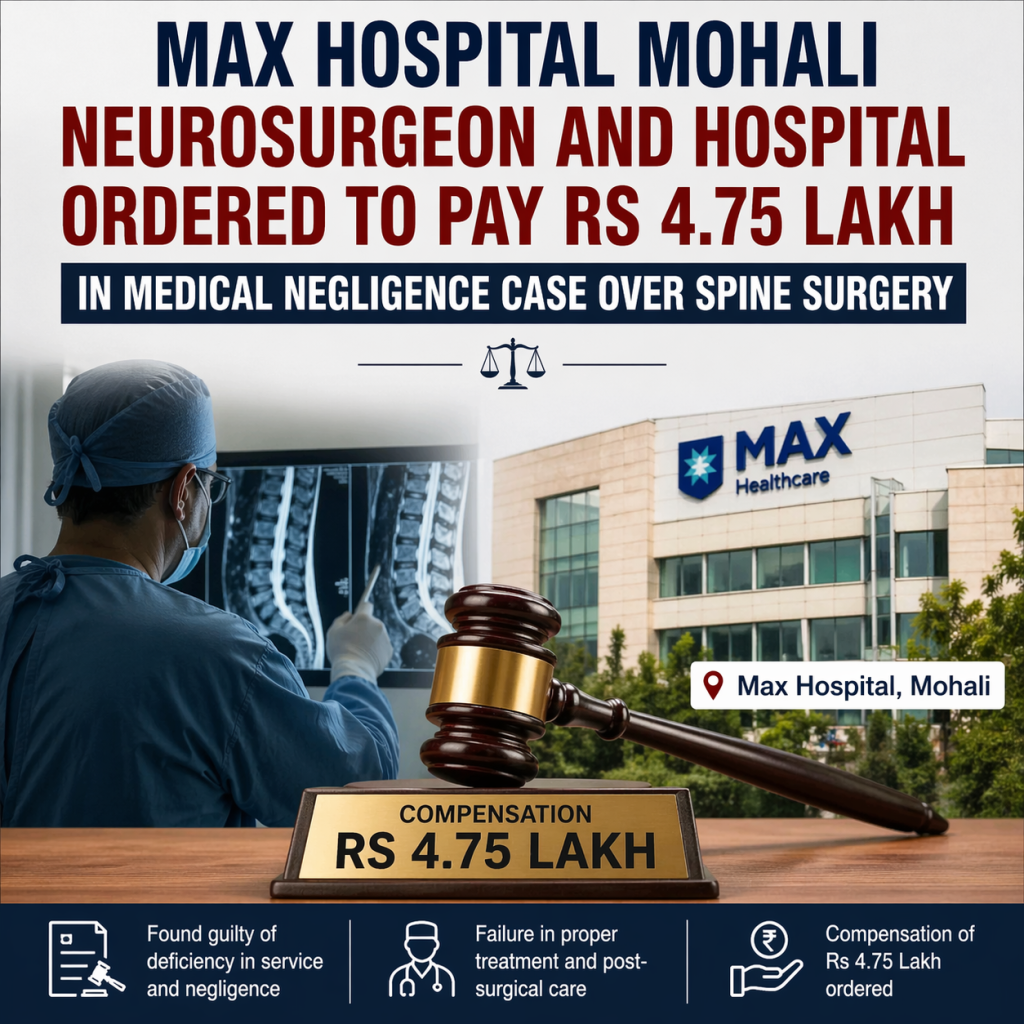
A recent ruling from the District Consumer Disputes Redressal Commission in SAS Nagar, Mohali brings this issue into sharp focus. On 22 April 2026, news broke that Max Super Speciality Hospital, Mohali and its Senior Director & Head of Department of Neurosurgery, Dr. Harjinder Singh Bhatoe have been directed to pay Rs 4.75 lakh in total to the family of a patient who underwent treatment there in 2020. Case involved allegations of medical negligence tied to inadequate pre operative testing and a subsequent reoperation.
This isn’t just another headline about a hospital dispute. It highlights a broader very practical concern for thousands of Indians considering back or spine procedures every year: the critical role of proper diagnostic work-up before surgery. Let’s break it down step by step what the court found, why it happened and what you can learn from it to protect yourself or your family.
What Was the Case About? The Patient’s Story
The story begins in early 2020. Prem Nath, a 76 year old resident of Sector 40, Chandigarh was living an independent life. He could manage his daily activities without assistance despite being diabetic and having a history of spinal issues (including a prior surgery in 2017).
In March 2020, he was admitted to Max Super Speciality Hospital, Mohali for degenerative lumbar canal stenosis (LCS) and listhesis at L5/S1 a common age related condition where the spinal canal narrows and vertebrae slip out of place causing pain, weakness and mobility problems. Between 19 March and 6 April 2020, he underwent treatment in three separate spells, including a major decompression and fusion surgery on 21 March that involved inserting rods and screws for spinal stability. Hospital billed approximately Rs 5.93 lakh.
According to his wife Krishna Rani (then 74), things went downhill quickly after the operation. Instead of improvement, her husband’s condition deteriorated. He became bedridden and remained so until his passing on 31 January 2021. Family believed the surgery not only failed to help but actually made matters worse.
They approached the consumer court arguing that basic precautions were skipped and that hospital later performed a repeat procedure while charging extra for what they saw as the same underlying problem.
Core Allegations: Failure to Perform Essential Diagnostic Tests
Complainant’s main point was straightforward and backed by medical reasoning that the court ultimately accepted: the hospital and surgeon proceeded with a complex implant surgery without adequate recent diagnostic imaging and bone health assessment.
Key missing elements as noted in the court observations:
- No fresh X-ray immediately before the March 2020 surgery (the one on record was reportedly more than a year old).
- No DEXA scan to evaluate bone density and strength especially important for an elderly diabetic patient where poor bone quality increases the risk of implant failure.
- No recent CT or MRI scans to give the surgical team the clearest possible picture of the spine’s current state.
Court pointed out that within days of the first operation, screws and rod became mal positioned. Screws protruded beyond the bone margins and there was chipping of bone. This led to a second admission and corrective procedure because the right L5 screw had loosened and the rod had dislocated.
In simple terms, implants didn’t hold because the team hadn’t fully assessed whether patient’s bones could support them. Doctor later acknowledged during cross examination that factors like diabetes, hypertension and advanced age could contribute to loosening but these weren’t adequately factored into pre op planning.
Re-operation and Questions of Unfair Trade Practice
Family also raised concerns about being charged again for what they described as essentially addressing the failure of the first procedure. Court agreed that performing a second surgery for the same issue caused by the initial shortcomings while billing separately amounted to both a deficiency in service and an unfair trade practice.
Commission observed that charging extra for a re do necessitated by poor planning or lack of diagnosis crosses a line. It referenced established legal principles from the Supreme Court of India, noting that each medical negligence case must be judged on its specific facts and expert opinion isn’t always required when the lapses are evident from the records themselves.
Court’s Ruling: Clear Accountability
After reviewing the discharge summaries, cross examination statements and medical records, Mohali District Consumer Disputes Redressal Commission held both hospital and Dr. Bhatoe jointly liable for medical negligence, deficiency in service and unfair trade practice.
In its order, commission stated that failing to carry out essential pre operative tests like a current X-ray or DEXA scan before proceeding with surgery breached the “duty of care” owed to the patient. It further noted that the patient was able to walk before the surgery contradicting any claim that he was already severely incapacitated.
Final direction: Hospital and doctor must jointly pay Rs 4.25 lakh as compensation to Krishna Rani, plus Rs 50,000 towards litigation expenses totaling Rs 4.75 lakh. Ruling came after careful examination of the timeline, clinical notes and admissions made during the proceedings.
Why This Matters: Importance of Pre-Surgical Diagnostic Tests in Spine Procedures
Spine surgeries particularly those involving implants for stenosis or listhesis are major interventions. Success depends heavily on understanding the patient’s exact anatomy and bone quality at the time of operation.
A DEXA scan for instance measures bone mineral density and helps predict whether screws and rods will stay firmly anchored. Skipping it in an older patient with diabetes is like building a bridge without checking the soil strength it might hold for a while but the risk of collapse is real.
Real life scenario: Imagine an elderly parent complaining of leg pain and difficulty walking. Doctor recommends fusion surgery. A responsible patient (or family) should ask:
- When was the last set of imaging done?
- Will you do a fresh X-ray, MRI or CT right before surgery?
- Given my age and diabetes, have we checked bone density with a DEXA scan?
- What are the chances of implant failure, and how will you minimize them?
These questions aren’t confrontational, they’re standard due diligence.
Practical Tips for Patients Considering Spine or Back Surgery
Here are actionable steps that can make a real difference:
- Insist on up to date imaging– Never accept surgery based solely on scans that are months or years old.
- Ask about bone health evaluation– Especially if you’re over 65 or have diabetes, osteoporosis risk factors or long term steroid use.
- Seek a second opinion– Another qualified neurosurgeon or spine specialist can review the same records and may suggest conservative options or additional tests.
- Understand informed consent– Make sure the discussion covers realistic outcomes, potential complications, and the surgeon’s personal experience with similar cases.
- Keep records– Request copies of every report, consent form and discharge summary. They become crucial if anything goes wrong.
- Know your rights under Indian consumer law– Medical services are covered under the Consumer Protection Act. You can approach district consumer forums for cases involving negligence or overcharging.
Hospitals and doctors provide a vital service, and the vast majority of procedures go well but cases like this remind us that vigilance is part of being a smart healthcare consumer.
Understanding Medical Negligence and Consumer Forums in India
Medical negligence occurs when a healthcare provider fails to meet the accepted standard of care, resulting in harm. In India, patients don’t need to prove criminal intent just that the duty of care was breached and it caused damage.
Consumer courts (District, State and National) handle these matters efficiently and at relatively low cost compared to civil suits. They focus on compensation for deficiency in service, unfair trade practices, and mental agony. Judgments often cite Supreme Court precedents emphasizing patient safety over blanket protection for doctors.
Broader Takeaways for Better Healthcare
This verdict sends a clear signal: cutting corners on basic diagnostics before high stakes surgery is not acceptable. It also underscores that elderly patients with comorbidities deserve extra caution not rushed procedures.
For the medical community, it reinforces the value of thorough pre-operative work ups and transparent communication. For patients and families, it’s a reminder that trust should be paired with informed questions.
FAQ
1. What exactly was the medical negligence in the Max Hospital Mohali case?
Court found that the hospital and neurosurgeon failed to perform fresh diagnostic tests (recent X-ray and DEXA scan for bone density) before a spinal fusion with implants. This led to early implant failure, a re-operation and overall deterioration of the patient’s condition.
2. How much compensation was ordered and who has to pay?
Max Super Speciality Hospital, Mohali, and Dr. Harjinder Singh Bhatoe were directed to pay a combined Rs 4.75 lakh (Rs 4.25 lakh compensation + Rs 50,000 litigation costs) to the patient’s wife.
3. Why is a DEXA scan important before spine surgery?
It measures bone strength and density. Weak bones raise the risk that screws and rods will loosen or pull out exactly what happened in this case. Doctors use the results to decide whether additional precautions or alternative treatments are needed.
4. What should I do if I suspect medical negligence after treatment?
Gather all medical records, get a second opinion if possible and file a complaint with your district consumer disputes redressal commission. Time limits apply so act promptly. Consulting a medico legal expert can also help.
5. Does this mean all spine surgeries carry high risk?
No. Most are safe and life changing when proper protocols are followed. Case highlights the importance of preparation and individualized care rather than suggesting surgery itself is inherently dangerous.
In the end stories like Prem Nath’s are tough to read because they involve real people and real loss. But they also empower the rest of us. Being an informed patient isn’t about distrusting doctors it’s about partnering with them to get the best possible outcome.
If you or someone you care about is facing a spine related decision take the time to ask the right questions, demand clear answers, and insist on the tests that matter. Your health and peace of mind depends on it.
Stay informed, stay safe and never hesitate to seek clarity before any major medical step. Your voice as a patient matters more than you might think.
Disclaimer
This post is for informational and educational purposes only. It does not constitute medical advice, legal opinion or an official investigation. Readers should consult qualified healthcare professionals for personal health concerns. All details are drawn from media reports and outcomes of any official inquiry may provide further clarity.
Link: According to media reports from Jagran https://www.jagran.com/punjab/chandigarh-max-hospital-mohali-fined-for-negligence-failed-surgery-40212250.html
According to to media reports from The Tribune
https://www.tribuneindia.com/news/chandigarh/mohali-max-hospital-doctor-to-pay-rs-4-75-lakh-to-chandigarh-woman-for-unfair-trade-medical-negligence/amp