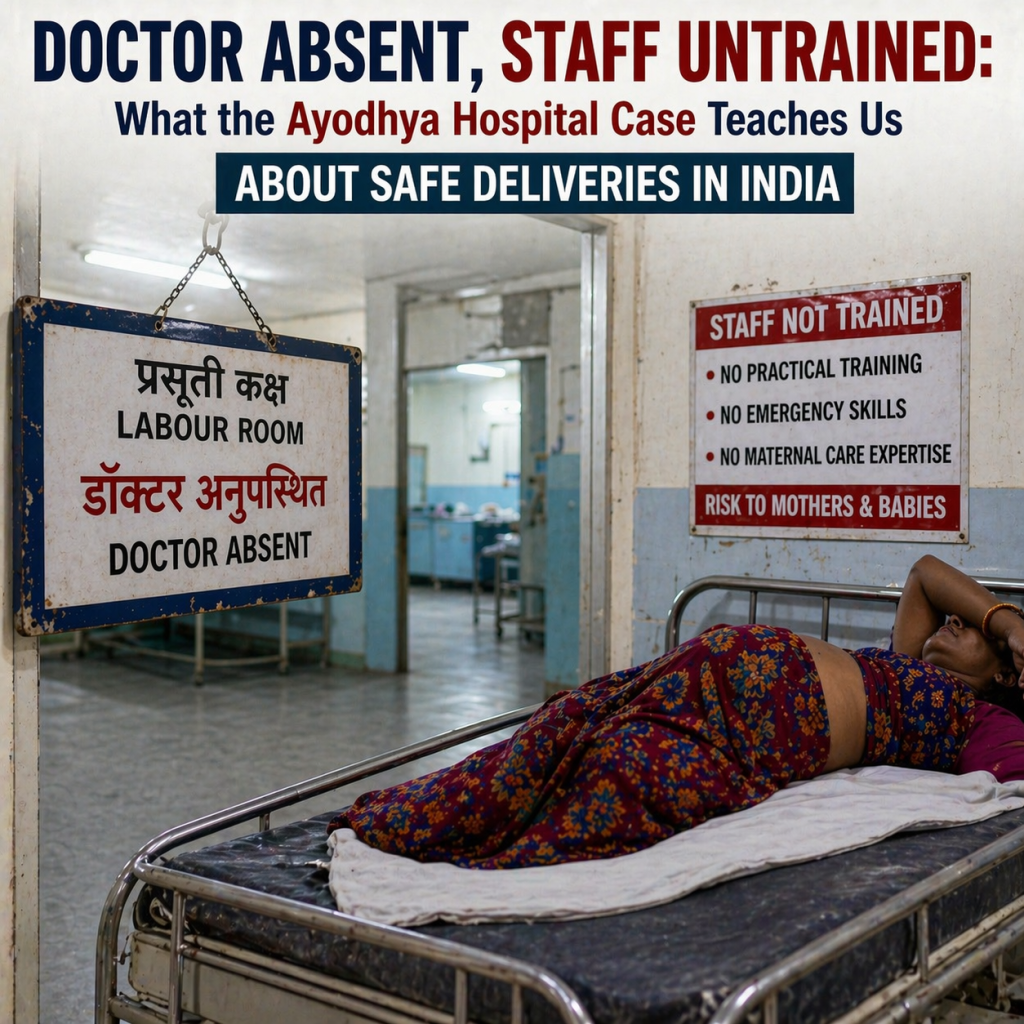
In the quiet hours of a Tuesday night in early April 2026, a young family in Uttar Pradesh looked forward to welcoming their first child. Instead they faced unimaginable loss. Thirty two year old Soni Yadav and her newborn did not survive the delivery at Maa Parmeshwari Devi Memorial Hospital in Faizabad (Ayodhya). Her husband Suresh Yadav later told authorities that the doctor was not physically present. According to the family’s account, untrained staff carried out the procedure while the doctor, Anjali Shrivastava, provided instructions over the phone.
Health officials acted quickly. They sealed the hospital shifted other patients to the district women’s hospital and launched a probe. During inspection, they found incomplete medical records, no qualified doctor or trained staff on site and issues with medical waste management. The doctor’s credentials were not produced. An investigation is ongoing, and authorities have said an FIR may follow if negligence is confirmed.
This case is not just one family’s tragedy. It has sparked fresh discussion among doctors, hospital administrators and patients about a simple but critical rule: who should actually be in the room during labour and delivery? Medico legal educator Dr. Vinaykumar S, a professor of paediatrics with qualifications in law (MBBS, DCH, DNB, LLB, PGDMLE from National Law School of India University) recently shared a clear tip on the matter. His message was straightforward: untrained staff conducting deliveries is criminal negligence, and phone guidance does not count as proper supervision.
Incident in Context: What Families and Officials Reported
Soni Yadav resident of Beniganj who had married Suresh the previous year was admitted after labour pains began. Family says the attending doctor initially reassured them that everything was normal but as the delivery progressed, doctor was reportedly not at the hospital. Instead, a staff member handled the birth under remote instructions.
Newborn was handed over not breathing. When the family rushed the baby to another doctor, they were told the child had already passed. Returning to the hospital, they learned Soni’s condition had worsened. She was shifted to another facility but was declared dead there as well.
Stories like this hit hard because childbirth is supposed to be a moment of joy. Yet complications such as postpartum haemorrhage, fetal distress or sudden changes in the mother’s condition can develop in minutes. A voice on the phone cannot check vital signs in real time, adjust positions or perform hands on interventions. That is why physical presence matters.
Why This Crosses into Criminal Negligence: The Legal Picture
Indian law draws a clear line between ordinary medical errors and gross negligence. Under Section 304-A of the Indian Penal Code causing death by a rash or negligent act (not amounting to culpable homicide) can lead to up to two years in prison, a fine or both.
Supreme Court has set a high bar. In the landmark Jacob Mathew v. State of Punjab (2005) case, the court ruled that for criminal liability, the negligence must be “gross” or “reckless” something a reasonably competent person would not have done. Simple errors of judgment or honest mistakes usually stay in the civil domain, where compensation may be ordered but jail time is rare. However, systematic shortcuts like letting unqualified people handle core clinical work often cross that line.
Clinical Establishments (Registration and Regulation) Act, 2010 adds another layer. It requires hospitals to maintain minimum standards for qualified staff, record keeping and emergency care. Private facilities offering obstetric services are expected to have a registered medical practitioner available for high risk procedures. Delegating delivery to untrained attendants violates these norms and can lead to the hospital being sealed or its registration cancelled.
Dr. Vinaykumar S puts it plainly in his medicolegal guidance: “Conducting labour or delivery without a registered medical practitioner physically present is treated as gross negligence. Phone based supervision has no legal validity in obstetrics.” He adds that only trained nursing staff (ANM, GNM or BSc Nursing) may assist under proper supervision. Untrained attendants or managers should never perform clinical procedures.
Courts have repeatedly supported this view. Judgments have held that a doctor’s absence during critical moments in labour or surgery amounts to prima facie negligence, especially when outcomes are tragic.
Real World Impact: Why Physical Presence and Trained Teams Matter
Imagine a routine delivery that suddenly turns complicated. The mother starts bleeding heavily after birth, a condition called postpartum haemorrhage that can become life threatening within minutes. A doctor on the phone might suggest medicines or manoeuvres, but the person on the ground needs the skill and authority to act instantly. Trained staff know how to monitor fetal heart rate, manage shoulder dystocia, or decide when to shift to emergency C-section. Untrained hands lack that readiness.
Similar cases have surfaced before in different parts of the country. Families have reported rushed procedures, missing doctors, and poor documentation. Each time, the common thread is the same: when protocols slip, trust breaks and lives are at risk. Ayodhya case is a reminder that even well meaning shortcuts can have irreversible consequences.
Practical Tips for Doctors and Hospitals: Building Real Protection
Doctors and hospital owners often ask what they can do differently to stay safe both for patients and legally. Here are clear, actionable steps based on established guidelines and expert advice:
- Ensure physical presence during active labour and delivery. For any facility handling births, a qualified doctor (or on-call specialist) must be on site or immediately available. Remote guidance is acceptable for initial advice or stable monitoring, but not for the actual delivery.
- Use only trained support staff. Auxiliary Nurse Midwives or General Nursing Midwives can assist, but they work under direct supervision. Never hand over core procedures to attendants or managers without medical qualifications.
- Maintain meticulous records. Note every decision, vital sign, consent discussion, and phone call (including time and content). Good documentation is often the strongest defence in any inquiry.
- Have clear protocols and emergency drills. Train your team on when to call the doctor, when to refer, and how to manage common complications. Display staff qualifications visibly.
- Never cut corners on infrastructure. Proper lighting, monitoring equipment, waste management, and backup power are non-negotiable under Clinical Establishments rules.
Dr. Vinaykumar Smessage to fellow doctors is direct: “Your physical presence, documentation, and trained team are your only medico legal protection.” Following these steps reduces risk for everyone.
Advice for Patients: How to Make Safer Choices
Expectant mothers and families can also take simple steps to lower risks:
- Ask upfront about staffing. “Who will actually be present during delivery? Is a qualified doctor on site 24/7?”
- Check the hospital’s registration and track record. Look for clear display of doctor qualifications and nursing staff credentials.
- Insist on informed consent. Understand the plan for normal delivery versus emergency C-section.
- Choose facilities with good reviews for emergency handling, not just low fees.
- Carry a copy of your medical records and discuss any high risk factors (previous complications, high blood pressure, etc.) early.
These conversations may feel awkward but they save lives.
FAQ: Common Questions About Medical Negligence in Deliveries
1. What exactly is criminal negligence in a hospital setting?
It is when the act (or failure to act) shows reckless disregard for patient safety far beyond a simple mistake. Courts look for gross deviation from accepted standards, as explained in Supreme Court rulings.
2. Can a doctor legally supervise delivery over the phone?
In routine, low risk monitoring, phone advice may be acceptable but during active labour or actual delivery, especially in private hospitals, courts and guidelines expect the doctor to be physically present. Phone guidance alone does not meet the legal standard of care.
3. What happens to a hospital found non compliant?
It can be sealed immediately. Clinical Establishments Act allows cancellation of registration, fines and further legal action if minimum staffing and safety norms are violated.
4. How can families seek justice if they suspect negligence?
They can file a police complaint leading to an FIR under Section 304-A IPC. Civil compensation claims are also possible through consumer forums. An independent medical board often reviews the case.
5. Are all bad outcomes considered negligence?
No, Medicine is not perfect. Courts recognise that complications can occur even with best care. Liability arises only when there is proven rash or grossly negligent conduct.
Moving Forward: A Call for Higher Standards
loss of Soni Yadav and her child is a painful reminder that healthcare is only as safe as the systems and people behind it. While the investigation continues, this case offers a chance for reflection across the medical community and among patients.
Doctors and hospital owners: review your protocols today. Make sure your team is trained, your records are complete, and your presence is guaranteed when it matters most. Patients and families: ask questions, choose wisely, and insist on transparency.
Safer deliveries are possible when everyone providers, regulators and families works from the same rulebook. Let this tragedy strengthen our resolve to protect mothers and babies not just in Ayodhya but across every hospital in India.
If you are a doctor facing similar dilemmas or a patient preparing for delivery, consider consulting established medicolegal resources or your local medical association for guidance. Small changes in practice today can prevent heartbreak tomorrow.
Disclaimer
This post is for informational and educational purposes only. It does not constitute medical advice, legal opinion or an official investigation. Readers should consult qualified healthcare professionals for personal health concerns. All details are drawn from media reports and outcomes of any official inquiry may provide further clarity.