What Exactly Happened?
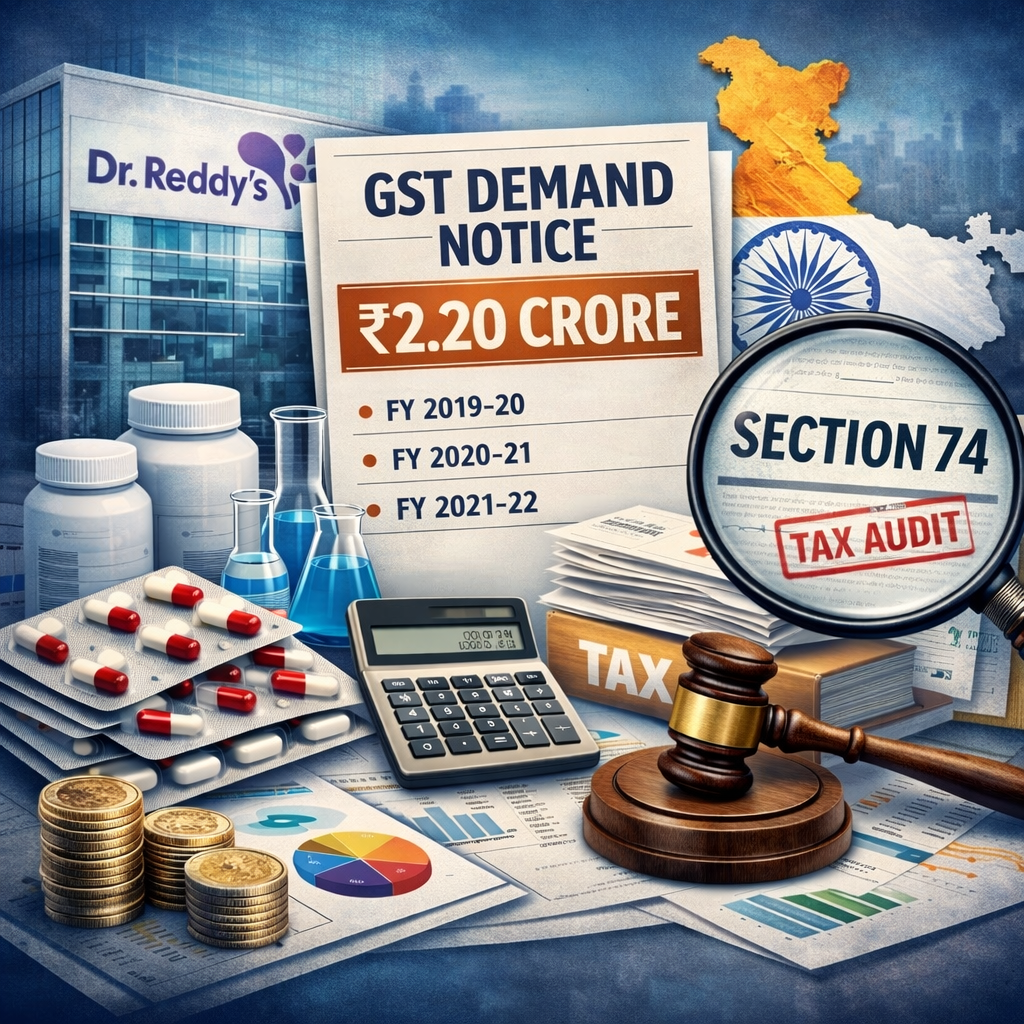
On March 16, 2026 Dr. Reddy’s Laboratories received three separate GST demand orders from the Commercial Taxes Department, Office of the Joint Commissioner (ST), Chennai Intelligence-II, under the Tamil Nadu Goods and Services Tax Act.
These orders were issued under Section 74 of the GST Act, which applies to cases involving tax not paid or short-paid due to reasons such as fraud, willful misstatement, or suppression of facts. However, the specific classification details of the supplies in question have not been publicly disclosed, beyond being deemed “taxable” by the authorities.
Breakdown of the Demand (Including Tax, Interest, and Penalties):
•FY 2019–20:₹2,19,48,944 (over 99% of the total demand)
•FY 2020–21:₹50,406
•FY 2021–22:₹4,384
Total:Approximately ₹2.20 crore (₹2,20,03,734)
The company promptly disclosed this information through a regulatory filing, likely under SEBI (LODR) regulations.
Company’s Response: “No Material Impact”
Dr. Reddy’s Laboratories has downplayed the significance of these GST demand orders. In its official statement, the company stated that, after internal evaluation, the demands “do not have any material impact”on its financial position, operations, or overall business activities.
Given the company’s scale reporting revenues in thousands of crores and maintaining a strong global presence in generics, APIs and biosimilars,this assessment appears reasonable.
The company has also indicated its intention to challenge the ordersby filing an appeal before the appropriate appellate authority. Such disputes are common in the pharmaceutical sector and often involve:
•Classification of supplies
•Eligibility of input tax credits
•Place of supply rules
•Interpretation issues during the early GST implementation phase (post-2017)
Why This Matters in the Bigger Picture
Although ₹2.20 crore is relatively small for a company of Dr. Reddy’s size, such notices highlight broader challenges within India’s GST framework:
•Complex supply chains:Pharma companies deal with exports (zero-rated supplies), varied tax structures, and R&D related credits.
•Retrospective scrutiny:Authorities continue to closely examine past GST periods, leading to show-cause notices and demands under Sections 73 and 74.
•Frequent litigation:Many large companies contest such orders, often achieving partial or full relief at appellate levels.
This is not an isolated case. Several pharmaceutical companies have faced similar GST demands in recent years. However, Dr. Reddy’s case has attracted attention due to its prominence and the dramatic tone adopted in some media headlines.
Looking Ahead
As of mid-March 2026, there has been no further public update regarding escalation or resolution. Investors and stakeholders appear largely unfazed, given the company’s reassurance of no material financial impact and its track record of handling regulatory challenges effectively.
For Dr. Reddy’s Laboratories, this appears to be a routine tax dispute rather than a significant operational concern. The company’s core focus innovation in affordable medicines, biosimilars, and global expansion remains far more consequential than a ₹2 crore tax demand.
Conclusion
While the GST demand on Dr. Reddy’s Laboratories is unlikely to materially impact its business, it serves as a reminder of the evolving and often challenging GST landscape in India. Proactive compliance and strategic tax planning remain essential for navigating such regulatory developments.
Final Thoughts
This case raises an important question:
Do such GST notices indicate genuine compliance gaps or are they part of increasingly aggressive tax enforcement efforts?