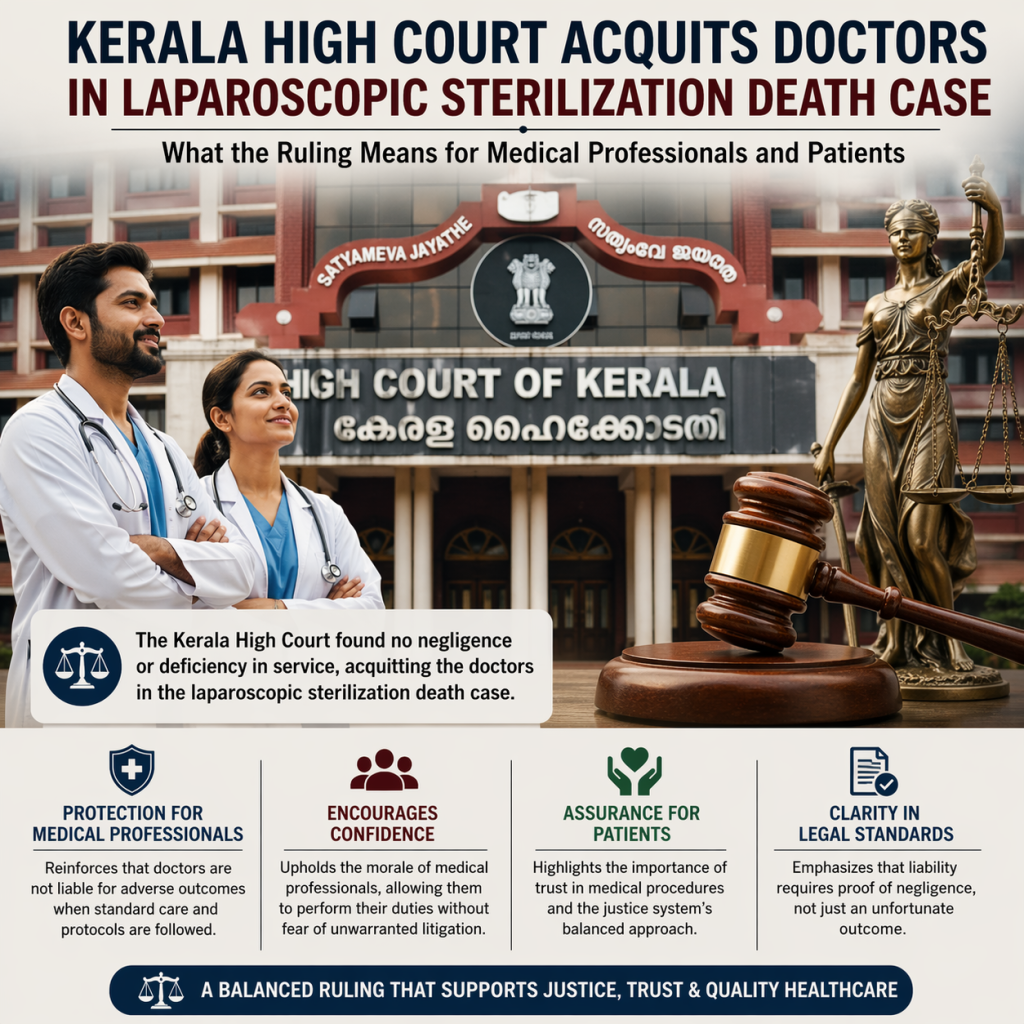
When a routine medical procedure goes wrong, families naturally look for answers and sometimes answers turn into accusations. In 2006 a woman in Kerala underwent laparoscopic sterilization at a government hospital during a family planning camp. She developed serious complications afterward and passed away the next day despite being transferred to higher centers for treatment. Two doctors involved in the case faced criminal charges for negligence. Seventeen years later, Kerala High Court stepped in with a clear verdict: doctors were not criminally liable.
This judgment delivered on February 2, 2023, by Justice Kauser Edappagath in Dr. Kauser Edappagath & Dr. Vinu Balakrishnan vs State of Kerala(Crl. Appeal No. 589/2015), offers important clarity in an area that affects thousands of doctors and patients every year. It reminds us that not every bad outcome in medicine equals negligence and certainly not criminal negligence. Let’s walk through what happened, why the court ruled the way it did and what it means in practical terms.
Facts of the Case: A Routine Procedure Turns Tragic
On September 26, 2006 patient underwent laparoscopic sterilization at the Government Hospital in Punalur, Kerala. These procedures are common relatively straightforward and performed frequently in government camps as part of India’s family planning initiatives. Surgery itself involves small incisions and the use of a laparoscope to block the fallopian tubes.
Post operatively patient developed complications. She was shifted to another hospital around 9 PM the same evening and later referred to a tertiary care center in Thiruvananthapuram. Despite medical efforts, she died the following day. Family alleged that the doctors failed in performing the surgery, providing post operative care, and referring her promptly. Case eventually led to charges under Section 304A of the Indian Penal Code (causing death by negligence) against members of the surgical team. Trial court had initially convicted some of the medical staff, doctors appealed arguing there was no evidence of gross negligence or a direct link between their actions and the patient’s death.
What the Kerala High Court Decided
High Court carefully reviewed expert committee reports, medical records and the evidence presented. It found no conclusive proof of reckless or grossly negligent conduct by the doctors.
Justice Kauser Edappagath observed that the complication was a known risk associated with laparoscopic sterilization, even when performed correctly. The court emphasized that there was no clear causal connection between the doctors’ actions (or any alleged omissions) and the patient’s unfortunate death. Importantly, judgment set aside the conviction and acquitted the doctors. Court noted that mere occurrence of a complication or an error of judgment does not automatically translate into criminal liability. This decision aligns with long standing legal standards in India that protect medical professionals from being prosecuted every time a patient suffers an adverse outcome. Separately on the civil side, a consumer court had awarded ₹70,000 in compensation to the family, with an appeal still pending before the National Consumer Disputes Redressal Commission at the time of the High Court ruling.
Criminal Negligence vs. Civil Negligence: Why the Distinction Matters
One of the most valuable takeaways from this case is the clear line drawn between civil and criminal medical negligence.
Civil negligencetypically arises in consumer or civil courts and focuses on whether the doctor fell short of the expected standard of care. If proven, it can result in compensation to the patient or family. Threshold here is lower essentially, did the doctor act as a reasonably competent professional would have in similar circumstances?
Criminal negligenceon the other hand requires something much more serious: grossor recklessnegligence. Under Section 304A IPC, the act (or omission) must be so rash or negligent that it goes beyond ordinary carelessness and shows a complete disregard for human life. There must also be a direct nexus between that conduct and the death.
Kerala High Court reiterated this principle, drawing on established Supreme Court precedents. In everyday terms, it means doctors aren’t criminally responsible for every unforeseen complication or honest mistake made under pressure. Criminal prosecution is reserved for truly egregious lapses.
Lessons from Landmark Precedents
This ruling builds directly on the Supreme Court’s authoritative guidance in Jacob Mathew vs State of Punjab(2005). In that case, apex court laid down clear guidelines for handling medical negligence complaints:
- Prosecutions against doctors should not be launched lightly.
- Expert medical opinion is usually essential before framing charges.
- A mere error of judgment, even if it leads to an adverse result, does not constitute negligence.
- Bolam test (from English law, adopted in India) remains relevant: a doctor is not negligent if they followed a practice accepted as proper by a responsible body of medical professionals.
Other referenced cases such as Kusum Sharma vs Batra Hospitaland Achutrao Khodwa vs State of Maharashtra, further underline that medicine is not an exact science. Unpredictable reactions can occur even with the best care.
Practical Takeaways for Doctors: How to Protect Yourself
For medical professionals, especially those working in high volume government setups or camps, this judgment sends a reassuring yet cautionary message. Here are some straightforward, actionable steps grounded in the court’s observations:
- Follow standard protocols rigorously.Laparoscopic sterilization has well-established guidelines from bodies like the Federation of Obstetric and Gynaecological Societies of India (FOGSI). Stick to them.
- Document everything.Detailed operative notes, pre- and post-operative observations, consent forms, and referral records can make all the difference in a later review.
- Obtain fully informed consent.Patients (and families) should understand the known risks, however small, before the procedure. Use simple language and document the discussion.
- Act promptly on complications.Early recognition and timely referral to a higher center, as attempted in this case, demonstrate diligence even if the outcome is tragic.
A useful mnemonic shared in medico legal circles is SAFE SURGERY:
- S– Standard protocol follow
- A– Adequate documentation
- F– Fully informed consent
- E– Early referral when needed
These steps not only reduce legal risk but also improve patient safety overall.
What This Means for Patients and Families
Patients and their loved ones also gain perspective from this case. It highlights that while accountability is essential, not every poor outcome justifies criminal proceedings.
If you or a family member experiences complications after surgery:
- Seek a second medical opinion and complete medical records.
- Understand that complications can arise even when care meets standards.
- Civil remedies (compensation claims) remain available where negligence is established, but criminal cases require stronger proof.
Imagine a similar sterilization camp in a rural district hospital. A patient develops unexpected bleeding or infection. The on duty team stabilizes her and refers her immediately. Later investigation shows the procedure followed textbook steps, yet the patient unfortunately passes away. Under the principles applied in the Kerala case, this would likely not result in criminal charges though a civil claim might still be examined on merits.
FAQ
1. What exactly is Section 304A IPC?
It punishes causing death by rash or negligent acts not amounting to culpable homicide. In medical cases, it applies only when the negligence is gross and directly linked to the death.
2. Can doctors be held liable for every surgical complication?
No, courts have consistently held that known risks of a procedure, even if they materialize, do not automatically mean negligence criminal or otherwise.
3. How does a patient prove medical negligence in court?
Through medical records, expert testimony, and evidence showing deviation from accepted standards of care. Mere dissatisfaction with the outcome is not enough.
4. What should doctors do if they face a negligence complaint?
Preserve all records, consult a medico-legal expert early, and cooperate with investigations. Many cases are resolved in favor of doctors when proper documentation exists.
5. Does this judgment affect compensation claims?
No, Civil and criminal proceedings are separate. Families can still pursue compensation through consumer forums even if criminal charges are dropped.
Moving Forward: Balancing Accountability and Trust in Healthcare
Kerala High Court’s decision in this laparoscopic sterilization case reinforces a fundamental truth: medicine involves inherent uncertainties. Doctors are human, and even the most skilled professionals can face outcomes they did not intend or could not have prevented.
By requiring grossnegligence for criminal liability, Indian courts protect the medical community from fear driven practice while still holding truly reckless individuals accountable. For patients, it underscores the importance of realistic expectations and open communication with healthcare providers. As we reflect on this 17 year old case and its resolution, both doctors and patients benefit from greater awareness. Doctors: prioritize documentation, consent and protocols. Patients: ask questions, understand risks and seek clarity before procedures.
Healthcare thrives on trust. When complications occur, let’s focus first on facts and evidence rather than assumptions. That balanced approach not blame at first sight ultimately serves everyone best. If you’re a medical professional navigating these issues or a patient seeking to understand your rights, staying informed is the first step. Consider discussing concerns directly with your doctor or consulting a qualified medico legal advisor when needed.
Disclaimer
This post is for informational and educational purposes only. It does not constitute medical advice, legal opinion or an official investigation. Readers should consult qualified healthcare professionals for personal health concerns. All details are drawn from media reports and outcomes of any official inquiry may provide further clarity.
This article is based on the public judgment of the Kerala High Court dated February 2, 2023, and established legal principles in India.