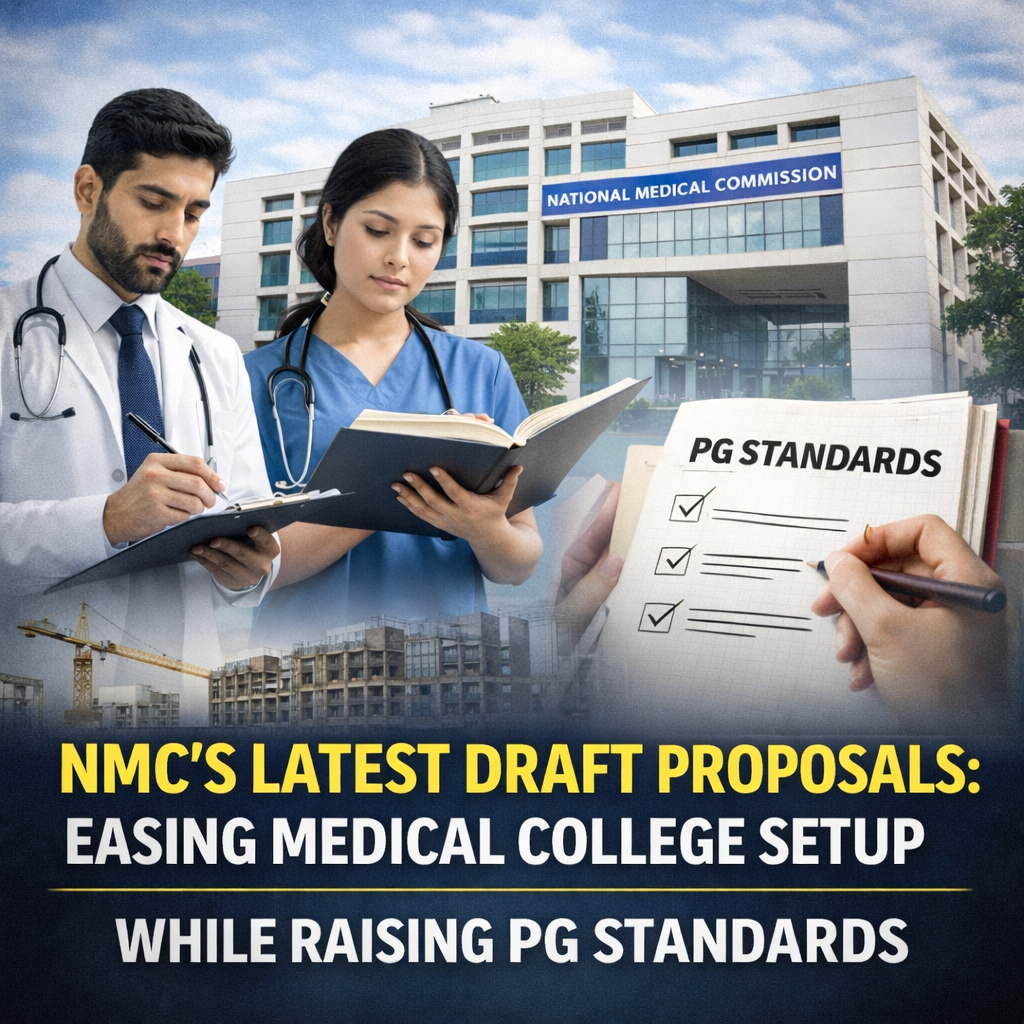
National Medical Commission (NMC) has released draft amendments that could reshape medical education in India. Titled “Registration of Medical Practitioners and Licence to Practice Medicine (Amendment), Regulations 2026”, these changes were notified in early April 2026 and are currently open for public comments until May 7, 2026.
At their core, proposals aim to balance two important goals: making it somewhat easier for qualified trusts and societies to establish new medical colleges, while introducing stricter oversight on postgraduate (PG) medical training to protect educational quality. They also include a practical adjustment for doctors serving in the Armed Forces Medical Services (AFMS), allowing a single state registration for nationwide practice during their service.
These updates build on earlier NMC efforts to expand access to medical education while addressing long-standing concerns about uneven quality across institutions. If finalized, they could influence everything from how many new MBBS seats become available to how specialist doctors are trained and how military physicians navigate licensing.
Why These Changes Matter Now
India faces a dual challenge in healthcare: a shortage of doctors in many regions, especially rural and underserved areas, alongside questions about the preparedness of graduates from rapidly expanding institutions. NMC as country’s unified regulator since replacing the Medical Council of India has been gradually refining rules for both undergraduate and postgraduate levels.
Recent years have seen a significant rise in medical colleges, yet reports from various stakeholders highlight gaps in infrastructure, faculty availability and clinical exposure in some newer setups. At the same time, PG seats remain highly competitive with thousands of MBBS graduates competing each year through NEET PG.
Current draft proposals appear to tackle these issues on multiple fronts. Easing certain establishment norms could encourage more investment in medical education infrastructure, potentially increasing overall seats. Tightening PG standards seeks to ensure that specialist training meets consistent benchmarks. AFMS provision addresses a specific operational need for doctors who serve across the country.
Easing Norms for Establishing New Medical Colleges
One notable aspect of the proposals involves streamlining requirements for new medical colleges. According to reports, NMC is considering adjustments that would allow a broader range of trusts and societies to apply, provided they meet core criteria related to land,hospital facilities and faculty.
What this could look like in practice:
Imagine a well established charitable trust in a tier-2 city with an existing multi specialty hospital that already serves a large patient base. Under stricter past norms, setting up a medical college might have required extensive additional documentation or proofs of financial stability that delayed the process. The proposed easing could reduce some of these procedural hurdles, enabling faster approvals where genuine capacity exists.
However, this does not mean a complete free for all. NMC continues to emphasize minimum standards for infrastructure, such as adequate teaching beds, laboratories, and qualified faculty. Goal seems to be removing unnecessary barriers for credible applicants without compromising safety or quality.
Real life scenario: Consider a region like eastern Uttar Pradesh or parts of Rajasthan, where doctor patient ratios remain challenging. A new medical college there could train local students who are more likely to serve nearby communities after graduation. Easier norms, if paired with rigorous inspections, might help bridge such gaps over time.
That said, stakeholders have pointed out the need for strong monitoring. Past expansions sometimes led to colleges with insufficient patient load or faculty, affecting training quality. Draft appears to acknowledge this by maintaining assessment and rating mechanisms.
Tightening Standards for Postgraduate Medical Education
While undergraduate setup might see some relaxation, the proposals signal a firmer approach to PG training. This aligns with separate NMC updates in early 2026 that revised the Minimum Standards of Requirements for Post-Graduate Courses (PGMSR-2023), which took effect immediately in some areas.
Key areas of focus include:
- Infrastructure and clinical material: Colleges must demonstrate sufficient patient footfall, functional operation theatres, ICUs, diagnostic facilities and teaching resources.
- Faculty and attendance norms: Requirements for full time faculty, senior residents, and biometric attendance tracking in some cases.
- Bed and workload standards: Specific minimum beds per unit for different specialties, with limits on how quickly seats can be increased in non government institutions (reports mention caps like four additional seats in certain applications).
Why tighten PG standards?
Postgraduate training is where doctors develop specialized skills in areas like surgery, internal medicine, pediatrics or radiology. Inadequate exposure during PG years can affect patient outcomes later. By raising the bar, the NMC aims to produce specialists who are better prepared for complex cases.
Practical example: Sudent pursuing MD in General Medicine needs regular access to a diverse range of cases from common infections to rare endocrine disorders plus hands on training in procedures. If a college has low bed occupancy or limited investigative workload, training suffers. Tighter norms could push institutions to invest more in their attached hospitals, benefiting both education and patient care.
For aspiring PG candidates, this might mean fewer seats in substandard setups but potentially higher quality training overall. It also underscores the importance of choosing colleges carefully based on NMC ratings and infrastructure reports.
Special Provision for Armed Forces Medical Services Doctors
A distinct and practical element in the draft is the introduction of a single-state licence for AFMS doctors.
Currently, doctors must register with the State Medical Council where they practice. For military physicians who get transferred frequently across states and union territories, this can create administrative burden multiple registrations, renewals and paperwork.
Under the proposal:
- AFMS doctors can register with one State Medical Council of their choice at the time of joining service.
- This single registration would allow them to practice legally anywhere in India during their service tenure.
- Additional qualifications acquired during service would also be recognized nationwide.
- After retirement, they would register in the state where they plan to settle permanently.
This change recognizes the unique service conditions of AFMS personnel, who often serve in remote border areas, disaster relief operations, or conflict zones. It simplifies compliance without diluting professional standards.
Insight for readers: If you know someone in the armed forces medical stream, this could reduce stress around licensing during postings. It also sets a precedent for addressing mobility issues in other public health services.
What Happens Next? Timeline and How to Engage
The draft is open for objections and suggestions until May 7, 2026. Stakeholders including medical associations, colleges, doctors, students and the general public can submit feedback through official NMC portal or as specified in the gazette notification.
Once comments are reviewed, NMC may finalize the regulations with modifications. Implementation would likely follow a phased approach giving institutions time to adapt where needed.
Actionable tip: If you are a medical professional, educator, or student affected by these rules, consider reviewing the full draft on the NMC website (nmc.org.in). Clear evidence based feedback can help refine the proposals.
Potential Benefits and Challenges
Potential upsides:
- Increased supply of MBBS seats in underserved regions.
- Stronger emphasis on quality in specialist training.
- Reduced red tape for AFMS doctors, improving operational efficiency.
- Overall push toward better healthcare access and standards.
Areas to watch:
- Ensuring that eased norms do not lead to a drop in infrastructure quality.
- Effective enforcement of PG standards across private and government colleges.
- Balancing quantity of seats with quality of training and faculty availability.
Long term, these changes could contribute to India’s goal of improving the doctor population ratio while maintaining global standards in medical education.
FAQ
1. Are the proposed changes final?
No. These are draft amendments open for public comments until May 7, 2026. The NMC will review feedback before finalizing the regulations.
2. Will it become easier to open a new medical college?
The proposals aim to ease certain procedural norms for eligible trusts and societies, but core requirements for land, hospital facilities, faculty and assessments remain in place.
3. How do the PG standards affect current students or aspirants?
Existing students may see continued implementation of stricter infrastructure and workload norms. Aspirants should focus on colleges that already meet or exceed NMC guidelines for better training outcomes.
4. What does the single-state licence mean for AFMS doctors?
They can register with one chosen State Medical Council and practice across India during service, reducing administrative hassle from frequent transfers. Post-retirement registration follows normal state rules.
5. Where can I read the full draft?
The official draft is available on the National Medical Commission website under the latest notifications or gazette section.
Final Thoughts
NMC’s 2026 draft proposals reflect an ongoing effort to evolve India’s medical education system expanding access where feasible while safeguarding the quality of training that ultimately affects patient care. Whether you are a student planning your career, a doctor navigating regulations, an institution planning expansions, or simply someone interested in India’s healthcare landscape, staying informed about these developments is valuable.
Take a moment to review the draft, share constructive feedback if it affects you, and follow official updates. Thoughtful input from the medical community can help shape rules that serve both future doctors and the millions who rely on quality healthcare.
In the end, the real measure of success will be healthier communities supported by well trained professionals. These proposals are one step in that direction balanced, practical and open to refinement.
Link: As reported by The Hindu
https://www.thehindu.com/news/national/nmc-proposes-to-ease-norms-for-establishing-medical-college-tighten-pg-education-standards/article70877366.ece/amp/
Disclaimer
This post is for informational and educational purposes only. It does not constitute medical advice, legal opinion or an official investigation. Readers should consult qualified healthcare professionals for personal health concerns. All details are drawn from media reports and outcomes of any official inquiry may provide further clarity.