Dr. Ram Manohar Lohia Institute of Medical Sciences (RMLIMS) in Lucknow has rolled out a new set of rules for its outsourced workers. The directive issued through the outsourcing agency lays down fines for everything from keeping a beard to skipping proper uniform or leaving your workstation without permission with around 4,000 contractual staff affected, the move has quickly become a talking point.
In this piece, we’ll walk through exactly what the new policy says, why the hospital (via the agency) introduced it, how workers are responding and what it means for everyday people in similar jobs across India. Whether you’re a nurse aide, security guard, cleaner or just someone curious about workplace rules in public hospitals, you’ll find clear answers and practical takeaways here.
Background: A Major Hospital and Its Outsourced Workforce
RMLIMS is one of Lucknow’s key government run super specialty hospitals, handling thousands of patients daily for everything from routine check ups to complex surgeries. Like many large public health institutions in India, it relies heavily on outsourced or contractual staff for non clinical roles security, housekeeping, patient attendants, counter operators and more.
These workers are employed through third party agencies rather than directly by the institute. This model helps hospitals manage costs and flexibility, but it often leaves staff with different terms of employment compared to permanent employees.
According to multiple reports published on April 21–23, 2026 the outsourcing agency recently circulated a detailed order setting out penalties for grooming, appearance, and daily conduct. The goal, it seems is to maintain a professional, hygienic and disciplined environment inside a busy medical facility.
Breaking Down the New Penalty Rules
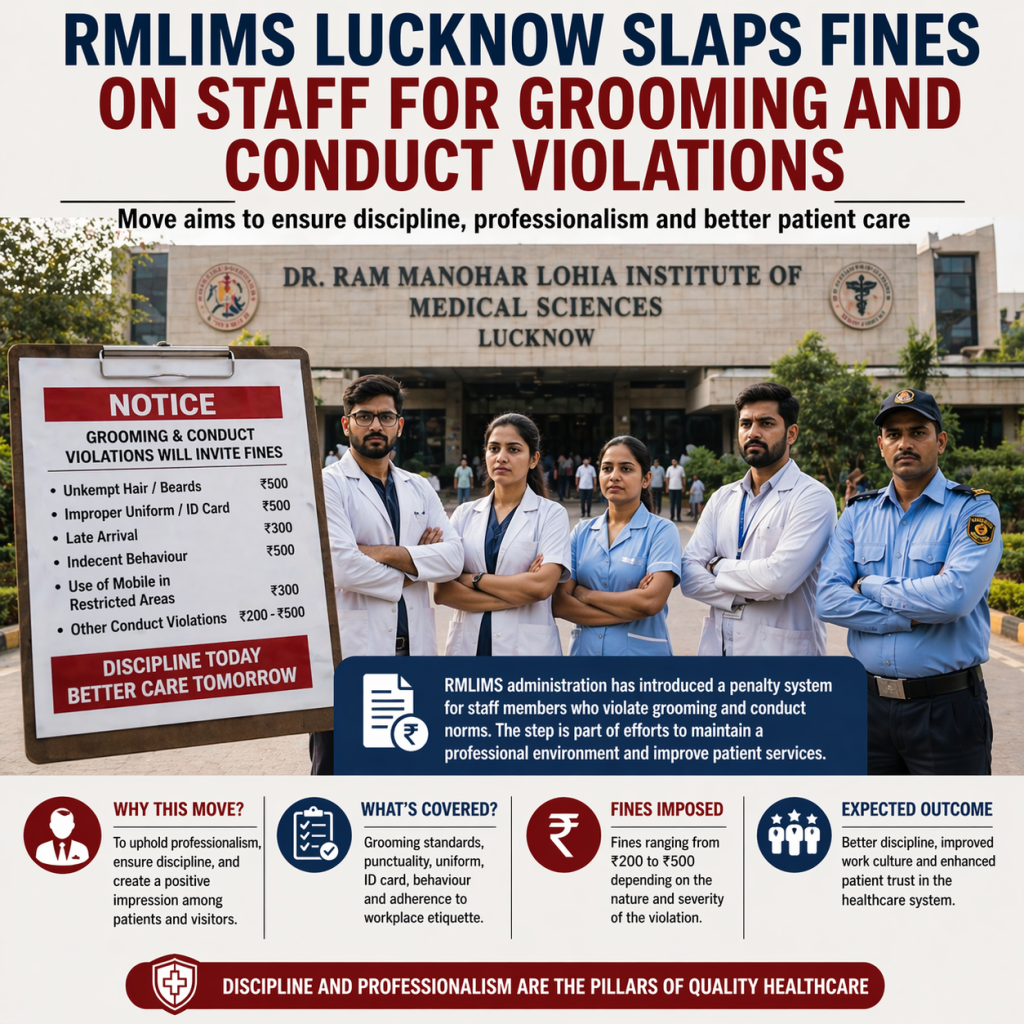
The directive is quite specific. Here’s a straightforward list of the main fines based on what’s been reported:
- Grooming standards: Male staff face a ₹200 fine for keeping a beard or long hair while on duty. Female staff can be fined ₹200 if they don’t tie their hair in a bun or use a hairnet.
- ID and uniform: ₹100 for not wearing an identity card or nameplate. ₹200 per day for not being in the prescribed uniform.
- On duty behavior: ₹500 for being found sleeping, smoking or consuming alcohol during work hours. Serious cases could lead to termination and even an FIR.
- Attendance and movement: ₹500 for leaving the workplace without permission or being absent. Unauthorized absence without prior notice can go up to ₹2,000.
- Additional rule for counter staff: Computer operators must deposit their mobile phones during duty hours, with strict action promised for violations.
These aren’t one time warnings, they’re daily deductions from wages, according to the order.
Why Grooming and Conduct Rules Matter in a Hospital Setting
Hospitals are unique workplaces. Infection control is a daily reality. Long hair or loose beards can potentially interfere with masks, gloves, or sterile procedures. Uniforms and ID cards help patients and doctors quickly identify who is authorized to be in sensitive areas. Clear rules around attendance and behavior aim to ensure that critical services like cleaning wards or managing crowds don’t get disrupted.
From the management’s point of view, these standards aren’t new ideas. Many private hospitals and even some government facilities already enforce similar grooming and dress codes for hygiene and safety reasons. The RMLIMS directive simply puts financial teeth behind them for outsourced staff. That said, critics point out that the same strict grooming rules aren’t always applied uniformly at other Lucknow medical colleges like King George’s Medical University (KGMU) or Sanjay Gandhi Postgraduate Institute of Medical Sciences (SGPIMS). This inconsistency has fueled much of the frustration.
Staff Reactions: Anger, Confusion, and Calls for Change
Many outsourced workers have described the rules as arbitrary and discriminatory. Some feel the beard fine, in particular, overlooks cultural, religious or personal reasons why men might keep facial hair. Others worry that daily deductions could seriously hurt already modest salaries. Reports from India Today, Republic World and Medical Dialogues note that staff have demanded the order be withdrawn. Some compare their situation unfavorably to permanent employees, who don’t face the same penalties through the agency route.
This isn’t just about one hospital. Across India, millions of contractual healthcare workers handle essential but often undervalued jobs. When new rules drop suddenly without much consultation, it can feel like the system is stacked against them.
Real Life Scenarios: How These Rules Could Play Out
Rajesh, a 35 year old security guard at RMLIMS, has worn a neatly trimmed beard for years as part of his personal grooming habit. He arrives on time, in uniform, and does his job well. Under the new rules, a supervisor spots the beard during rounds and notes a ₹200 deduction. Rajesh now has to decide shave daily or lose part of his pay? Or take Priya, a female attendant in the OPD. She usually keeps her hair tied but forgets the hairnet one busy morning. A quick ₹200 fine follows. These small slips add up fast when you’re living paycheck to paycheck.
On the flip side, consider the hospital’s perspective through a simple example: During peak hours, a cleaner with loose hair or improper uniform moves between wards. A small hygiene lapse could, in theory, contribute to infection spread. Strict enforcement aims to prevent such risks before they become problems.
Practical Tips for Outsourced Healthcare Workers
If you or someone you know works under similar contracts, here are a few straightforward steps to navigate the situation:
- Know the rules inside out: Ask your supervisor or agency for a written copy of the policy. Understand exactly what’s expected before your next shift.
- Document everything: Keep records of your attendance, uniform issuance, and any fines deducted. This creates a paper trail if disputes arise.
- Explore reasonable accommodations: If grooming rules conflict with religious practices (for example, Sikh traditions or personal beliefs), many labor guidelines encourage dialogue with management. Reach out politely through your union or agency representative.
- Focus on hygiene alternatives: For beards, some hospitals accept neatly trimmed styles covered with beard nets or masks. Hairnets and buns are cheap and easy stock up and make them part of your routine.
- Build collective voice: Talk to colleagues. Many hospitals have staff welfare forums or unions that can raise concerns constructively without confrontation.
Remember clear communication often leads to better outcomes than immediate protests.
The Bigger Picture: Contract Workers and Hospital Standards
India’s healthcare system depends on outsourced labor more than ever especially after the lessons of the COVID-19 pandemic while permanent staff enjoy job security and benefits, contractual workers often deal with lower pay, fewer protections and sudden policy changes.
Policies like RMLIMS’s highlight an ongoing tension: how to maintain high professional standards without eroding dignity or fairness. Good hospitals balance both strict on safety and hygiene, supportive on employee welfare.
Experts in labor rights often suggest that involving workers in rule making (even informally) leads to higher compliance and morale. Fines alone rarely solve underlying issues like training or supply of proper uniforms.
FAQ: Quick Answers to Common Questions
1. Who does this RMLIMS fine policy apply to?
It applies only to outsourced/contractual staff (roughly 4,000 workers) not permanent institute employees.
2. Is the beard fine the only grooming rule?
No. Both men and women face ₹200 penalties for hair related issues plus separate fines for uniforms and ID cards.
3. Can workers challenge these deductions?
Yes, under Indian labor laws, wages can only be deducted according to clear, communicated rules. Workers can approach the agency, labor department, or seek legal advice if they believe deductions are unfair.
4. Has RMLIMS commented officially?
As of April 23, 2026 public statements from the institute’s director are limited. Order came through the outsourcing agency and coverage has focused on staff reactions.
5. Will the rules be withdrawn?
It’s too early to say. Staff demands are ongoing, and further updates may come in the coming days.
Moving Forward: Fair Standards Benefit Everyone
RMLIMS directive shines a light on an important conversation happening in hospitals across the country. Clean, professional environments save lives and build patient trust. At the same time, the people who keep those environments running deserve respect, clear communication and policies that consider real life circumstances.
For readers working in healthcare support roles, this is a reminder to stay informed and proactive. For hospital administrators everywhere, it’s a cue to review how rules are rolled out and whether they strike the right balance between discipline and dignity.
What do you think should grooming standards be non negotiable in patient facing roles, or is there room for more flexibility? Share your experiences in the comments or discuss it with colleagues. The goal isn’t just compliance,it’s creating workplaces where everyone from doctors to support staff feels valued and motivated to deliver the best care possible.
Disclaimer
This post is for informational and educational purposes only. It does not constitute medical advice, legal opinion or an official investigation. Readers should consult qualified healthcare professionals for personal health concerns. All details are drawn from media reports and outcomes of any official inquiry may provide further clarity.
Link: News Reports According to Republic World
https://www.republicworld.com/amp/india/200-fine-for-long-hair-and-beard-for-hospital-staff-lucknow-rmlims-arbitrary-rules-sparks-outrage