On a quiet evening in October 2007, a young doctor bought a second class ticket at Mumbai CST and boarded an express train bound for Bhusawal. Hours later, his life ended tragically when he fell from the moving train between Mulund and Thane stations.
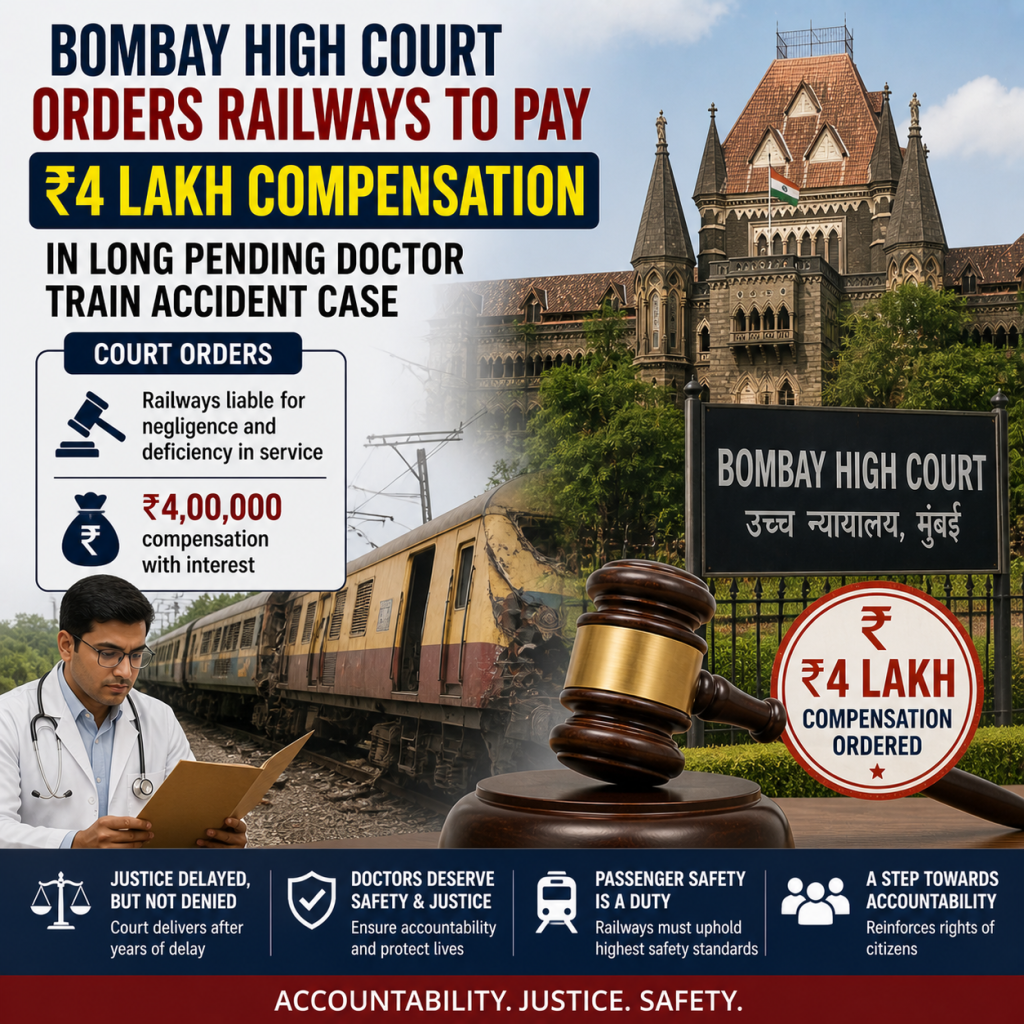
For almost two decades his family fought for compensation through the Railway Claims Tribunal only to be turned down. This week, Bombay High Court stepped in. In a detailed order, Justice Jitendra Jain set aside the tribunal’s decision and directed Central Railway to pay the family ₹4 lakh as compensation along with 6% annual interest from the date of the accident (subject to a cap of ₹8 lakh total).
The ruling delivered recently and reported on 3 May 2026 has renewed conversations around passenger rights,definition of “untoward incidents” and the documents families actually need when tragedy strikes on Indian Railways.
Night Everything Changed
Doctor then in his late twenties had come to Mumbai to appear for his D.G.O. examination. After finishing his work, he purchased his ticket around 9:30 pm on 17 October 2007. He boarded the express train and settled into a second class compartment. Roughly two hours later near 11:30 pm something went wrong, young man fell from the moving train. There were no eyewitnesses. No train number was immediately noted by railway staff. The station master at Thane prepared a memo but he had not seen the incident himself. Police and railway authorities later recorded the death as the result of being “knocked down by an unknown train.” His family received the devastating news the next morning. What followed was a long, painful journey through legal channels that would stretch across 19 years.
Why the Railway Claims Tribunal Said No
When family approached the Railway Claims Tribunal, they expected a straightforward process. Under the Railways Act, 1989 families are entitled to compensation when death or injury occurs due to an “untoward incident” a term that includes falling from a moving train, even if the railway was not at fault.
Instead, tribunal rejected the claim on three main grounds:
- It was not an untoward incident because the death was attributed to an unknown train.
- The doctor was not considered a “bona fide passenger” because of small age differences across documents (the station master’s report mentioned 26 years, the application 29, and the ticket 31).
- Proof of relationship with the legal heirs was deemed insufficient without a ration card and the father’s death certificate.
The family was left empty handed. Many families in similar situations quietly accept such rejections assuming the system has spoken. This family chose to appeal.
Bombay High Court’s Careful Re-examination
When the matter reached the Bombay High Court, Justice Jain went through every document and every argument with fresh eyes. The court’s reasoning was clear and methodical. First it examined the timeline. The doctor bought his ticket at 9:30 pm and incident occurred around 11:30 pm on the same express train route. There was no evidence of any other train in the vicinity at that exact moment. The court concluded it was far more probable that he had fallen from the train he had boarded rather than being struck by an unknown one.
Second, original ticket had been recovered and produced before the tribunal. That single piece of evidence was enough, the High Court said to establish that he was a bona fide passenger. Minor age discrepancies on secondary documents could not override the physical ticket.
Third, legal heir certificate issued by competent authorities carried sufficient weight. The court noted that insisting on additional documents like a ration card in every case would create unnecessary hurdles for grieving families. Order states that once an untoward incident is established and the passenger’s status is confirmed, compensation must follow. The tribunal’s earlier findings were therefore set aside.
What This Ruling Means for Ordinary Passengers
This judgment is not just about one family. It highlights practical realities that thousands of railway passengers and their families face every year.
Railway accidents whether falls from moving trains, collisions or derailments continue to occur. While safety improvements have been made human error, overcrowding and fatigue still play a role. When tragedy strikes, families often discover that claiming compensation is far from simple.
High Court’s order sends a clear message:
- A valid ticket is the strongest proof of being a passenger.
- Small inconsistencies in age or other details should not automatically disqualify a claim.
- Legal heir certificates issued by proper authorities are generally sufficient.
- Courts are willing to look at the overall chain of events rather than isolated pieces of paper.
For families who have waited years, this ruling offers hope that persistence can eventually lead to justice.
Practical Steps If You or Your Family Ever Face a Similar Situation
While no one wants to think about such scenarios, being prepared can make a difficult time slightly easier. Here are straightforward steps many legal experts recommend:
- Secure the ticket immediately — Keep the physical ticket safe. In this case, the original ticket proved decisive after 19 years.
- File an FIR without delay — A police report creates an official record of the incident.
- Collect medical and postmortem documents — These establish cause and time of death.
- Obtain a legal heir certificate early — Apply through the local tehsildar or municipal office. It carries strong legal weight.
- Approach the Railway Claims Tribunal — Claims are usually filed within one year of the incident though courts sometimes condone delays in genuine cases.
- Keep all correspondence — Every letter, memo, and order from railway or police authorities should be preserved.
If the tribunal rejects the claim, families have the right to appeal to the High Court. The process can be long, but as this case shows, it is sometimes the only way to receive what the law provides.
Broader Lessons on Documentation and Passenger Rights
One of the most useful takeaways from this ruling is the importance of basic travel documentation. A simple second class ticket, bought for a few hundred rupees, became the centrepiece of a 19 year legal battle. Many passengers travel without keeping tickets after journeys end. Others assume that once the ticket is torn or lost, their rights disappear. This case reminds us that tickets are not just proof of payment they are evidence of presence on a particular train at a particular time.
Ruling also shows that Indian courts are increasingly looking at the spirit of the law rather than getting stuck on technicalities. When a young professional loses his life while travelling for an examination, the focus should remain on whether he was a legitimate passenger and whether the death qualifies as an untoward incident.
Frequently Asked Questions
What exactly counts as an “untoward incident” under the Railways Act?
It includes death or injury caused by falling from a moving train, collision, derailment or any other accident connected with train operations even if the railway staff was not negligent.
How much compensation is typically paid in death cases?
Amount is governed by rules under the Railways Act and has been revised over the years. In this particular 2007 case, High Court awarded ₹4 lakh plus interest, reflecting both the facts and the long delay.
Can families still claim compensation if the ticket is lost?
It becomes much harder but not always impossible. Other evidence like witness statements, CCTV (if available) or travel records can sometimes help. However, keeping the ticket is strongly advised.
Does a small mistake in age on the ticket affect the claim?
Bombay High Court has clarified that minor discrepancies alone are not sufficient grounds to reject a claim when other evidence especially the original ticket, supports the passenger’s presence.
How long does the entire claims process usually take?
It varies. Simple cases may be resolved in months, while contested matters can stretch for years, as seen here. Early legal advice often helps families navigate the process more smoothly.
A Final Reflection
Nineteen years is a long time for any family to wait for closure, young doctor who left Mumbai CST that October evening never returned home. His family’s persistence has now resulted in a court order that acknowledges both the tragedy and their legal rights.
This case is ultimately about more than money. It is about recognition that a life was lost while travelling on Indian Railways, and that the law provides a mechanism for support. If you or someone you know has faced a similar situation, consider speaking with a lawyer who handles railway claims. Understanding your rights and keeping proper records can make a real difference when it matters most. Justice may sometimes arrive late but when it does it still matters.
Disclaimer
This post is for informational and educational purposes only. It does not constitute medical advice, legal opinion or an official investigation. Readers should consult qualified healthcare professionals for personal health concerns. All details are drawn from media reports and outcomes of any official inquiry may provide further clarity.