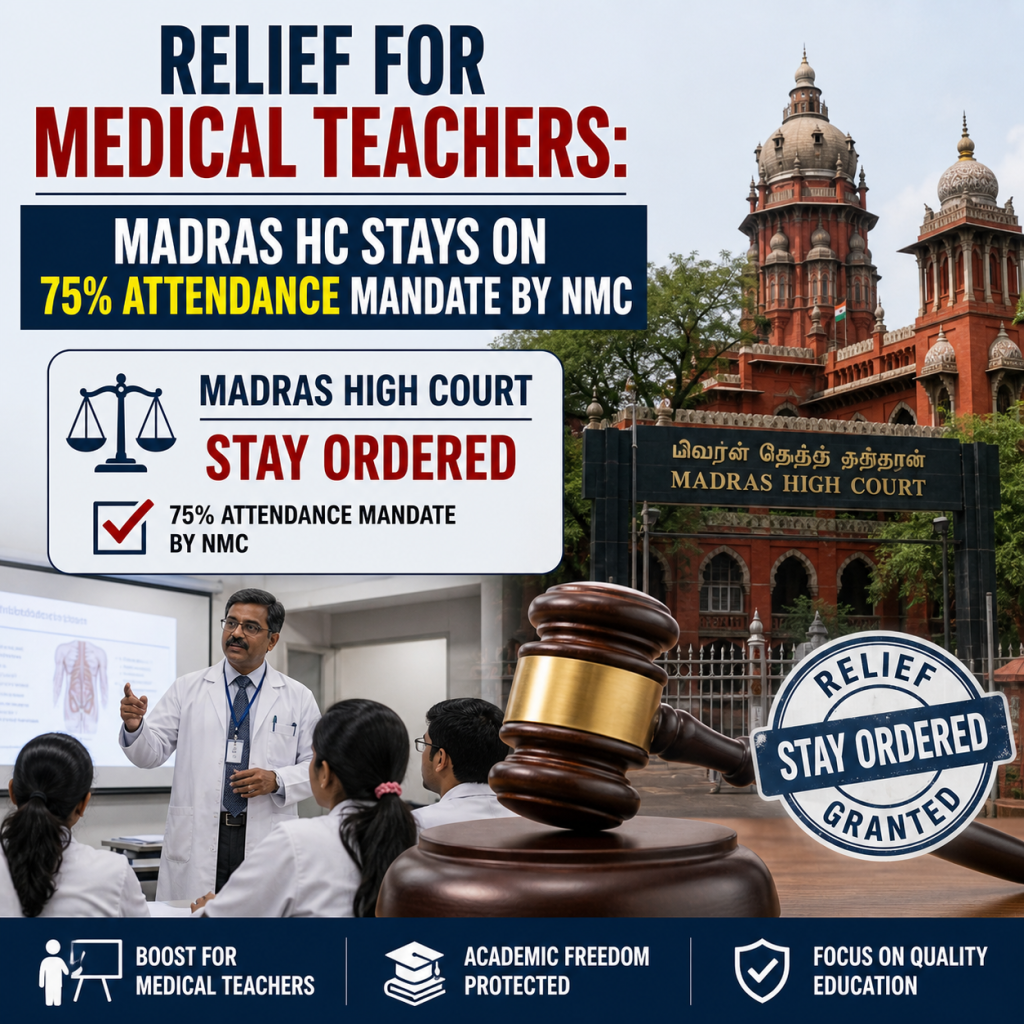
On 2 May 2026 Madurai Bench of the Madras High Court delivered a significant interim order that has brought immediate relief to hundreds of postgraduate medical teachers across India. Justice Chandangoudar stayed a key clause in the recently amended Minimum Standard Requirements (MSR) issued by the Post Graduate Medical Education Board (PGMEB) under the National Medical Commission (NMC).
The clause had made it mandatory for faculty in PG medical courses to clock at least 75% attendance calculated against a fixed 300 working days in a calendar year. In simple terms that meant 225 days of physical presence every year, court found enough merit in the petitioners arguments to pause this specific requirement for now, case has been listed for further hearing on 8 June 2026.
This decision matters because postgraduate medical education trains the specialists who will treat complex cases in the coming decades. When rules governing their teachers become too rigid, ripple effects reach patients, hospitals and the overall quality of healthcare training.
What Exactly Did the NMC Change?
In early 2026 NMC’s PGMEB released amendments to the Post Graduate Medical Minimum Standard Requirements, 2023. These updates aimed to raise the bar for medical colleges offering MD, MS and other postgraduate programmes.
Among the new conditions were:
- All faculty must work full time with no private practice during college or hospital working hours.
- Attendance must be recorded through Aadhaar enabled biometric systems (AEBAS) and supported by CCTV monitoring.
- Hospitals attached to colleges must maintain at least 80% bed occupancy.
- Faculty attendance was fixed at a minimum of 75% out of 300 working days per calendar year.
The 300 day figure drew the strongest criticism. Earlier versions of the standards did not lock in such a rigid annual working day count. Different states and colleges follow varying academic calendars, festival holidays and clinical schedules. Many faculty members also juggle emergency duties, research projects, conferences and administrative responsibilities that do not always fit neatly into a biometric swipe in, swipe out model.
Why Faculty Took the Matter to Court
Several medical faculty members and associations approached the Madurai Bench. Their main points were straightforward and practical:
- The 300 day benchmark felt arbitrary.Not every medical college operates 300 full working days. Some follow state government holiday lists; others have extended clinical postings or exam schedules that reduce actual teaching days.
- Clinical reality versus classroom presence.A professor in surgery or medicine often spends long hours in the operating theatre or intensive care unit. These hours save lives but may not always register perfectly on an attendance system designed for classroom hours.
- Work life balance and retention concerns.With already high workloads, adding a strict 225 day presence requirement risked driving experienced teachers away especially women faculty managing family responsibilities or senior doctors with health considerations. A shortage of qualified PG teachers would ultimately hurt students and patients.
- No transition periodamendments were implemented almost immediately, leaving colleges and individuals little time to adjust rosters or seek clarifications.
The petitioners did not oppose the broader goal of improving accountability. They simply argued that the specific formula needed more thought and consultation.
Court’s Balanced Interim Order
After hearing both sides, Justice Chandangoudar stayed the operation of the clause that fixed attendance at 75% of 300 days. However, the court did not give a complete free pass. Faculty members are still expected to maintain 75% attendance calculated on 238.5 days a figure the court appears to have derived from more flexible or previously accepted working day norms.
This interim arrangement prevents immediate disruption while the full case is argued. It also sends a clear signal: regulations must be workable on the ground, not just on paper.
How This Affects Different Stakeholders
For postgraduate medical faculty
You now have breathing room. Continue marking attendance through the biometric system as required, but keep detailed records of legitimate absences approved leaves, official duties, conferences with prior sanction or emergency clinical work. Document everything. Many faculty associations are already circulating guidance on what constitutes acceptable absence under the interim order.
For medical colleges and administrators
Review your current faculty rosters and duty rosters. Ensure that teaching schedules, clinical postings, and leave policies align with the court’s modified calculation. Colleges in Tamil Nadu and those following similar patterns should prepare compliance reports for the June hearing. Proactive communication with the NMC and state health departments will help avoid future surprises.
For postgraduate students
Your training continues uninterrupted for now. The stay protects your teachers’ ability to focus on both patient care and classroom teaching without the immediate fear of punitive action for minor shortfalls. However, the larger debate on faculty accountability will continue, and better standards ultimately benefit your education.
For patients and the healthcare system
When faculty feel supported rather than overburdened, the quality of bedside teaching improves. PG students learn not just theory but how experienced doctors manage real emergencies, court’s order indirectly protects this ecosystem.
Real Life Scenarios That Highlight the Issue
Consider Dr. Meera an associate professor of obstetrics and gynaecology at a government medical college in southern Tamil Nadu. On any given day she might start with a 7 a.m. ward round move to a high risk delivery, conduct a postgraduate seminar at 11 a.m. handle an emergency caesarean in the afternoon and still need to complete departmental paperwork before leaving at 6 p.m. Under the original 300 day rule, even one extra sanctioned leave for a family emergency or a national conference could push her below the threshold or take Dr. Rajesh, a senior professor in general medicine at a private medical college. He also serves on the institutional ethics committee and guides three postgraduate theses. His “working days” often spill into weekends for thesis reviews or emergency consultations. A rigid attendance formula risked penalising exactly the kind of dedicated teacher the NMC wants to retain. These are not isolated cases. Across India, thousands of PG faculty balance multiple roles, court’s interim relief acknowledges that one size fits all arithmetic does not always serve the noble aim of quality medical education.
What Should You Do Next? Practical Steps
If you are a PG faculty member:
- Continue using the AEBAS system diligently.
- Maintain a personal log of all approved leaves, official duties and conference attendances with supporting documents.
- Stay connected with your state or national medical teachers association for collective updates.
- If you face any immediate compliance pressure, consult your college administration and, if needed, legal counsel familiar with service matters.
If you are a college administrator:
- Organise a quick internal meeting to explain the interim order to faculty.
- Prepare a compliance note for the upcoming court hearing.
- Consider writing to the NMC seeking clarification on how the 238.5 day calculation will be applied uniformly.
If you are a PG student or aspiring faculty:
- Focus on your training. Use this period of relative stability to build strong mentor relationships.
- Follow reputable medical news sources for updates on the June 8 hearing.
Bigger Picture: Balancing Regulation and Reality
NMC was created to replace the older Medical Council of India and bring greater transparency and quality into medical education. Its efforts to tighten standards through better infrastructure norms, faculty accountability and monitoring are widely welcomed in principle. No one disputes that dedicated present faculty produce better doctors. Yet regulations work best when they are shaped by ground level feedback. Madras High Court’s interim order is not a rejection of accountability; it is a pause button that invites finer calibration. Similar debates have occurred in other professional fields where rigid presence rules clashed with the nature of the work.
June 8 hearing will likely examine whether the 300 day figure can be justified with data on actual working patterns across diverse medical colleges. Whatever the final outcome, conversation has already highlighted the need for evidence based policy making in medical education.
Frequently Asked Questions
1. Does the stay apply only in Tamil Nadu?
The order comes from the Madurai Bench of the Madras High Court and directly affects institutions and faculty under its jurisdiction. However, the precedent often influences how other high courts and the NMC itself approach similar issues nationwide.
2. Can colleges still take action against faculty for low attendance?
Under the interim order, the specific 75% of 300 days clause is stayed. Faculty must still meet the modified 75% of 238.5 days requirement. Colleges should follow the court’s direction until further orders.
3. Will this affect ongoing PG admissions or examinations?
No immediate impact is expected on admissions or exams. The order concerns faculty attendance norms, not student eligibility or assessment processes.
4. Is the NMC likely to appeal?
It is too early to say. NMC has the option to approach the Supreme Court or modify the rule after further consultation. Most stakeholders expect continued dialogue rather than immediate escalation.
5. How can faculty ensure they remain compliant?
Use biometric attendance consistently, obtain prior approval for all leaves and official duties, and keep digital and physical records. Join professional networks that are tracking the case closely.
Final Thoughts
Madras High Court’s decision on 2 May 2026 is more than a legal victory for one group of petitioners. It is a reminder that good intentions in policy must be matched by practical wisdom. Medical education shapes the doctors who will care for us and our families tomorrow. When rules support rather than strain the people delivering that education, everyone benefits students, patients and the nation’s healthcare system.
If you are a faculty member college administrator or student now is the time to stay informed and engaged. Share your experiences with your professional associations. Attend the upcoming hearing updates. And most importantly, keep focusing on what matters most: delivering excellent patient care and training the next generation of compassionate, competent specialists, story is far from over. June 8 hearing could bring further clarity. Until then, this interim relief offers a valuable window to refine how we balance accountability with the real demands of medical teaching. Quality medical education is not built on rigid numbers alone, it thrives when dedicated professionals are given the space to do their best work every single day.
Link:According to news report from The New Indian Express https://www.newindianexpress.com/amp/story/states/tamil-nadu/2026/May/02/madurai-bench-of-madras-hc-stays-nmc-rule-mandating-75-attendance-for-pg-medical-faculty-members