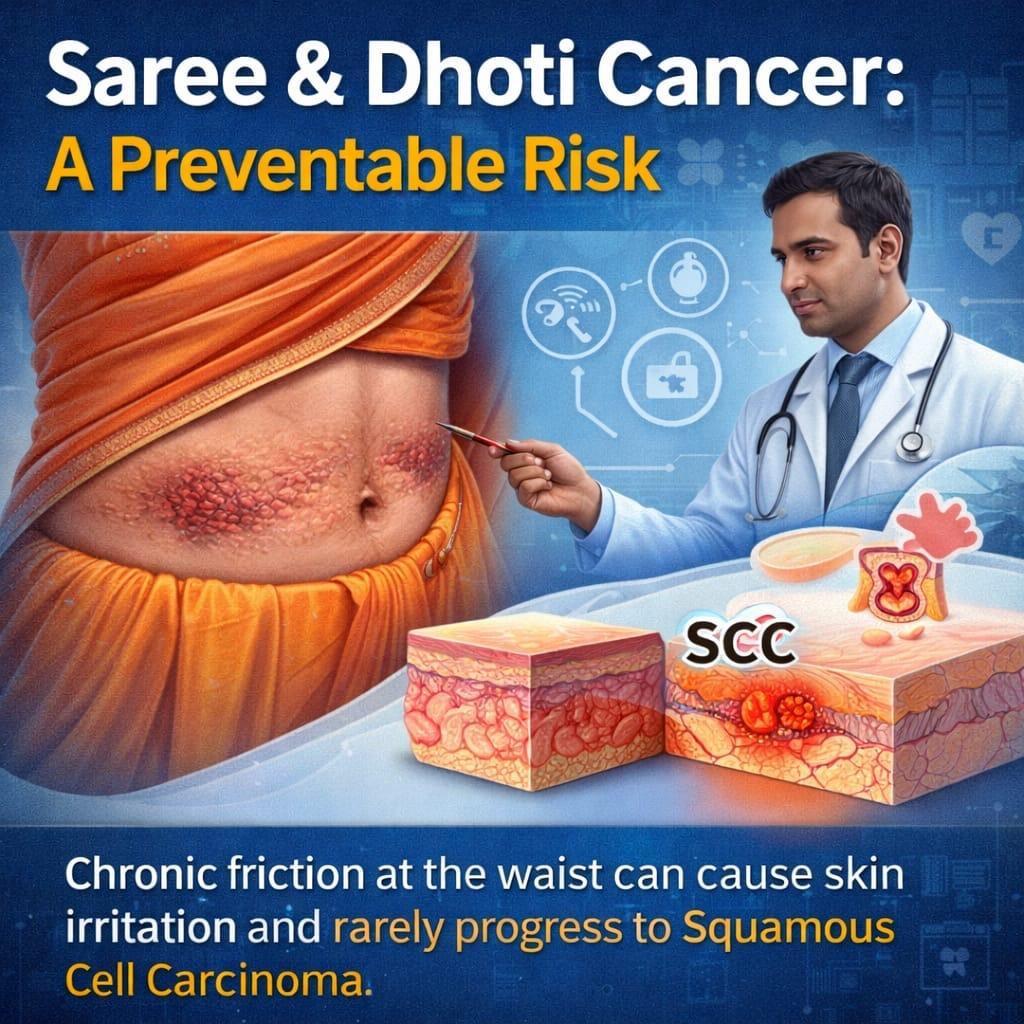
When Tradition Meets an Overlooked Health Risk
Traditional attire such as sarees and dhotis are integral to Indian culture, worn daily by millions across the country. While these garments symbolize identity and heritage, a growing body of medical literature has drawn attention to a rare but noteworthy health concern associated with their prolonged use, waistline dermatoses progressing to squamous cell carcinoma (SCC).
A recent systematic review has consolidated evidence linking chronic saree and dhoti induced skin changes to malignant transformation. Although rare, this condition highlights the intersection between lifestyle practices and long term health outcomes.
Understanding “Saree Cancer” and “Dhoti Cancer”
The terms “saree cancer” and “dhoti cancer” refer to a specific form of cutaneous squamous cell carcinoma occurring along the waistline. These lesions develop due to chronic mechanical irritation caused by tightly tied garments at the same anatomical site over years.
Repeated friction leads to a sequence of skin changes, including:
● Hyperpigmentation
● Acanthosis (thickening of skin)
● Scaling and dryness
● Scar formation
Over time, these chronic inflammatory changes may evolve into non healing ulcers and eventually malignant lesions.
This condition is considered a variant of scar related malignancy, similar to Marjolin’s ulcer, where chronic irritation predisposes to cancerous transformation.
Key Findings from the Systematic Review
The systematic review analyzed multiple case reports and studies to evaluate the association between chronic waist dermatoses and SCC.
The findings indicate:
● A clear association between long term friction at the waistline and development of dermatoses
● Rare but documented progression to squamous cell carcinoma
● Predominance in populations wearing traditional garments for decades
Importantly, the review highlights that while the incidence is low, the condition is likely underreported due to lack of awareness and misdiagnosis in early stages.
Pathophysiology: How Chronic Irritation Leads to Cancer
The progression from dermatosis to malignancy is a multistep process driven by chronic inflammation.
Key mechanisms include:
● Continuous friction causing epithelial damage
● Repeated cycles of injury and repair leading to cellular atypia
● Chronic inflammatory milieu promoting DNA damage
● Possible genetic mutations (e.g., tumor suppressor genes like p53)
Over time, these processes may culminate in dysplasia and eventual malignant transformation into SCC.
Additionally, factors such as lymphatic obstruction and reduced immune surveillance in scarred tissue may further contribute to carcinogenesis.
Risk Factors Identified
The review identifies several contributing factors that increase susceptibility:
1. Prolonged Duration of Garment Use
Individuals wearing sarees or dhotis tightly for decades are at highest risk.
2. Fixed Knot Position
Repeated tying at the same site leads to localized chronic trauma.
3. Hot and Humid Climate
Sweating and moisture exacerbate skin irritation and infection.
4. Poor Hygiene
Accumulation of sweat, dust, and friction worsens dermatoses.
5. Delayed Medical Attention
Early lesions are often ignored due to lack of awareness.
These factors collectively create a microenvironment conducive to chronic inflammation and malignant transformation.
Clinical Presentation: Recognizing Early Signs
Early identification is critical to preventing progression.
Common features include:
● Hyperpigmented or hypopigmented patches at the waist
● Thickened, leathery skin
● Persistent itching or irritation
● Non healing ulcers or nodules
In advanced cases, patients may present with ulceroproliferative growths with everted edges, hallmarks of squamous cell carcinoma.
Diagnosis and Management
Diagnosis is primarily clinical, supported by histopathological confirmation via biopsy.
Treatment Options
● Early lesions:Wide local excision with adequate margins
● Advanced cases:Surgery combined with radiotherapy or chemotherapy
● Follow up:Long term monitoring to detect recurrence
Early stage SCC has an excellent prognosis, with high survival rates when treated promptly.
Prevention: Simple Measures, Significant Impact
One of the most important takeaways from the review is that this condition is largely preventable.
Recommended measures include:
● Avoid tying garments tightly at the same location
● Alternate knot positions regularly
● Use broader waistbands to reduce pressure
● Maintain proper hygiene
● Monitor skin changes and seek early medical advice
These simple interventions can significantly reduce the risk of chronic dermatoses and subsequent malignancy.
Public Health Implications
Although rare, saree and dhoti cancers highlight an important public health message, chronic irritation and neglected skin conditions can have serious consequences.
The study emphasizes:
● Need for awareness among clinicians and the general population
● Inclusion of such conditions in medical education
● Early screening at primary healthcare levels
Given that these conditions are culturally linked, public health strategies must be sensitive and awareness driven rather than discouraging traditional attire.
Conclusion: Awareness is the First Step to Prevention
The systematic review sheds light on a rare but preventable condition rooted in everyday practices. While saree and dhoti cancers are uncommon, their existence underscores the importance of recognizing chronic skin changes and addressing them early.
With increased awareness, timely diagnosis, and simple preventive measures, this condition can be effectively controlled, and in many cases, entirely avoided.
Source: https://ijmsweb.com/saree-and-dhoti-induced-waist-dermatoses-leading-to-squamous-cell-carcinoma-a-systematic-review/