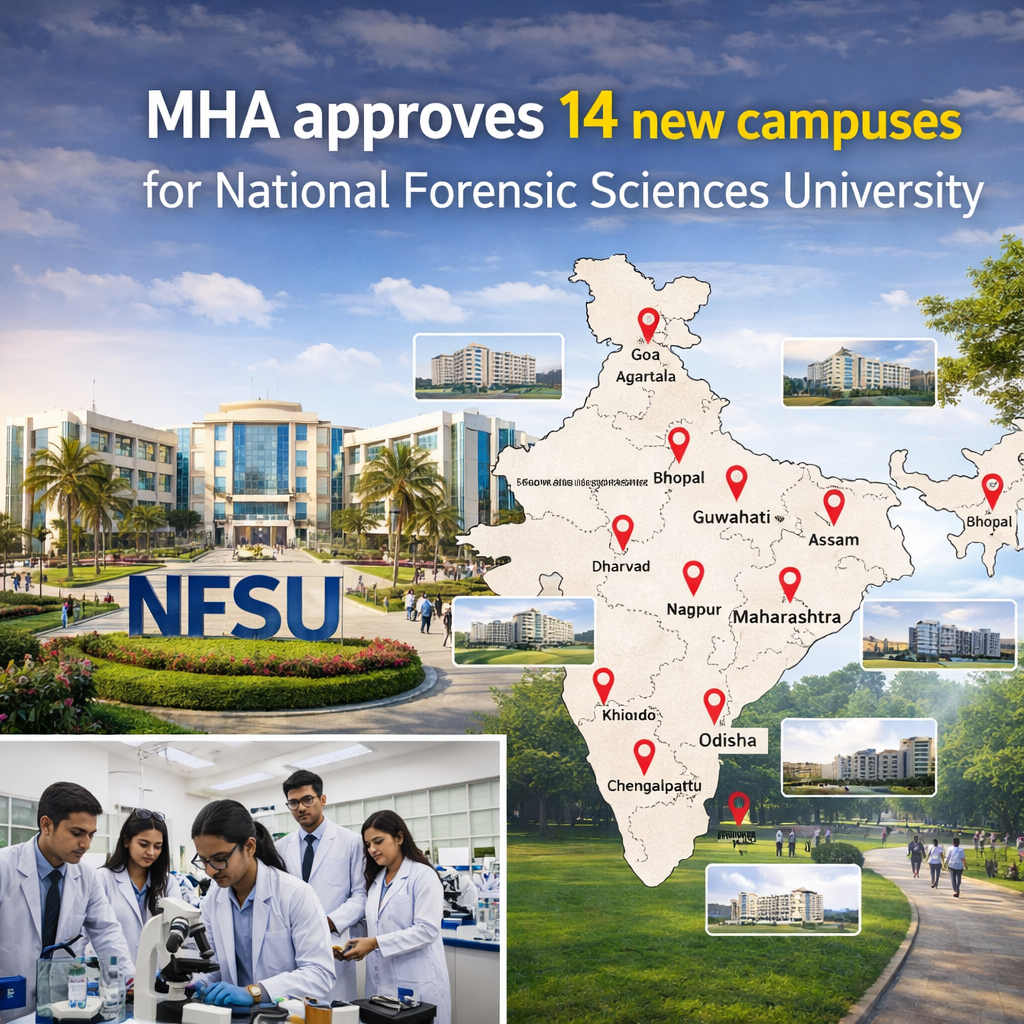
The National Forensic Sciences University (NFSU), the world’s first and only university dedicated exclusively to forensic sciences and allied disciplines is undergoing a major expansion. Recently, the Ministry of Home Affairs (MHA), Government of India, approved the establishment of 14 new campuses across various states.
This move marks a significant step toward building a nationwide network of forensic education and training hubs. Many of these campuses will begin operations from temporary or transit facilities while permanent infrastructure is being developed.
What is NFSU and Why Does It Matter?
Established in 2009 as Gujarat Forensic Sciences University and later elevated to national status in 2020 as an Institution of National Importance, NFSU is headquartered in Gandhinagar, Gujarat.
The university offers specialized programs in:
•Forensic Science
•Digital Forensics
•Criminology
•Homeland Security
•Cyber Security
•Ballistics
•Questioned Documents
•DNA Analysis
•Toxicology
With courses ranging from undergraduate to PhD levels, NFSU trains professionals who play a crucial role in India’s criminal justice system.
India currently faces a shortage of trained forensic experts, which leads to backlogs in forensic laboratories and delays in investigations. By expanding NFSU, the government aims to produce thousands of skilled graduates annually, reduce case pendency, and strengthen evidence-based policing under modern laws such as the Bharatiya Nyaya Sanhita.
Key Details of the Expansion
The 14 new campuses will be distributed across various states to ensure better geographical coverage and accessibility.
In addition to existing campuses in Gandhinagar and Delhi, new NFSU campuses have been approved in:
•Goa
•Agartala (Tripura)
•Bhopal (Madhya Pradesh)
•Dharwad (Karnataka)
•Guwahati (Assam)
•Nagpur (Maharashtra)
•Khordha (Odisha)
•Raipur (Chhattisgarh)
•Chengalpattu (Tamil Nadu)
•Rajasthan
•Andhra Pradesh
•West Bengal
•Bihar
•Uttar Pradesh
Many of these campuses will initially operate from transit facilities, such as existing institutional buildings or rented spaces. This approach will enable faster academic rollout while permanent campuses are being constructed.
Programs likely to be offered in the initial phase include:
•M.Sc. in Forensic Science
•M.Sc. in Digital Forensics
•Other specialized forensic and security-related courses
Benefits and Impact
1. Strengthening the Criminal Justice System
An increase in trained forensic professionals will lead to faster and more accurate evidence analysis from crime scenes to cybercrime investigations thereby reducing case backlogs.
2. Skill Development
NFSU emphasizes practical training, research, and innovation. This helps bridge the gap between rising crime rates and limited forensic capacity in India.
3. Regional Empowerment
The establishment of campuses in states like Odisha, Chhattisgarh, and those in the Northeast will bring world-class forensic education closer to local students and law enforcement agencies.
4. Global Recognition
As the only dedicated forensic university in the world, NFSU’s expansion strengthens India’s leadership in forensic science education and research on a global scale.
Looking Ahead
This expansion is part of a broader vision to make forensic science education accessible, efficient, and impactful across India. With several transit campuses already operational or expected to launch soon, admissions and academic activities are likely to begin in upcoming academic sessions.For students interested in forensic science, law enforcement, or research, this development opens up exciting new opportunities.
Conclusion
The expansion of NFSU is a transformative step toward strengthening India’s justice system. By enhancing forensic capacity, improving investigation timelines, and promoting scientific evidence in policing, this initiative has the potential to bring lasting reforms.
What are your thoughts on this development? Does it make you optimistic about the future of justice in India? Share your views!