If you’re a NEET 2026 aspirant, parent or simply someone tracking India’s healthcare growth, this news is huge. In this post we break down what this expansion really means, why it happened, how it affects your chances and what the road ahead looks like.
The Big Numbers: From Scarcity to Opportunity
According to the latest data from the National Medical Commission (NMC), India now offers:
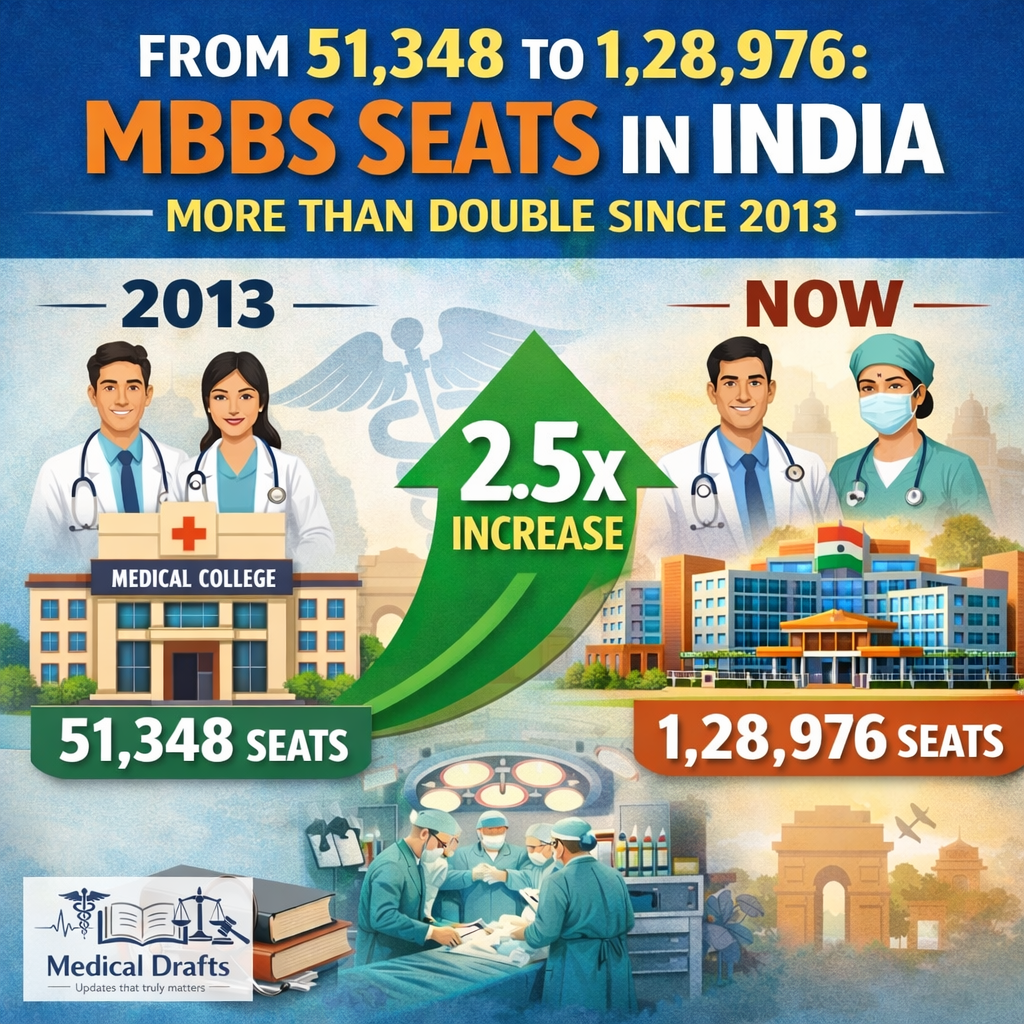
- 1,28,976 MBBS seats(undergraduate)
- 85,020 PG seats(postgraduate)
- 818 medical colleges(including government, private, deemed, and Institutes of National Importance like AIIMS)
Just over a decade ago, same figures stood at 51,348 MBBS seats and 387 colleges. The growth has been steady and strategic with the biggest boost coming in the last few years.
In the 2025-26 academic session alone, government approved 11,682 new MBBS seatsand 43 new medical colleges. This brings fresh opportunities right in time for the next batch of NEET qualifiers.
Why This Explosion in MBBS Seats? Government’s Focused Push
The increase isn’t accidental. It’s the result of deliberate policy moves by the Ministry of Health and Family Welfare:
- Centrally Sponsored Scheme (CSS) for new medical colleges: 157 colleges approved, many attached to existing district/referral hospitals in underserved and aspirational districts. Preference is given to areas that previously had zero medical colleges.
- Upgradation of existing colleges: Schemes to add more UG and PG seats in government institutions.
- Pradhan Mantri Swasthya Suraksha Yojana (PMSSY): Focus on super-specialty blocks and infrastructure upgrades.
- Recent approvals: Over 10,000 new seats cleared in 2025-26 alone, with more in the pipeline.
What This Means for NEET 2026 Aspirants
Good news first:
- More seats = better chances of securing a government or private MBBS seat.
- Students scoring in the mid-to-high range (especially in reserved categories or certain states) now have realistic hope.
- New colleges often come with lower cut-offs in initial years.
- Reduced migration pressure many students can now study closer to home.
The reality check:
- NEET competition remains fierce. Lakhs of students appear every year and top ranks still dominate premium colleges.
- Not all new seats are in government colleges many are private, which means higher fees for some.
- Infrastructure in newly opened colleges may take time to match older institutions.
Long Term Benefits: Fixing India’s Doctor-Patient Ratio
India has long struggled with a shortage of doctors especially in rural areas. This massive seat expansion directly addresses that gap:
- More MBBS graduates → stronger primary healthcare.
- Better distribution of doctors across states.
- Stronger foundation for postgraduate specializations (PG seats have also grown by 172% since 2013).
By 2030, experts predict India could see a much healthier doctor to population ratio a big win for public health.
Challenges That Still Need Attention
While the growth is impressive, a few issues remain:
- Quality control in rapidly expanding colleges.
- Faculty shortages in some new institutions.
- High fees in private/deemed colleges.
- Some PG seats still going vacant due to location or specialty preferences.
The government and NMC are actively working on these through strict regulations and incentives.
Conclusion
The jump to 1,28,976 MBBS seatsis more than a statistic, it’s proof that India is serious about building a stronger healthcare system and giving its youth real opportunities.