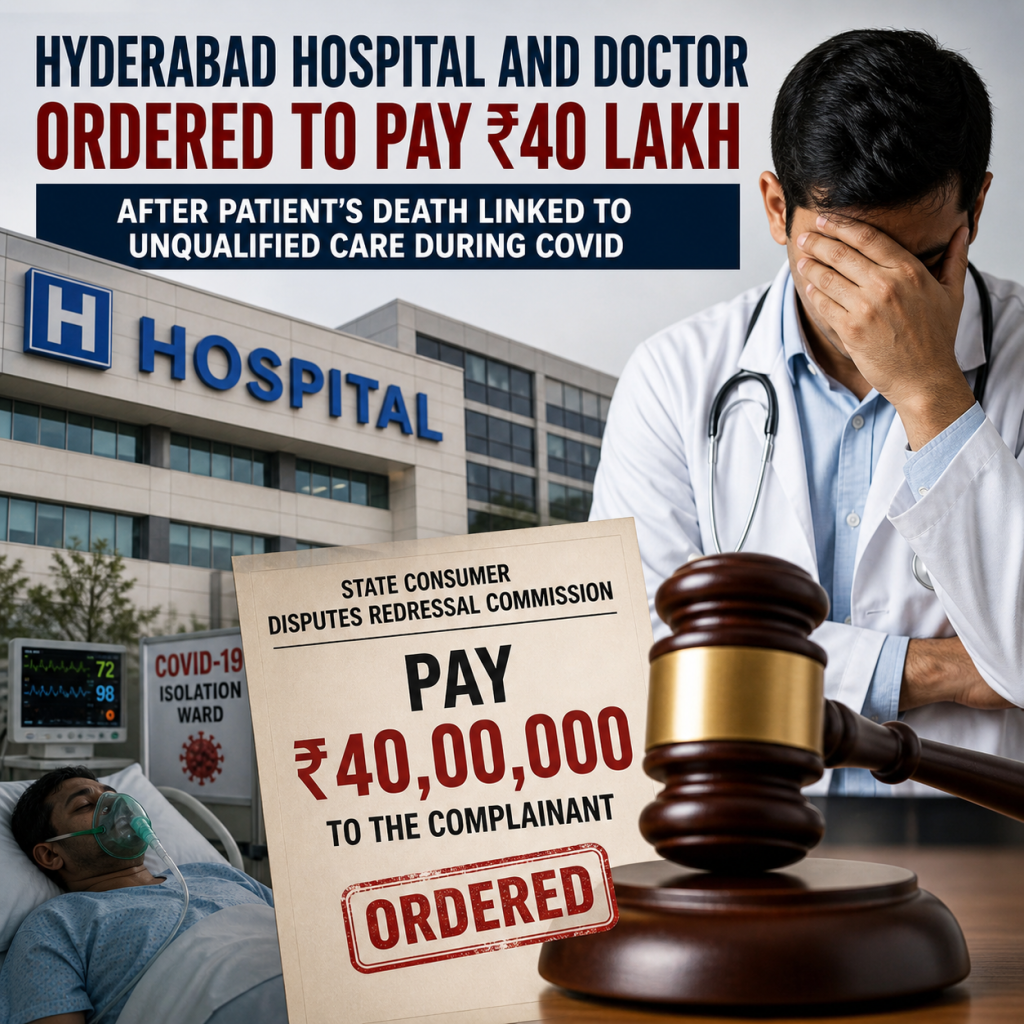
In the middle of the first COVID-19 wave in September 2020 Hyderabad family rushed their loved one, a woman in her middle years to a private hospital after she developed high fever and breathing trouble. What followed was 20 days of treatment that cost the family more than ₹13 lakh, a premature discharge and ultimately her death 72 days later from a severe lung complication.
On 3 May 2026, District Consumer Disputes Redressal Commission-2 in Hyderabad delivered its verdict: the hospital and the doctor who primarily treated her must together pay ₹40 lakh in compensation. The court found clear deficiency in service and medical negligence, largely because the hospital had allowed an unqualified doctor to manage a complex respiratory case without proper specialist oversight. This is not just another compensation order. It is a stark reminder of how fragile trust in private healthcare can become when basic checks on who is actually treating patients are skipped especially in the middle of a national health emergency.
Family’s Ordeal: From Hope to Heartbreak
Smt. T. Srilatha was admitted with classic early COVID symptoms during the terrifying first wave. Her husband and son placed their complete faith in the hospital’s promise of quality care. For nearly three weeks she received treatment that included an injection of Tocilizumab a powerful medicine used to calm severe inflammation in COVID patients but the court later noted it was given without adequate monitoring, family was billed for visits by a pulmonologist (lung specialist). Yet records and later investigation showed that only one doctor Dr. Kumar listed as a general physician was actually attending her. No specialist input appears to have happened on the ground.
After 20 days and ₹13.27 lakh spent, hospital discharged her with a note saying “Discharged at our Request.” The family was told she was “almost cured” and could continue recovery at home. Within days her condition worsened. At another hospital she was diagnosed with pulmonary fibrosis scarring of the lungs that makes breathing progressively harder. She passed away 72 days after leaving the first facility.
Her husband and son filed a consumer complaint in 2026. They submitted medical records, bills, discharge summaries and sworn statements detailing every day of the stay, hospital and doctor denied wrongdoing, claiming the patient was discharged against medical advice and that her later complications had nothing to do with their care. Crucially, they did not produce any evidence or affidavits to back their version.
What the Court Actually Found
Consumer commission was clear: when a hospital brings in a doctor who lacks the necessary specialist qualifications for the condition being treated, and then bills patients as if proper specialist care is being provided, that amounts to deficiency in service, judges observed that the complainants had proved their case through detailed, sworn evidence. The opposite parties had not. In consumer cases pleadings without supporting proof on oath carry little weight, hospital’s decision to discharge the patient once family funds appeared exhausted combined with the lack of proper specialist involvement, pointed to negligence that directly contributed to the tragic outcome.
Compensation of ₹40 lakh was broken down as:
- ₹25 lakh to the husband
- ₹15 lakh to the son
An additional ₹25,000 was awarded as litigation costs, court also directed both complainants to ensure the well being of the patient’s daughter (husband’s daughter and son’s sister) who was ailing and could not participate in the proceedings.
Why This Case Matters Beyond One Family
During the peak of the pandemic, hospitals across India were under enormous pressure. Beds were full, staff were exhausted and many facilities hired extra hands quickly but pressure is never an excuse for placing an unqualified person in charge of critically ill patients. This ruling sends a strong signal: hospitals cannot outsource accountability. If you advertise specialist care or charge for it, you must actually deliver it. Engaging someone who is not properly qualified to handle respiratory emergencies is not a minor paperwork issue it can cost lives.
For ordinary families, case raises uncomfortable but necessary questions:
- How do we know the doctor treating our parent or spouse is actually trained for the condition?
- What checks should hospitals be required to show before letting someone prescribe powerful medicines like Tocilizumab?
- When a patient is discharged “at request,” is it truly voluntary or because the bill has become unaffordable?
Practical Steps Every Family Can Take Right Now
You don’t need to become a medical expert, but a few simple habits can protect your loved ones:
- Ask for credentials openly.Before admission or major treatment, request to see the treating doctor’s registration number and speciality. In India you can quickly verify any doctor on the National Medical Commission or state medical council websites. It takes two minutes on a phone.
- Insist on written daily updates.During any hospital stay longer than 48 hours, ask for a brief written summary each day who visited, what medicines were given, and why. Keep photos or copies. These records become powerful evidence if something goes wrong.
- Get a second opinion early.If a serious diagnosis is made or an expensive injection is recommended, politely ask whether another specialist can review the case. Most good hospitals will not object.
- Document discharge conversations.If staff suggest taking the patient home because “recovery is almost complete,” note the exact words, date and time. Record the conversation if legally allowed in your state. Families have later used such notes successfully in consumer courts.
- Know your rights under the Consumer Protection Act.You can file a complaint in the district consumer forum without a lawyer for amounts up to ₹50 lakh, process is simpler and faster than civil court. Keep all bills, prescriptions and discharge papers organised.
These steps are not about distrusting every doctor. They are about partnership making sure the system works for patients not around them.
Bigger Picture: Accountability After the Pandemic
India’s private healthcare sector expanded rapidly during COVID and many dedicated doctors and nurses worked heroically. Yet cases like this one keep surfacing, showing that oversight of who is actually allowed to treat patients sometimes slipped.
Hyderabad commission’s order is part of a growing body of consumer court decisions that treat medical care like any other paid service when it falls short, compensation follows Hospitals that cut corners on staffing or verification now face real financial consequences. For the medical community, the message is equally clear: proper credential checks are not optional bureaucracy. They are the foundation of patient safety.
Frequently Asked Questions
What exactly made the doctor “fake” or unqualified in this case?
Court accepted evidence that Dr. Kumar was practising as a general physician without the specialist training required to independently manage severe COVID-19 complications, hospital had billed for pulmonologist visits that never materialised.
How long after the incident can families still approach consumer court?
Consumer complaints for medical negligence generally have a two-year limitation from when the cause of action arose but courts sometimes condone delay if the family shows genuine reasons. In this case the complaint was filed in 2026 for a 2020 incident and was accepted.
Does this ruling mean every private hospital is risky?
No, vast majority of hospitals maintain proper standards. This case involved one facility where verification and specialist oversight failed. The ruling actually helps good hospitals by raising the bar for everyone.
What should I do if I suspect my hospital used unqualified staff?
Collect all records first. Then consult a local consumer lawyer or directly approach the district consumer forum. Many families also file complaints with the state medical council against the individual doctor.
Will the hospital appeal this order?
The opposite parties have the right to appeal to the state commission within the prescribed time. Until then ₹40 lakh award stands as per the district commission’s direction.
A Final Thought
When a family walks into a hospital during a crisis, they are not just buying treatment they are placing their deepest trust in strangers. That trust must be earned through competence, transparency and accountability, ₹40 lakh compensation cannot bring Smt. T. Srilatha back but court’s clear message that hospitals cannot hide behind “we were busy” or “the patient left on her own” may prevent similar heartbreaks for other families. If you are reading this because someone you love is in hospital right now, take one small step today: ask to meet the doctor in charge and request their full qualifications in writing. It costs nothing and may save everything that matters.Healthcare is a service. When it fails the basic test of safety, the law now has teeth. Use them wisely and demand better care for everyone.
Disclaimer
This post is for informational and educational purposes only. It does not constitute medical advice, legal opinion or an official investigation. Readers should consult qualified healthcare professionals for personal health concerns. All details are drawn from media reports and outcomes of any official inquiry may provide further clarity.
Link:According to news report from The New Indian Express https://www.newindianexpress.com/amp/story/cities/hyderabad/2026/May/01/negligence-in-covid-care-hyderabad-hospital-doctor-fined-rs-40-lakh