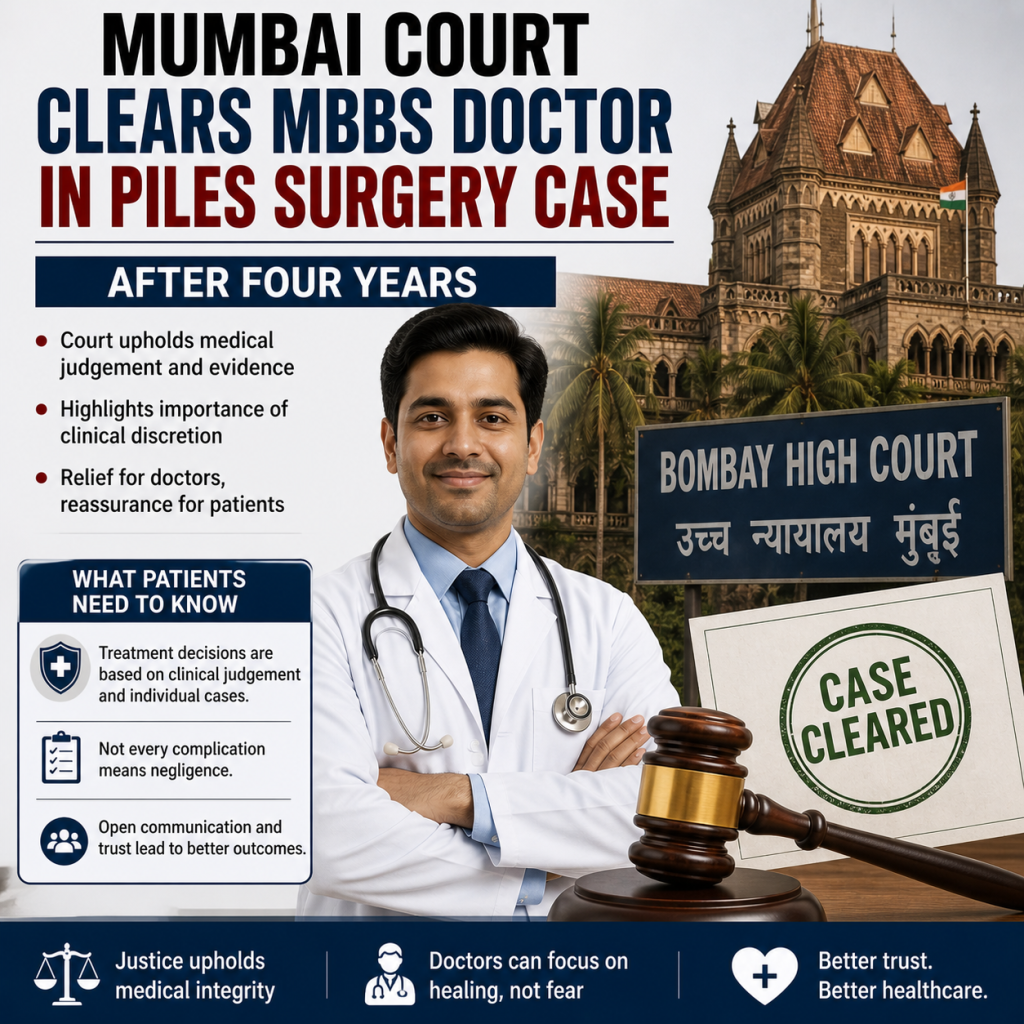
In a quiet courtroom in Kurla, Mumbai on 7 December 2024 judge delivered a verdict that ended a long running legal battle for one MBBS doctor. Court acquitted him of all charges related to a piles operation he performed back in 2021. Patient of 46-year old taxi driver had complained that the procedure was done without proper qualifications and had put his life at risk.
After nearly four years of investigation, trial and witness statements, Judicial Magistrate First Class found the evidence simply wasn’t strong enough. The prosecution couldn’t prove allegations beyond reasonable doubt. Witnesses who were expected to support the case didn’t back it up in court. No solid proof of negligence or deliberate wrongdoing emerged.
This outcome has sparked fresh conversations across medical circles and patient communities. What exactly can an MBBS doctor do? When should you insist on seeing a specialist? And how does the legal system handle complaints like this?Let’s break it down clearly, without the legal jargon or medical hype.
What Actually Happened in 2021
Story began when the patient visited the doctor’s clinic complaining of painful piles (medically called haemorrhoids).Doctor, who holds an MBBS degree performed a minor surgical procedure under local anaesthesia something many general practitioners handle for straightforward cases. A few days later, patient filed a police complaint. He alleged doctor had operated without an MS (Master of Surgery) qualification and that the procedure had endangered his life. Police registered a case under three sections of the Indian Penal Code:
- Section 419 – Cheating by personation
- Section 420 – Cheating and dishonestly inducing delivery of property
- Section 337 – Causing hurt by an act endangering life or personal safety
Doctor was arrested. His clinic was scrutinised, case dragged on for years.
Fast forward to December 2024. After examining medical records, hearing multiple witnesses and reviewing all evidence, the court said the prosecution had failed to make its case. The doctor walked out acquitted free of all charges.
Why the Charges Didn’t Hold Up
Courts don’t decide medical cases on emotions or assumptions. They need proof. In this instance, judge noted several gaps:
- Key witnesses did not repeat their earlier statements during the trial.
- There was no independent medical evidence showing the procedure was performed wrongly or that it caused lasting harm.
- The prosecution couldn’t establish that the doctor had any criminal intention or that he hid his qualifications.
Medical negligence cases are notoriously difficult to prove. A bad outcome doesn’t automatically mean a doctor committed a crime. Sometimes complications happen even with the best care. Sometimes patients have unrealistic expectations, court recognised this distinction. This verdict doesn’t declare the doctor “perfect.” It simply says the evidence presented didn’t meet the high legal standard required for conviction.
What This Means for Everyday Patients
If you’re someone who has piles or any common medical issue, this case raises practical questions. Here are a few real scenarios most people face:
Scenario 1:You’re in pain and see a clinic offering “same day piles treatment.” The doctor seems confident. Should you go ahead?
Scenario 2:Your family doctor (MBBS) suggests a minor procedure in the clinic instead of referring you to a surgeon. Is that safe?
Scenario 3:After a procedure, something doesn’t feel right. How do you know whether it’s normal healing or actual negligence?
The answer isn’t black and white. Many MBBS doctors in India routinely handle minor anorectal procedures especially in smaller towns and clinics where specialist surgeons aren’t immediately available. According to guidelines from institutions like AIIMS, MBBS graduates are trained to manage common conditions and perform basic surgical interventions under local anaesthesia, including simple piles ligation.
However, complex or recurrent cases, or situations involving bleeding disorders, large prolapsed piles or other complications are best handled by a qualified surgeon (MS or higher).
Practical Steps You Can Take Before Any Procedure
Here’s a simple checklist patients can use:
- Ask for credentials openly.A good doctor will happily show you their degree certificates or registration number with the Medical Council. You can verify it on the National Medical Commission website.
- Understand what “minor” really means.A quick ligation or banding for small piles is often considered minor. Cutting, stapling or laser procedures for advanced cases usually require a specialist setup.
- Get a second opinion for anything invasive.Even if the first doctor says it’s simple, spending 30 minutes with another practitioner can save you months of worry.
- Document everything.Keep records of what was explained to you, consent forms and post-procedure instructions. These become crucial if something goes wrong.
- Know your rights.If you genuinely feel harmed, you can file a complaint with the state medical council or consumer court but remember burden of proof lies with the complainant.
How Doctors Can Protect Themselves and Their Patients
This acquittal also carries lessons for medical practitioners:
- Always maintain detailed records of every consultation and procedure.
- Clearly explain risks, alternatives and your own qualifications before any intervention.
- When in doubt, refer. It’s not weakness it’s responsible practice.
- Stay updated on current guidelines from NMC and professional bodies.
Many young MBBS doctors work in high pressure environments with limited resources. This case shows that while the legal system eventually cleared one doctor, the process itself was long and stressful. Better documentation and transparent communication can prevent such situations from reaching the police station in the first place.
Larger Debate: Who Should Perform What Surgery?
India has a massive shortage of specialist surgeons especially in rural areas. At the same time patients expect high quality care at affordable prices. This creates a grey zone. MBBS doctors are the backbone of primary healthcare. They’re trained to diagnose, manage and perform basic procedures but the line between “basic” and “specialist” can blur especially with conditions like piles, fissures or fistulas that sit right on the edge.
Court in this case deliberately avoided ruling on the qualification question. That debate continues in medical education circles and policy discussions. For now, the practical takeaway is this: patients should feel empowered to ask questions and doctors should feel confident referring when the case exceeds their comfort zone.
Real Life Takeaway: Trust But Verify
Imagine you’re the taxi driver in this story. You’re in pain, you want quick relief and you trust the doctor who’s been treating your family for years. Then something goes wrong or at least feels wrong. Fear and anger take over. A police complaint follows.
Now imagine you’re the doctor. You’ve done hundreds of similar procedures without issue. Suddenly you’re facing criminal charges that could end your career. The stress, legal fees and public scrutiny are enormous. Both sides suffer when communication breaks down or expectations aren’t managed. Court’s decision reminds us that justice works best when evidence not emotion drives the outcome. It also reminds patients and doctors alike that medicine is part science, part trust and part clear boundaries.
Frequently Asked Questions
Can an MBBS doctor legally perform piles surgery?
Yes, for straightforward minor procedures under local anaesthesia, many MBBS doctors are trained and permitted to do so. Complex cases are usually referred to specialists.
What should I check before agreeing to any surgical procedure?
Ask about the doctor’s qualifications, experience with your specific condition, possible complications, and recovery time. Request written consent and keep copies of all documents.
If I’m unhappy with the result of a procedure, what are my options?
You can first discuss it with the treating doctor. If unresolved, approach the state medical council for professional misconduct or file a case in consumer court for deficiency in service. Criminal complaints require strong evidence of negligence or intent.
How long does a medical negligence case usually take in India?
It varies widely from a few months to several years. This particular case took over four years from arrest to acquittal.
Does this verdict mean all MBBS doctors can now perform any surgery?
No, court did not issue any broad ruling on qualifications. Each case is judged on its own facts and evidence.
Final Thoughts
This Mumbai court verdict closes one chapter but opens an important conversation. Medicine is about healing, not headlines. Patients deserve safe, transparent care. Doctors deserve fair treatment when complaints arise and the legal system however slow must continue to demand solid proof before labelling someone a criminal. If you’re currently dealing with piles or any medical concern, take a moment to research your options. Talk to your doctor openly. Ask the tough questions and remember the best outcomes happen when both sides communicate clearly and act in good faith.
Have you faced a similar situation with a medical procedure? What questions would you want answered before trusting a doctor with surgery? Share your thoughts below your experience could help someone else make a better decision. Stay informed. Stay safe and choose care that feels right for you.
Disclaimer
This post is for informational and educational purposes only. It does not constitute medical advice, legal opinion or an official investigation. Readers should consult qualified healthcare professionals for personal health concerns. All details are drawn from media reports and outcomes of any official inquiry may provide further clarity.
Link:According to news report from Medical Dialogues https://medicaldialogues.in/amp/news/health/doctors/mumbai-court-acquits-mbbs-doctor-earlier-arrested-for-operating-on-piles-patient-169828