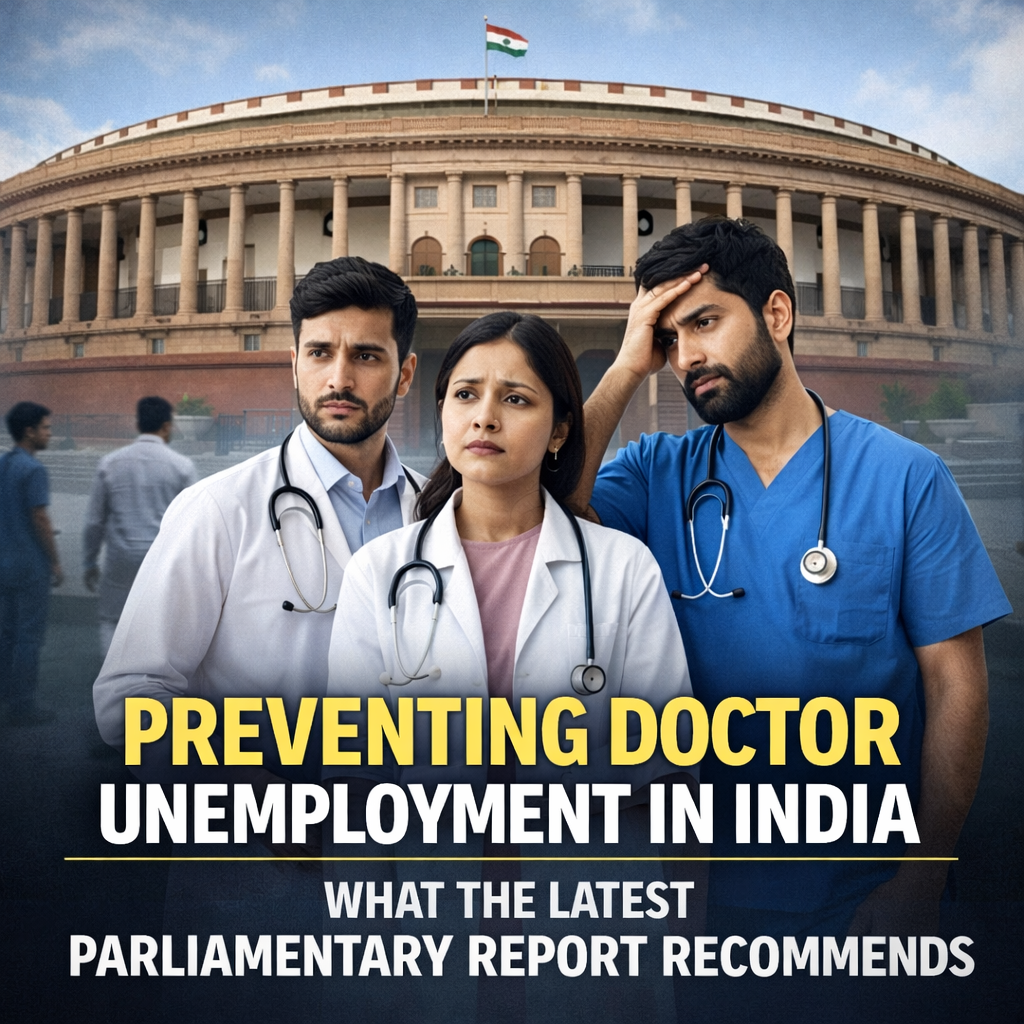
India is producing more doctors than ever before, over past 11 years MBBS seats have jumped by 151 per cent from 51,348 to 1,28,976 while postgraduate seats have grown by 173 percent reaching 85,020. Country now has 2,086 medical colleges including 818 allopathic institutions and 23 AIIMS with latest one in Assam’s northeast. National Medical Commission (NMC) has also recognised DNB qualifications for teaching faculty roles to ease shortages.
These numbers reflect a serious national effort to strengthen healthcare access. Yet same growth has raised a practical worry: without matching improvements in training quality, we risk creating a generation of doctors who struggle to find suitable employment or end up under skilled for roles available. In its 172nd report tabled in Parliament in April 2026, Department related Parliamentary Standing Committee on Health and Family Welfare directly tackled this issue. Committee’s recommendations focus on pairing seat expansion with stronger safeguards so that medical graduates remain employable and capable of delivering high quality care.
Surge in Medical Education and the Emerging Challenge
Expansion of medical seats is not happening in isolation. New colleges are opening, existing ones are adding seats and the government is pushing to improve doctor patient ratios especially in underserved regions. On paper this is progress. More trained professionals should mean shorter waiting times in hospitals better rural coverage and a stronger public health system.
However, committee noted a clear risk. Rapid growth can strain resources faculty numbers, hospital beds for clinical training and infrastructure. If these gaps are not closed graduates may complete their degrees but lack the hands on competence that employers (government hospitals, private chains or even patients) expect. In some states, young doctors already report spending months or years preparing for competitive PG entrance exams or settling for locum positions with uncertain pay. Others move to urban centres, leaving rural vacancies unfilled, committee’s message is straightforward: quantity alone does not guarantee quality or jobs.
What Parliamentary Panel Recommends
The 172nd report does not suggest slowing down seat creation. Instead, it calls for parallel action on quality. Here are the main recommendations, explained in practical terms:
1. Robust Quality Assurance Mechanisms
The committee strongly recommends that the Ministry of Health and Family Welfare ensure every new seat and college is backed by strong oversight. This means regular checks on whether a college has enough patients for training, proper equipment, and faculty who actually teach rather than just hold posts. Without this, the risk of producing “under skilled specialists” increases, which could lead to future unemployment when hospitals hesitate to hire graduates they do not fully trust.
2. Strengthening Faculty Development, Clinical Exposure, and Skill Based Training
Faculty shortages remain a reality in many institutions. Panel urges targeted programmes to train teachers, update their skills, and retain them. At the same time, every medical college must guarantee adequate clinical exposure real patients, real procedures, not just theory. Skill based modules (simulation labs, workshops on new protocols, communication training) should become standard. A doctor who has only read about laparoscopic surgery, for example is far less employable than one who has practised it under supervision.
3. Periodic Accreditation
One time approvals are not enough. The committee wants regular, transparent accreditation of medical colleges perhaps every few years so that standards are maintained over time. Colleges that fall short would need to improve or face consequences. This creates accountability and gives students and parents confidence in the degree they are earning.
4. Competency Based Assessments
Exams should test what a doctor can actually do not just what they remember. The panel supports shifting to practical, scenario-based evaluations that mirror real clinical situations. This aligns training with the skills the health system actually needs emergency care, chronic disease management, preventive health and digital record keeping.
5. Structured Career Planning
Perhaps the most forward-looking suggestion is to align medical education output with national health priorities. The committee wants the government to map future workforce needs how many cardiologists, paediatricians, or public health specialists will be required in different regions and guide students and colleges accordingly. This could include incentives for serving in rural areas, special tracks for high-demand specialties, and data driven counselling during admissions and counselling rounds.Taken together, these steps aim to ensure that the growing pool of doctors is “well trained, employable and capable of delivering high quality healthcare services nationwide,” as the report puts it.
Why These Steps Matter: A Real World Perspective
Consider a typical MBBS graduate in 2026. She clears NEET, joins a new college in a tier-2 city, and completes her degree. If the college had limited OPD footfall and outdated labs, her clinical confidence may lag behind peers from established institutions. When she appears for PG entrance or job interviews, that gap becomes visible. Structured career planning could have steered her earlier toward a needed specialty or given her clear pathways into community health roles.
On the flip side college that follows the committee’s advice invests in simulation centres and faculty training. Its graduates enter the job market with portfolios of certified procedures and strong references. Hospitals compete to hire them, difference is not luck it is deliberate quality focus.
Practical Steps for Stakeholders
For the Government and NMC:
- Publish annual workforce requirement reports so colleges know which specialties to prioritise.
- Tie funding or seat approvals to measurable quality indicators (faculty student ratio, patient exposure hours).
- Expand multi skilling programmes so doctors can handle a wider range of cases, especially in smaller towns.
For Medical Colleges:
- Invest in faculty development workshops and retain experienced teachers with better incentives.
- Introduce mandatory skill labs and logbooks that track real clinical procedures.
- Collaborate with nearby district hospitals to increase hands-on training opportunities.
For Aspiring Doctors and Current Students:
- Choose colleges with strong clinical records, not just the lowest fees or easiest admission.
- Supplement your curriculum with online certifications, internships, and research projects.
- Develop “future-proof” skills: telemedicine, data interpretation, patient communication, and leadership in public health.
- Consider rural service bonds or incentive schemes that offer PG seat advantages many states already run such programmes.
For Practising Doctors:
Even those already qualified can stay employable by pursuing continuing medical education (CME) credits and specialising in high demand areas such as geriatrics, mental health, or non communicable diseases which are rising rapidly in India.
Moving Beyond Traditional Roles
Unemployment fears often assume every doctor must work in a hospital. The committee’s emphasis on workforce planning opens the door to other fulfilling paths: public health administration, medical writing, health tech startups, medical education itself or roles in insurance and corporate wellness. A well trained doctor who understands both clinical care and data analytics is valuable in multiple sectors.
Conclusion
The Parliamentary Standing Committee’s 172nd report offers a balanced, forward looking roadmap. India does not need to choose between producing more doctors and producing better ones we can do both. By implementing robust quality assurance, faculty strengthening, periodic accreditation, competency assessments and structured career planning, policymakers, regulators and educators can ensure that the current boom in medical education translates into a stronger, more stable healthcare workforce.
Responsibility is shared. Students must choose wisely and keep learning. Colleges must raise their standards and government must keep the data and incentives aligned with real needs. If these recommendations are acted upon seriously, future doctors will not just graduate,they will thrive. That is good news for patients, for the profession, and for the country’s health system as a whole.
FAQ
1. What is the 172nd report of the Parliamentary Standing Committee on Health?
It is a detailed review by the Department related Parliamentary Standing Committee on Health and Family Welfare that examines medical education expansion under the NMC. April 2026 report specifically addresses the risk of doctor unemployment and recommends quality focused measures alongside seat growth.
2. How much have medical seats increased in India?
In the last 11 years, MBBS seats rose 151% to 1,28,976 and postgraduate seats grew 173% to 85,020. Total number of medical colleges now stands at 2,086.
3. Will these recommendations stop new medical colleges from opening?
No. The committee supports continued expansion but insists it must be matched with quality controls, faculty development and workforce planning.
4. What can a medical student do right now to improve employability?
Focus on colleges with strong clinical exposure, build practical skills through workshops and certifications and explore rural service incentives that offer PG advantages.
5. How does structured career planning help prevent unemployment?
It matches the number and type of doctors produced with actual health system needs urban, rural, specialty wise reducing mismatch between graduates and available jobs.
Link: As reported by Medical Dialogue
https://medicaldialogues.in/amp/news/health/doctors/how-to-prevent-future-unemployment-of-doctors-here-are-parliamentary-panels-recommendations-169010
Disclaimer
This post is for informational and educational purposes only. It does not constitute medical advice, legal opinion or an official investigation. Readers should consult qualified healthcare professionals for personal health concerns. All details are drawn from media reports and outcomes of any official inquiry may provide further clarity.