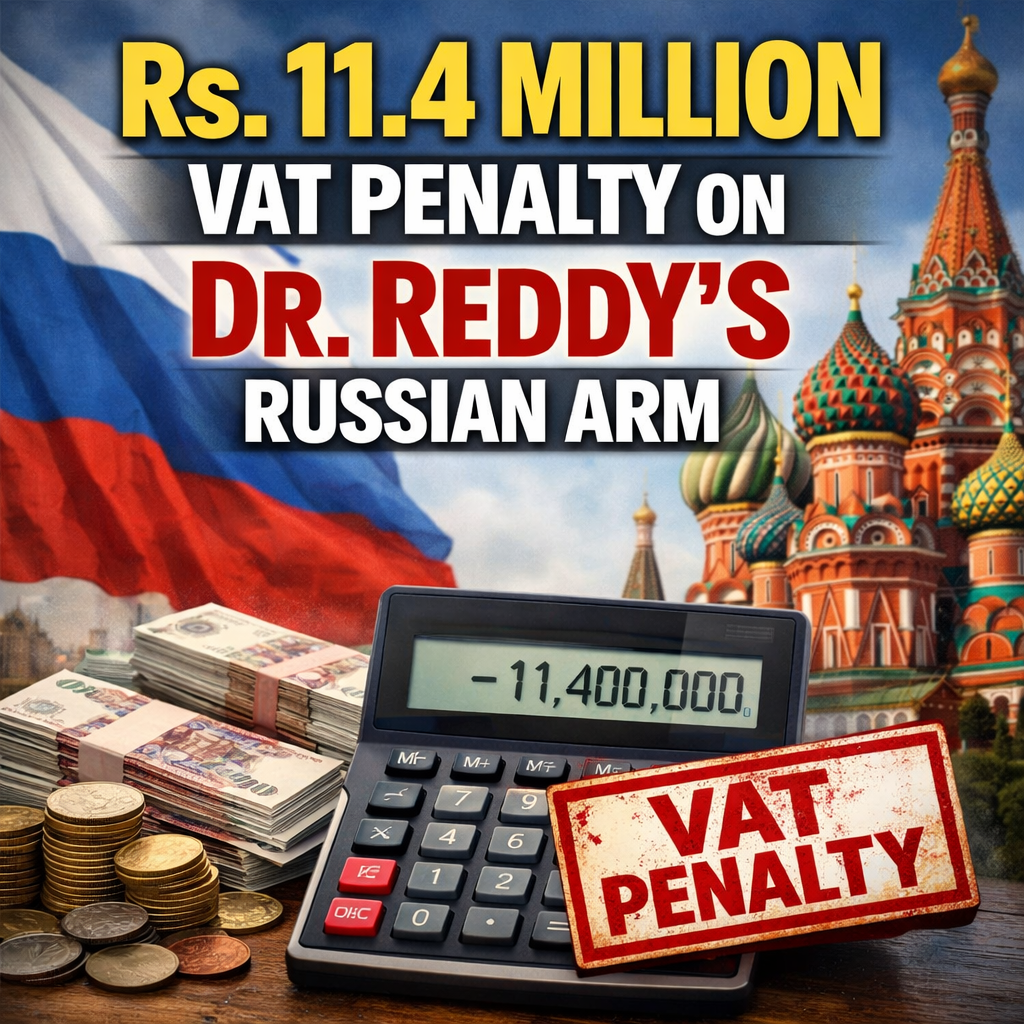
For a company that clocks thousands of crores in annual revenue, this amount is tiny. Yet it offers a fascinating window into how Indian pharma giants navigate complex international tax landscapes especially in a key market like Russia.
The Full Story Behind the Penalty
The penalty stems from a reclassification of certain marketing and promotional servicesprovided by the Russian subsidiary. Russian tax authorities determined that these services should attract VAT, leading to an initial demand of around RUB 20.09 million (roughly Rs 24.5 million) in January 2026.
After due process, final order issued on 13 April 2026reduced the penalty significantly to RUB 9.27 million. This represents more than a 50% cut an outcome the company is likely to view as a reasonable resolution.
Dr. Reddy’s has already stated in its regulatory filing that the penalty will not have any material impacton its consolidated financial results or operations. This is standard corporate language but in this case, it rings true given the numbers.
Quick Background: Why Russia Matters to Dr. Reddy’s
Dr. Reddy’s Laboratories is one of India’s top five pharmaceutical companies and a global leader in generic medicines. The company has a strong presence in over 100 countries with Russia being one of its important emerging markets.
In FY25, the Russian subsidiary reported a turnover of approximately Rs 2,347 crore. The business focuses on generics, biosimilars, and over the counter products tailored to Russian healthcare needs. India Russia pharmaceutical trade has grown steadily in recent years, supported by strong diplomatic ties and Russia’s reliance on affordable, high quality generic drugs. Just months ago Dr. Reddy’s infused fresh capital of around Rs 565 croreinto its Russian arm, signalling continued confidence in the market despite global geopolitical headwinds.
What Is VAT and Why Does It Matter Here?
Value Added Tax (VAT) in Russia is similar to GST in India a consumption tax levied at each stage of the supply chain. The dispute arose because tax officials re categorised certain marketing services (likely related to doctor promotions, pharmacy tie ups or patient awareness campaigns) as taxable supplies.
Such re classifications are common in cross border pharma operations where service contracts, licensing fees and marketing arrangements often fall into grey areas. The good news? The final penalty is modest, and the company appears to have successfully negotiated it down.
Financial Impact: Barely a Blip
Let’s put Rs 11.4 million in perspective:
- Dr. Reddy’s consolidated revenue for FY25 crossed Rs 28,000 crore.
- The penalty equals roughly 0.04%of the Russian subsidiary’s annual turnover.
- Even after the penalty, the subsidiary’s profitability remains virtually untouched.
For investors, this is the kind of disclosure that gets filed, noted, and quickly forgotten. The BSE/NSE likely saw no meaningful price movement on the announcement.
Lessons for Indian Pharma Companies Operating Abroad
This episode highlights three broader trends:
- Tax Scrutiny is Rising Worldwide
Governments everywhere are tightening rules on transfer pricing, marketing spend, and digital services. Russia, like many countries, is actively plugging revenue leaks. - Negotiation Works
The reduction from Rs 24.5 million to Rs 11.4 million shows that engaging constructively with authorities can yield favourable outcomes. - Russia Remains Attractive
Despite occasional regulatory noise, Indian pharma continues to view Russia as a high potential market. Affordable medicines, large population, and government support for local manufacturing make it strategically important.
What Should Investors and Industry Watchers Do?
If you hold Dr. Reddy’s stock or follow the Indian pharma sector, treat this as noise, not news. The company’s Russia operations are healthy, well capitalised and growing. Management has repeatedly emphasised that international markets remain a key growth driver.
For other Indian pharma players with Russian exposure (think Sun Pharma, Lupin, or Aurobindo), this case serves as a gentle reminder to keep compliance teams sharp on VAT/GST treatment of marketing services.
Final Takeaway
Regulatory penalties are part and parcel of doing business globally. What matters is the scaleand the company’s response. In this instance Dr. Reddy’s has handled the situation transparently, negotiated a lower settlement and confirmed zero material impact.
For India’s second largest pharma company by market cap, this is just another day at the office proof that even in turbulent times, solid fundamentals and proactive stakeholder communication keep the ship steady.
What do you think?
Is Russia still a growth market for Indian generics or should companies focus more on the US and Europe? Drop your thoughts in the comments below.
Stay tuned for more sharp analysis on Indian pharma, regulatory updates and investment opportunities. If you found this useful, share it with fellow investors and healthcare professionals.
Disclaimer: This post is for informational purposes only and does not constitute investment advice. Always consult your financial advisor before making investment decisions.