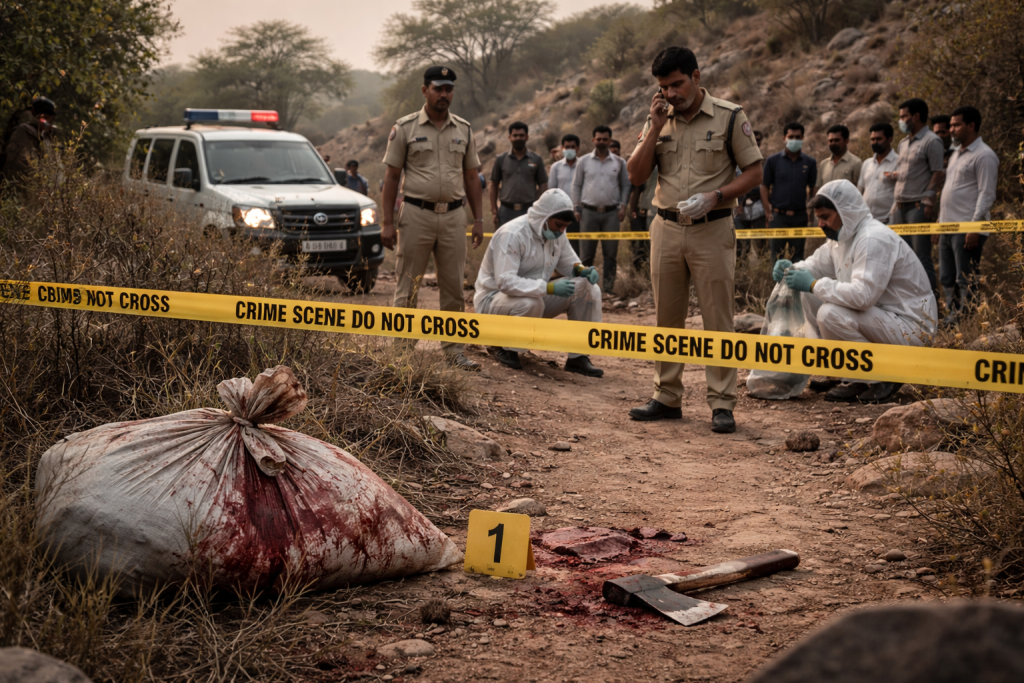
In the quiet villages of Nagaur district, Rajasthan, life often moves at the pace of tradition rooted in farming, family bonds, and neighborly trust. However, on March 16, 2026 that sense of trust was shattered when villagers made a horrifying discovery: a sack containing the dismembered torso of an elderly woman in a rocky, bushy area near Padukalan village.
What followed was a chilling investigation that unraveled a cold-blooded plot driven by greed solved not only through police diligence but also by an ironic forensic clue: the professional precision of a carpenter.
The Victim: Nathi Devi
Nathi Devi, aged around 70–75 years, was a resident of Paldi Kalan village under the Padu Kalan police station. She was a familiar and respected figure in her community.
On Sunday, March 15, she left her home around 11 a.m., informing her family that she was heading to the market. She never returned.
The next morning, a shepherd stumbled upon a plastic sack in a secluded area. Inside was her torso her throat slit, legs severed, and other body parts missing. Her head and feet were initially untraceable.
Family members identified her partly through a mobile phone found nearby. They also confirmed that she had been wearing jewellery worth ₹5–7 lakh when she left home all of which was missing.
The gruesome discovery sparked outrage across the region. Protests erupted as locals demanded justice for the elderly widow, raising serious concerns about safety in rural Rajasthan.
The Massive Manhunt
Nagaur police launched one of the largest search operations in recent memory under the leadership of SP Roshan Meena. Nearly 300 personnel were deployed across ten teams, supported by drones, sniffer dogs, and local volunteers.
The teams combed over 10 kilometers of rugged terrain in an effort to recover the missing body parts and reconstruct the sequence of events.Over the following days, more sacks containing severed limbs were discovered at different locations. This suggested a deliberate attempt to mislead investigators and delay identification.
The nature of the crime indicated planning, brutality and familiarity with the area.
The Breakthrough: A Carpenter’s Precision
The turning point came during the postmortem examination.
Forensic experts observed that the cuts on the body were unusually clean, deep, and precise far from the irregular and chaotic marks typically seen in crimes of rage. These cuts reflected methodical skill and control.
The pattern pointed toward someone experienced in handling tools particularly someone accustomed to cutting wood with precision.In short, the evidence suggested the involvement of a carpenter.
Evidence and Arrest
Investigators shifted their focus to local carpenters, especially those living near the victim. They analyzed call detail records (CDR) of approximately 8,000 mobile numbers in the area to identify suspicious activity.
Suspicion soon fell on Mukesh Bharti, a 38 year old carpenter and neighbor of Nathi Devi.
A search of his residence revealed critical evidence:
•Bloodstains on the floor
•Blood traces inside his Wagon R car, allegedly used to transport the body
•Fodder stored in sacks used to conceal the remains
•An axe believed to be the murder weapon
Mukesh Bharti was arrested on March 20. His wife, Maya and nephew Chandanpuri were also detained.
During interrogation, Bharti allegedly confessed that the trio conspired to kill Nathi Devi for her jewellery. They murdered her using an axe, dismembered the body with carpentry tools, and scattered the remains to confuse investigators.
The Irony and the Lesson
The very skill that made Mukesh Bharti a respected carpenter his precision with tools became the forensic clue that ultimately exposed him.
As SP Roshan Meena noted, the case was solved through a combination of coordinated teamwork, relentless investigation, technical analysis, and a crucial forensic observation.
This is not just another crime story. It highlights:
•How greed can turn neighbors into perpetrators
•The vulnerabilities that still exist in rural communities
•The power of modern policing, where traditional forensics meets advanced data tracking
Conclusion
As the investigation continues and the accused face legal proceedings, the village of Paldi mourns the loss of Nathi Devi.This tragic case serves as a harsh reminder: sometimes, the tools of one’s trade can reveal truths no one expects and no one wants to hear.
What do you think does this case highlight the power of forensic science, or the dangers hidden in everyday life? Share your thoughts.