India’s medical education is expanding rapidly as the National Medical Commission approves 265 new medical colleges out of 443 applications in just five years with 43 colleges cleared for 2025–26 alone, this growth boosts MBBS seats improves doctor patient ratios and creates new opportunities for NEET aspirants while strengthening healthcare in rural India.
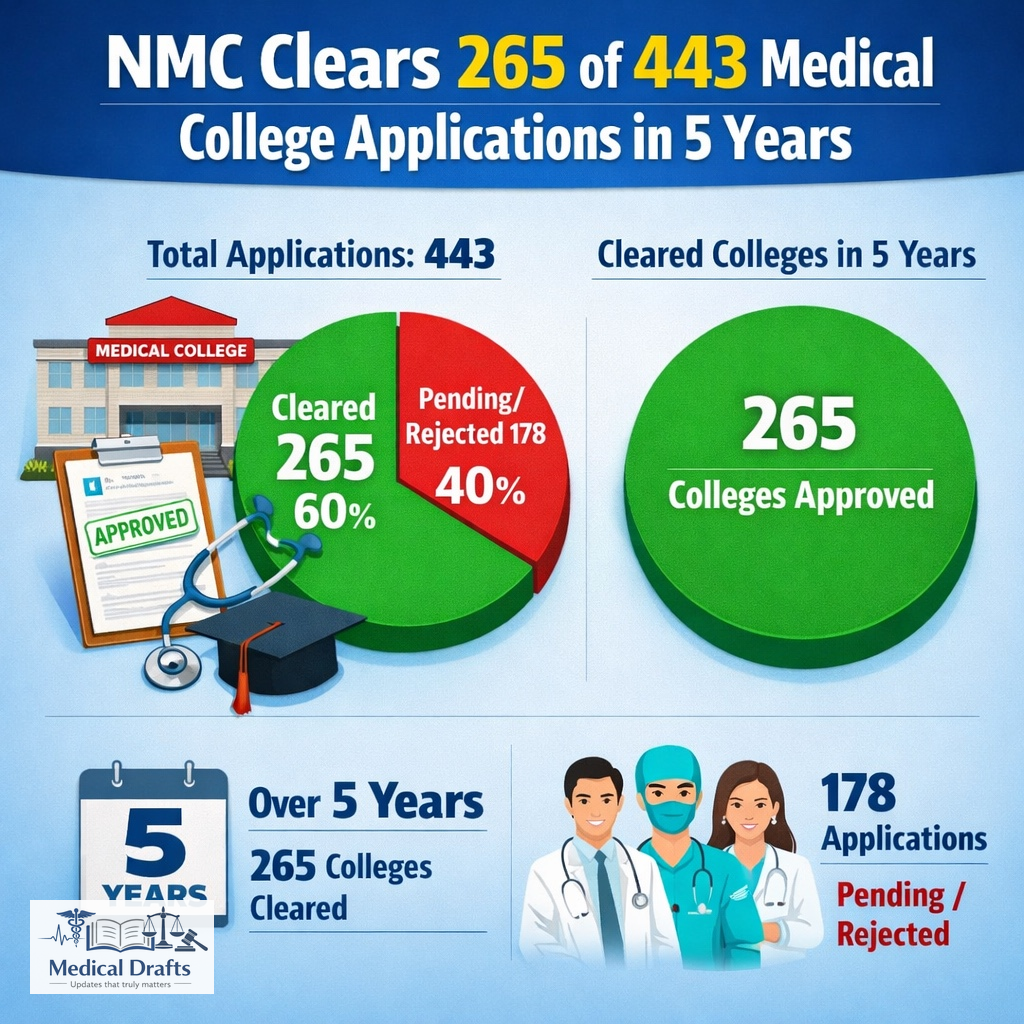
India is witnessing one of the fastest expansions in medical education in its history. In a written reply to the Lok Sabha, Union Minister of State for Health Smt. Anupriya Patel revealed that the National Medical Commission (NMC) has approved 265 out of 443 applicationsfor new medical colleges over the last five academic years (2021-22 to 2025-26). For the ongoing 2025-26 session alone, 43 new collegeshave received the green light.
This isn’t just another government statistic it’s a game changing development for lakhs of NEET aspirants, rural healthcare and India’s long term goal of improving the doctor patient ratio.
The Big Numbers: 443 Applications, 265 Approved
Between 2021-22 and 2025-26, NMC received a total of 443 applicationsto set up new medical colleges across India. Out of these, 265were approved after rigorous scrutiny of infrastructure, faculty, hospital beds and clinical facilities.
Here’s the year wise breakup (official data shared in Parliament):
Academic Year
Applications Received
Colleges Approved
2021-22
82
48
2022-23
83
46
2023-24
86
54
2024-25
112
74
2025-26
80
43
Total
443
265
State Wise Growth in Medical Colleges (2021-22 to 2025-26)
Parliamentary reply also included a detailed state wise table showing the total number of undergraduate medical colleges year after year. Some states have seen remarkable jumps:
Maharashtra: From 62 to 85 colleges (+23)
Rajasthan: From 26 to 49 colleges (+23)
Uttar Pradesh: From 67 to 88 colleges (+21)
Telangana: From 34 to 66 colleges (+32one of the highest)
Gujarat: From 30 to 43 colleges (+13)
Smaller states like Assam, Bihar and Odisha have also added multiple new college helping bridge the urban rural divide in medical education. This targeted growth ensures that Tier-2 and Tier-3 cities get their share of new institutions rather than everything concentrating in metros.
Why This Expansion Matters for Students and Healthcare
1. More Seats = More Opportunities for NEET Aspirants
Every new medical college typically adds 100–250 MBBS seats. With 265 new colleges approved in five years, India is creating thousands of additional seats annually. This directly benefits the 20+ lakh students who appear for NEET-UG every year.
2. Improving Doctor-Patient Ratio
India currently has roughly 1 doctor per 811 people (as per recent government data). The WHO recommends 1:1000. The massive addition of colleges is a practical step toward hitting and eventually surpassing that target.
3. Boost to Rural and Underserved Areas
Many recent approvals have gone to states with historically low doctor density. New colleges often come with attached hospitals, which immediately improve local healthcare infrastructure.
4. Economic Ripple Effect
Each new medical college creates jobs for doctors, nurses, paramedics, faculty, and support staff. It also spurs local economies through student spending, hostels and related services.
The NMC doesn’t approve applications blindly. Under the Establishment of New Medical Institutions Regulations 2023, every proposal must meet minimum standards for:
Land and building requirements
Faculty student ratio
Hospital bed strength and clinical material
Laboratories and library facilities
This explains why only 265 out of 443 applications made the cut, focus remains on producing skilled, competent doctors rather than just increasing numbers.
The Road Ahead: What 2026 and Beyond Look Like
With 43 new colleges already approved for 2025-26, momentum is clearly upward. If the current trend continues, India could cross 900 medical collegesin the next 2–3 years. Government is also encouraging private participation while maintaining oversight through the Medical Assessment and Rating Board (MARB). This balanced approach is key to sustainable growth.
For NEET 2026 aspirants: more colleges mean slightly better chances but competition remains tough. Focus on consistent preparation and keep an eye on counselling rounds for newly approved institutes.
Final Thoughts
The NMC’s approval of 265 new medical colleges in five years is more than a policy win, it’s a promise of a healthier, more self reliant India. For millions of young Indians dreaming of becoming doctors, this expansion opens real doors. For the healthcare system, it brings much needed manpower closer to every district.
Final year MBBS student with strong clinical knowledge in medicine, pharmacology, pathology and evidence based research. In depth knowledge of global geopolitics and its effects on healthcare systems, supply chains and international health regulations
The National Testing Agency has officially announced the new date for the NEET UG 2026 re examination after cancelling the earlier exam due to the alleged paper leak controversy. The re exam will now be conducted on June 21, 2026, affecting more than 22 lakh medical aspirants across India.
PMOS, previously known as PCOS, is a newly renamed condition that better reflects its hormonal and metabolic effects beyond the ovaries. The change from Polycystic Ovary Syndrome to Polyendocrine Metabolic Ovarian Syndrome highlights its association with insulin resistance, obesity, fertility issues, and long term health risks affecting millions of women worldwide.
A doctor in Bhilwara allegedly attempted suicide by consuming phenyl after accusing a private hospital operator of financial exploitation, unpaid salary, mental harassment, and police inaction. The incident has sparked concern over workplace conditions and disputes in the medical profession.