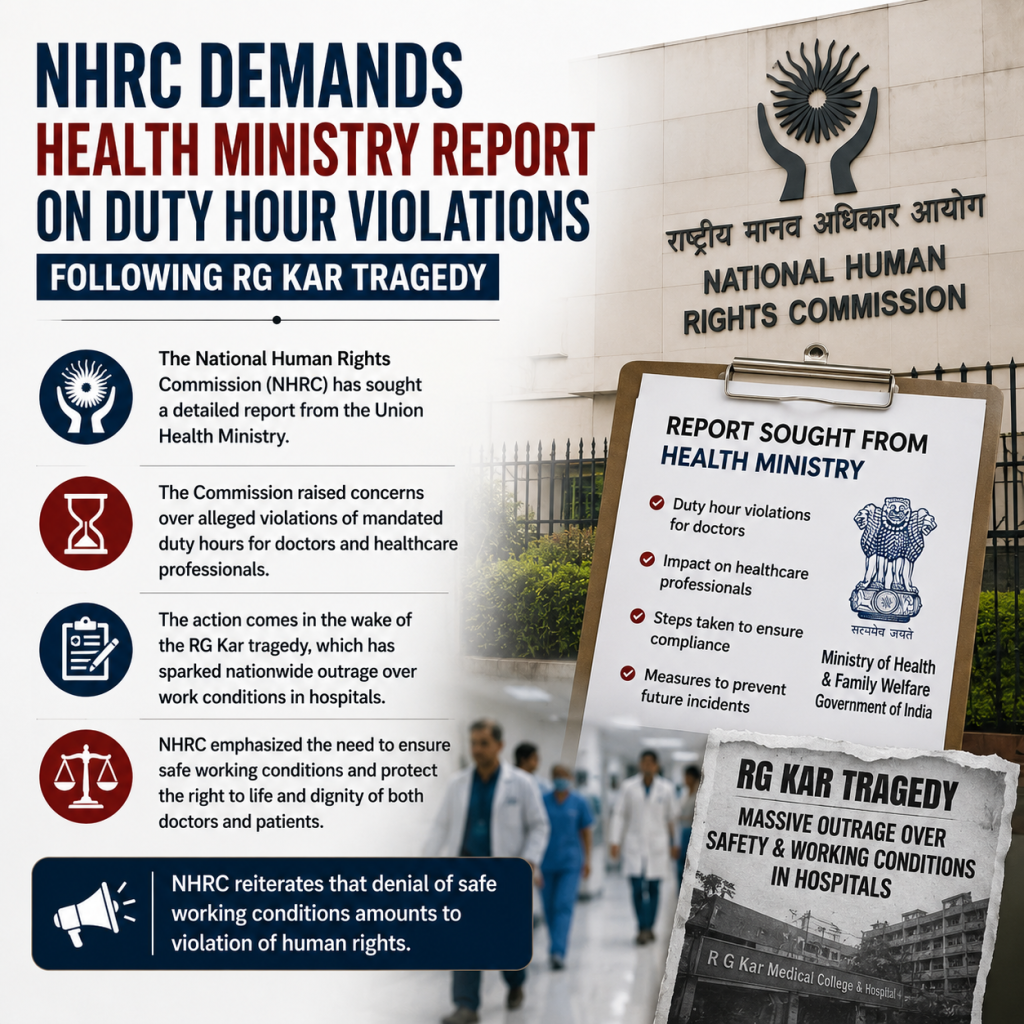
Two years after the shocking incident at RG Kar Medical College in Kolkata, conversation has moved beyond one terrible crime. The National Human Rights Commission (NHRC) has now stepped in with a formal directive to the Union Health Ministry. It wants a full report within four weeks on how duty hour rules are being broken across the country and what action has been taken against those responsible at institutions like RG Kar.
This is not just another notice. It is a clear signal that the long working hours forced on young doctors are no longer being treated as a minor administrative issue. They are being viewed as a serious human rights concern that affects both the doctors and the patients they treat.
What Exactly Happened at RG Kar and Why It Still Resonates
In August 2024, a 31 year old postgraduate trainee doctor was raped and murdered inside the hospital premises. The case shook the entire medical community and triggered nationwide protests while the crime itself was horrific many doctors pointed out that the tragedy also exposed deeper problems: poorly lit corridors, inadequate security and crucially, extreme fatigue among staff who were routinely working 24 to 36 hour shifts with almost no rest.
Fast forward to May 2026 and the NHRC has linked those same conditions directly to the RG Kar case. In its latest order Commission has asked the Health Ministry to explain what steps have been taken to enforce duty hour regulations under the Postgraduate Medical Education Regulations (PGMER) 2023 and the older Uniform Central Residency Scheme of 1992.
The Rules That Are Supposed to Protect Doctors But Often Don’t
According to long standing guidelines, resident doctors (the young specialists still in training) should work a maximum of 48 hours in a week. No single shift should exceed 12 hours, and there must be at least one full day off every week. These rules exist for a simple reason: tired doctors make mistakes and exhausted doctors cannot provide safe care.
Yet in reality, many hospitals both government and private routinely schedule residents for 24 hour, 36 hour or even longer continuous duties. Some doctors report working 80 to 100 hours in a single week. NHRC has received complaints that these violations are especially harsh for doctors with disabilities, who are often denied the reasonable adjustments they are entitled to. One resident doctor from a busy government hospital in Uttar Pradesh (who asked not to be named) described a typical week: “I finish a 36 hour shift on Monday morning go home for maybe four hours of sleep, then return for another long stretch. By Wednesday, my hands shake when I write notes. I’ve seen colleagues fall asleep while standing during rounds.” This is not an isolated story. Similar accounts come from medical colleges across states from AIIMS institutions to smaller district hospitals.
Why Overwork Is Everyone’s Problem
You might think long hours only affect the doctors themselves but the ripple effects reach every patient who walks into an emergency room or waits for a surgery.
When a doctor has been awake for 30 hours, reaction time slows, decision making suffers, and the chance of medical errors rises. Studies from around the world show that sleep deprived healthcare workers are more likely to misdiagnose or prescribe incorrectly. In India where patient loads are already high, this combination becomes dangerous.
Families who have spent nights in hospital corridors often notice the difference. A tired doctor may rush through explanations or miss subtle warning signs. The human cost is real both for the medical professional burning out and for the patient whose care suffers. Mental health is another casualty. Many young doctors report anxiety, depression, and in extreme cases, thoughts of self harm. The pressure of endless shifts, combined with academic exams and family expectations, leaves little room for recovery.
Doctors Associations Push for Prime Minister’s Office Intervention
In response to the NHRC notice groups like United Doctors Front (UDF) have written directly to the Prime Minister’s Office. They argue that state governments and medical college administrations have failed to enforce even basic rules for years. They want the central government to step in with stronger monitoring, penalties for non compliant hospitals, and a clear national policy that cannot be ignored.
Dr. Lakshya Mittal, a vocal advocate for resident doctors has highlighted that the current system treats young doctors as “disposable labour” rather than future specialists who need proper training and rest. The demand is straightforward: treat duty hour violations with the same seriousness as any other safety breach in a hospital.
Practical Steps That Could Actually Make a Difference
Reform does not have to wait for another tragedy. Here are concrete actions that hospitals, regulators and even the public can support right now:
For hospital administrations
- Install transparent digital duty rosters that cannot be altered after the fact.
- Appoint an independent compliance officer whose only job is to track working hours and report violations monthly to the National Medical Commission (NMC).
- Create proper resting rooms with beds, not just a chair in the duty room.
For resident doctors
- Document every shift that exceeds limits and share the records with their association.
- Use the grievance redressal mechanisms already available under NMC regulations instead of suffering in silence.
- Prioritise basic self care even short power naps during long shifts have been shown to improve alertness.
For patients and families
- Ask politely about the doctor’s shift length when you notice signs of extreme fatigue. A simple question like “Doctor, have you been on duty long?” can sometimes prompt better handovers.
- Support campaigns for better working conditions. When the public understands that rested doctors mean safer care, pressure on policymakers increases.
For policymakers
- Move from vague “reasonable hours” language in the 2023 regulations to clear, enforceable numbers with automatic penalties for violations.
- Link hospital accreditation and funding to verified compliance with duty hour rules.
What This Moment Could Mean for Indian Healthcare
NHRC’s intervention is a rare opportunity. For the first time in years, a constitutional body has connected the dots between one high-profile tragedy and the everyday exhaustion faced by thousands of young doctors. If the Health Ministry submits a thorough report and follows it with real enforcement, we could see meaningful change within 12–18 months. If the opportunity is wasted, we risk another cycle of protests, burnout and preventable mistakes.
Frequently Asked Questions
1. What are the current legal limits on doctor duty hours in India?
The 1992 Uniform Central Residency Scheme caps weekly work at 48 hours with a maximum 12vhour shift and one weekly off. The 2023 PGMER regulations require “reasonable working hours” and rest but many institutions still ignore these standards.
2. How does long duty affect patient safety?
Fatigue slows reaction time and impairs judgment. International research shows that doctors working beyond 16–18 continuous hours have significantly higher error rates, which directly impacts diagnosis, treatment and surgical outcomes.
3. Can resident doctors refuse excessive shifts?
In theory yes but in practice many fear academic penalties, delayed promotions, or being labelled “non cooperative.” Stronger legal protection and anonymous reporting channels are needed.
4. What can an ordinary citizen do to help?
Write to your Member of Parliament, share verified information on social media, and support doctors’ associations when they raise legitimate concerns. Public awareness is one of the strongest drivers of policy change.
5. Is this issue limited to government hospitals?
No, while government medical colleges often have higher patient loads, several private institutions also schedule long shifts. The problem is systemic across the country.
A Final Thought
Every time we walk into a hospital, we place our trust and sometimes our lives in the hands of young doctors who may have slept only a few hours in the last two days. The RG Kar tragedy reminded us that this trust comes with responsibility. The NHRC’s latest order is not just about rules on paper; it is about protecting the people who protect us.
If we want safer hospitals, better training and doctors who can actually think clearly when it matters most, then fixing duty hours is not optional. It is essential.
The next four weeks while the Health Ministry prepares its report will tell us whether this moment becomes a turning point or just another missed chance. The choice ultimately is ours to demand better for the doctors who serve us and for every patient who deserves care from someone who is awake enough to give it properly.
Disclaimer
This post is for informational and educational purposes only. It does not constitute medical advice, legal opinion or an official investigation. Readers should consult qualified healthcare professionals for personal health concerns. All details are drawn from media reports and outcomes of any official inquiry may provide further clarity.