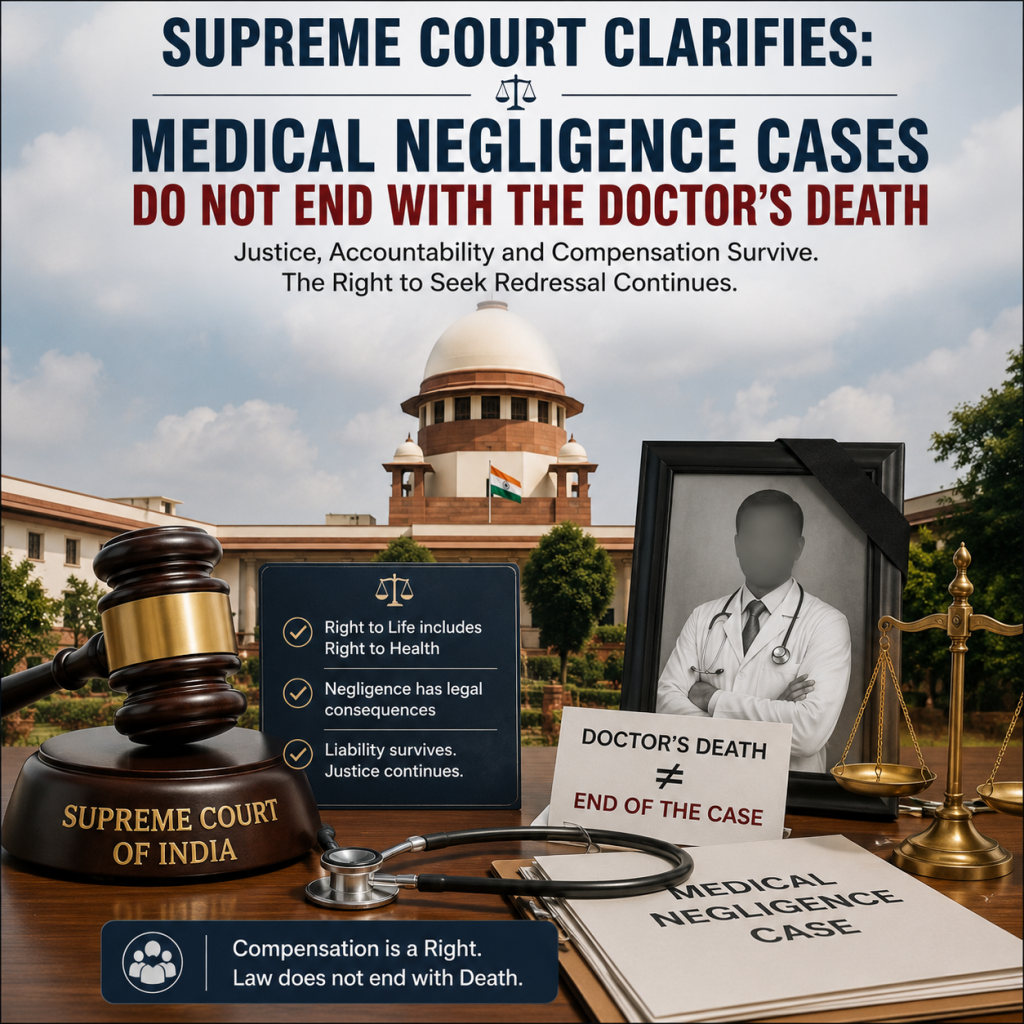
On 5 May 2026, India’s Supreme Court delivered a judgment that is now being discussed in hospitals, clinics and medical association meetings across the country. The court held that a medical negligence case does not automatically end when the doctor against whom the complaint was filed passes away. Legal heirs of the deceased doctor can now be brought into the proceedings. However any compensation awarded will come only from the doctor’s estate not from the personal savings or assets of the family members.
The ruling has been welcomed by some patient rights groups as a step toward ensuring justice is not denied simply because time has passed. At the same time, doctors and their associations have expressed serious reservations about the practical and emotional impact it may have on families who were never part of the original treatment.
This article breaks down the verdict in simple terms, looks at both sides of the debate and offers practical insights for anyone who might be affected.
What Exactly Did the Supreme Court Decide?
In straightforward language, the court clarified two important points:
- The right to claim compensation survives the death of the doctor.
- Liability is limited to the estate the doctor left behind.
This means if a patient or their family had filed a case years earlier and the doctor later passed away, the case can continue. The heirs (usually spouse or children) can be added as parties to the case, but they will not be personally punished or asked to pay from their own pockets beyond what the deceased doctor owned at the time of death.
The bench comprising Justices J.K. Maheshwari and Atul S. Chandurkar, observed that under the Consumer Protection Act (both the 1986 and 2019 versions), focus is on providing relief to the consumer rather than punishing the individual. Therefore once negligence is proved and compensation is awarded, the amount can be recovered from the doctor’s property or assets that pass on to the heirs.
This marks a clear departure from the old legal principle actio personalis moritur cum persona a Latin phrase that roughly means “a personal action dies with the person.” In consumer cases involving money, the court has now said that principle does not apply in the same rigid way.
The Long Running Case That Brought This Question to the Fore
The ruling came while deciding a question of law in a matter that had been going on for more than three decades. In that case, a woman had lost her vision after a surgery performed by a doctor. Both the patient and the doctor eventually passed away during the long legal battle, question before the Supreme Court was simple yet significant: Should the patient’s family be left without any remedy just because the doctor is no longer alive?
The court answered in the negative, holding that the legal heirs of the doctor can be impleaded (legally brought into the case) so that the proceedings can reach a logical conclusion.
Why the Medical Fraternity Is Raising Concerns
While the court’s intention appears to be protecting patients’ right to compensation, several doctors and professional bodies have pointed out potential downsides.
Dr. Anjali Rao, a senior gynaecologist practising in Lucknow for 22 years puts it this way:
“Medicine is not like selling a defective product. Every case involves uncertainty, human judgment, and sometimes emergencies where split second decisions are made. When liability extends even after death, it creates a lingering shadow over the entire profession.”
Leading associations such as the Federation of All India Medical Associations (FAIMA) and the Forum of Resident Doctors’ Associations (FORDA) have issued statements highlighting three main worries:
- Emotional and financial stress on families: Heirs who never met the patient or participated in any medical decision may now receive court notices years later. Defending such cases requires time, money, and legal knowledge that most families do not possess.
- Rise in defensive medicine: Doctors may start ordering more tests, avoiding complicated procedures, or referring patients elsewhere simply to reduce their own legal exposure. This can increase costs for patients and delay care.
- Discouragement of high-risk specialties: Fields like neurosurgery, oncology, and emergency medicine already carry higher chances of complaints. Young doctors may think twice before choosing these areas or serving in smaller towns where infrastructure is limited.
Dr. Vikram Singh, national vice president of a doctors’ welfare body, explains:
“We are not against accountability but when the burden shifts to people who had zero role in the treatment, it feels like the system is punishing the family instead of addressing the real issues better training, improved documentation systems and faster disposal of cases.”
What This Could Look Like
Consider this situation: Dr. Meera Kapoor, a 58 year old orthopaedic surgeon in Nagpur, passed away in 2024 from a sudden cardiac event. Three years earlier, a patient had filed a complaint alleging that a knee replacement surgery did not yield the expected results. The case was still pending in the state consumer commission.
Under the new ruling, Dr. Kapoor’s 32 year old daughter who works as a software engineer in Bengaluru and has never stepped into an operation theatre, could now be asked to appear in court and respond to questions about surgical techniques she knows nothing about or imagine a young doctor who joins a government hospital in a rural district. Knowing that any future complaint could follow his family even after his death, he might choose to play it extremely safe ordering every possible scan and avoiding any procedure that carries even a small risk. Over time, this defensive approach could affect thousands of patients who need timely intervention.
These are not extreme examples. They reflect the kind of conversations happening in doctors’ WhatsApp groups and association meetings right now.
How This Affects Patients and Their Families
On the other side patient rights advocates argue that without this ruling, many legitimate claims would simply evaporate if the doctor died during the long Indian judicial process. For a family that has already spent years attending hearings and spending money on lawyers, the new clarity offers a sense of closure. If negligence is eventually proved, they will not be told “the doctor is no longer alive, so the case is closed.”
The key point to remember is that the court has kept the liability strictly limited to the estate. Family members are not being held criminally responsible, nor are their personal assets at risk beyond what they inherited.
Practical Steps Doctors and Families Can Take Today
If you are a practising doctor or part of a doctor’s family, here are some concrete actions worth considering:
- Review your professional indemnity insurance — Check whether your policy covers claims that may arise or continue after your lifetime. Some newer policies now explicitly mention post-death coverage up to a certain limit.
- Maintain clear, contemporaneous records — Good documentation has always been the best defence. In the age of this ruling, it becomes even more important because your family may one day need to rely on those notes.
- Have an open conversation with your family — Many doctors avoid discussing legal risks at home. A calm discussion about where important documents are kept and who the family lawyer is can reduce panic if a notice ever arrives.
- Support systemic reforms — Through your state or national medical association, push for faster timelines in consumer courts, creation of expert medical panels to screen complaints early and better training in communication skills that reduce misunderstandings with patients.
Patients too can benefit from understanding that not every poor outcome is negligence. Asking questions, seeking second opinions, and maintaining realistic expectations often prevent complaints from arising in the first place.
Frequently Asked Questions
Does this mean a doctor’s children will have to pay compensation from their own salaries?
No, Supreme Court has clearly stated that liability is restricted to the deceased doctor’s estate whatever assets or property the doctor owned at the time of death.
Can criminal cases also continue against the heirs?
This ruling applies specifically to civil compensation claims under consumer protection law. Criminal proceedings, if any, follow a different legal path and are generally considered personal in nature.
How long can such cases continue after a doctor’s death?
There is no fixed time limit mentioned in the judgment. However, consumer courts are expected to dispose of matters within reasonable timeframes. In practice, many medical negligence cases already take 8–15 years.
Is there any way for heirs to exit the case early?
Heirs can approach the court and request that only claims directly linked to the estate be considered. The court has emphasised that personal claims (such as mental agony of the patient) abate with the doctor’s death.
What if the doctor had no significant assets left?
In such situations, compensation awarded may be limited or even become unrecoverable though the legal process can still continue.
A Balanced Way Forward
India’s healthcare system is already under pressure from doctor shortages in rural areas to rising incidents of violence against medical professionals. This new ruling adds another layer of complexity. Supreme Court has attempted to strike a balance between two important values: ensuring that patients are not left without remedy, and recognising that medicine involves inherent risks and human limitations. Whether this balance works in practice will depend on how lower courts apply the judgment and how quickly systemic improvements are made.
For doctors, the message is clear: the era of “the case ends with me” is over. For patients, it offers reassurance that justice will not be defeated by the passage of time alone.
Perhaps the most useful takeaway is this both the medical profession and the legal system need to work together to reduce the number of complaints that reach the courts in the first place. Better communication, realistic consent processes, robust documentation and quicker grievance redressal at the hospital level can prevent many disputes from ever becoming long-drawn legal battles.
As someone who has followed India’s medico legal landscape for years, I believe this verdict is not the final word but the beginning of an important conversation. Whether you are a doctor worried about your family’s future, a patient seeking accountability or a policymaker shaping healthcare law, your voice matters now more than ever.
What steps do you think medical associations and the government should take next to address these concerns? Share your views thoughtful discussion is the first step toward a fairer system for everyone involved in healthcare.
Disclaimer
This post is for informational and educational purposes only. It does not constitute medical advice, legal opinion or an official investigation. Readers should consult qualified healthcare professionals for personal health concerns. All details are drawn from media reports and outcomes of any official inquiry may provide further clarity.