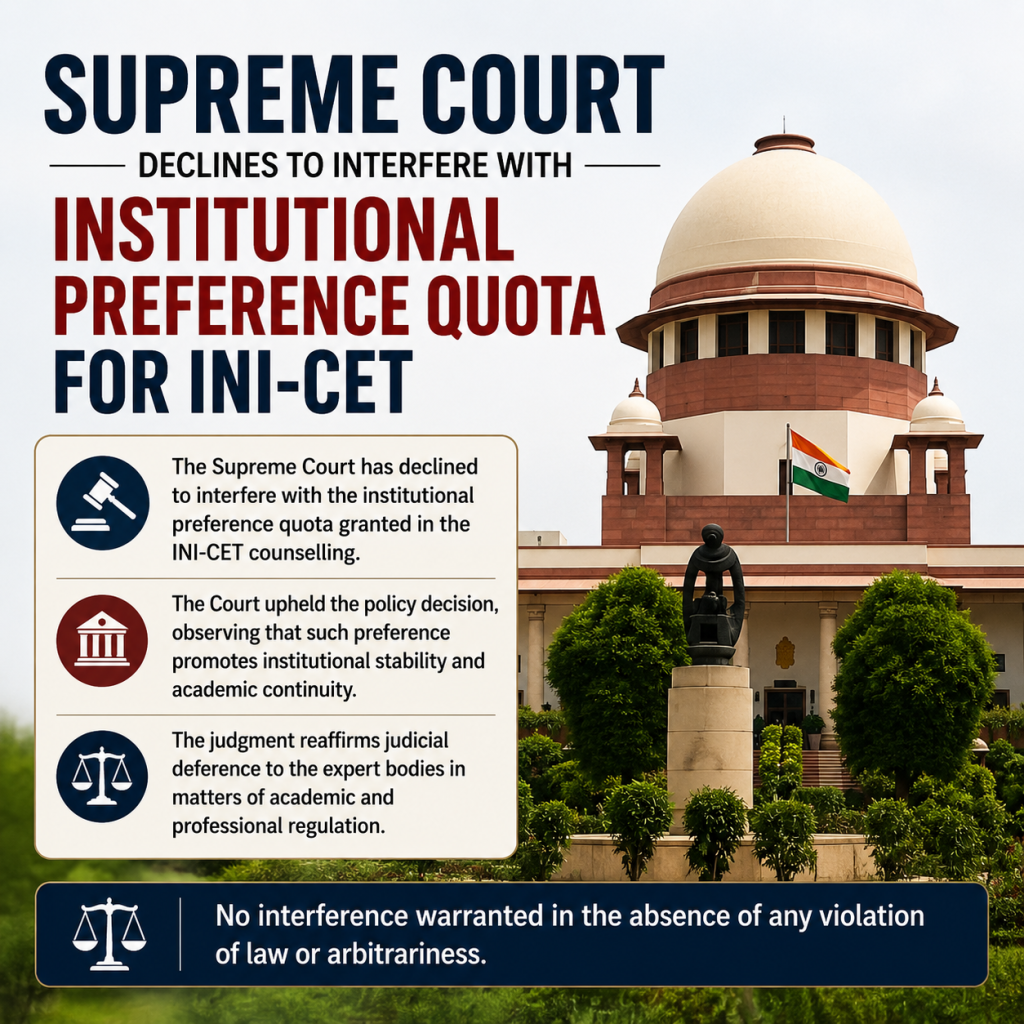
On 7 May 2026, the apex court turned down a petition that questioned the way AIIMS and other Institutes of National Importance (INIs) apply an “institutional preference” system during INI-CET counselling. The decision brings some immediate clarity to thousands of students preparing for the next round of admissions, even though the bigger legal debate remains open for another day. In plain terms, the court said it wasn’t inclined to step in under Article 32 of the Constitution right now but it left the door slightly ajar for future challenges in the proper forum. For students, this means the existing rules stay in place at least for now. Let’s break it all down step by step so you can understand exactly how it affects your chances and what you can do about it.
What Exactly Is Institutional Preference in INI-CET?
First, a quick refresher on INI-CET. It’s the single entrance test for postgraduate medical courses (MD, MS, DM, MCh, etc.) at AIIMS (all centres), JIPMER, PGIMER Chandigarh and a few other premier institutes. After the exam comes the counselling and seat allotment, where this “institutional preference” (often called IP) comes into play.
IP is not a full blown reservation like the ones for SC, ST, OBC, EWS or PwD categories. It’s a limited preference given to doctors who completed their MBBS from the same institute where they’re applying for PG seats. The idea is to reward loyalty and keep talented graduates within the system that trained them. Here’s how the numbers work, according to AIIMS guidelines that follow earlier Supreme Court directions:
- The preference can cover up to 50% of the unreserved (UR) seats at that particular institute.
- It cannot exceed 50% of the total MBBS seats the institute offers.
- In real life, this usually translates to roughly 18–24% of all PG seats across the institutes.
Importantly, these seats are not fixed subject wise. Unlike regular reservations, the actual number of IP seats can vary from one department to another (say, more in Medicine, fewer in Surgery) as long as the overall cap is respected. AIIMS uses a detailed 200 point roster system to decide the order of allotment which ensures transparency and compliance with past court orders.
Think of it like this: If you’re an AIIMS Delhi MBBS graduate, you get a small but meaningful edge when competing for PG seats at AIIMS Delhi. Outsiders compete purely on merit for the remaining seats.
Petition That Reached the Supreme Court
The case that just got dismissed involved doctors like Dr. Sukrit Nanda M and others. They argued that in practice, the way IP was being implemented sometimes looked more like a hidden reservation that went beyond what the law allows. One widely discussed example was a candidate with a very high rank (around 287) who missed out on a seat at AIIMS Delhi while a much lower ranked in house graduate (reportedly in the 10,000+ range) secured one. The petitioners claimed this amounted to unfair treatment and effectively created a “super-reservation” in popular specialties.
Senior advocates representing the petitioners highlighted earlier Supreme Court rulings that had struck down outright institutional reservations but allowed limited preference. They wanted the court to examine whether AIIMS was strictly following those limits.
What the Supreme Court Actually Said
A bench comprising Justices P.S. Narasimha and Alok Aradhe heard the matter. After listening to both sides at length, the court observed: “Having heard the counsel for the parties at a considerable length and on carefully perusing the material placed on record, we are not inclined to entertain these petitions under Article 32 of the Constitution.”
In simpler words, they declined to interfere at this stage. However they explicitly kept the broader legal question open for consideration in an appropriate future case. That’s important it means no one is calling the policy unconstitutional once and for all; they just didn’t find this particular petition the right vehicle to decide it.
AIIMS through its counsel, strongly defended the system. They pointed out that they follow three key earlier judgments to the letter:
- The 2001 AIIMS Students Union case
- The 2003 Saurabh Chaudri case
- The 2022 order in the Student Association AIIMS Bhopal matter
The institute also clarified that the petitioner’s failure to get a seat had more to do with the specific choices they filled during counselling rather than any flaw in the quota implementation.
How This Affects Real Students: Two Typical Scenarios
Let’s make this concrete with everyday examples.
Scenario 1 – The Outsider with a Strong Rank
Rohan cracked INI-CET with an excellent rank but did his MBBS from a state medical college. He has his heart set on AIIMS Delhi for MD Medicine because of IP, some seats that would otherwise be open to him are ring fenced for in house graduates. He still has a fair shot at the remaining UR seats, but he needs to be realistic about his choices and rank.
Scenario 2 – The In-House Graduate
Priya studied MBBS at AIIMS Bhopal. Her rank is decent but not top tier. Thanks to IP, she has a genuine chance at staying on at her alma mater something that feels rewarding after years of hard work there. Many in house students see this as fair recognition of their attachment to the institute both sides have valid points. Supporters of IP say it helps institutes retain talent, reduces brain drain, and maintains institutional continuity in research and patient care. Critics worry it can sometimes dilute pure merit, especially for brilliant outsiders who have fewer “home” options.
Practical Tips for INI-CET Aspirants Right Now
The good news? The rules haven’t changed overnight. Here’s how you can use this information to your advantage:
- Understand the roster and percentages – Before filling choices, check the latest seat matrix and IP calculations for each institute on the official AIIMS website. Some centres have higher IP impact than others.
- Be smart with choice filling – Don’t put all your eggs in one basket. List realistic options across multiple institutes and specialties. Remember that in later rounds, vacated IP seats often convert to open UR seats.
- Focus on what you can control – A single rank can make or break your chances, but so can strategy. Mock counselling sessions (many coaching platforms offer them) can help you practice without the pressure.
- Have backup plans – INI-CET is tough, but NEET-PG, state counselling and even private colleges are still there. Diversify your preparation.
- Stay updated – Follow official notifications from AIIMS Exams section and reliable medical education portals. Policies can evolve, especially if someone files a fresh petition in the right court.
Real talk: Many students who felt disadvantaged in one round have still landed excellent seats in subsequent rounds or at other INIs. Persistence and informed decision making matter more than any single policy.
FAQ
1. Is institutional preference the same as reservation?
No, It’s a limited preference for in-house MBBS graduates, capped at around 18–24% of total seats overall. It does not work subject-wise like constitutional reservations.
2. Did the Supreme Court uphold or strike down the quota?
The court dismissed the specific plea but did not pass any final judgment on the policy’s legality. The system continues unchanged for now and the legal question remains open.
3. How many seats does IP actually cover?
It varies by institute but stays within the 50% limit of unreserved seats and the institute’s MBBS intake. In practice, it’s a meaningful but not overwhelming portion of seats.
4. Will this affect the July 2026 INI-CET session?
No immediate changes. The existing guidelines and roster system remain in force unless a future court order or policy tweak says otherwise.
5. I’m an outsider what’s my best strategy?
Rank improvement is still king. Beyond that, research institute wise IP impact, fill choices broadly and be prepared for multiple counselling rounds. Many outsiders succeed every year.
Wrapping Up: What This Really Means for the Future of Medical Education
The Supreme Court’s decision this week keeps the current institutional preference framework intact while signalling that the conversation about fairness in PG medical admissions is far from over. For students, that means stability in the short term and a reminder that understanding the rules inside out is just as important as cracking the exam.
Medical education in India has always balanced merit, equity and practical needs. Whether you see IP as a helpful nudge for institutional growth or as something that needs rethinking, one thing is clear: the path forward rewards preparation, strategy and resilience.
If you’re in the middle of INI-CET prep or planning for the next cycle, take a moment today to review the latest seat matrices and your own choice list. Talk to seniors, consult mentors and keep your options open. The system may not be perfect, but thousands of dedicated doctors still find their way to great careers every year. Stay focused, stay informed and keep pushing. Your next big breakthrough could be just one smart decision away. For the latest official updates, head straight to the AIIMS examination portal or trusted medical education resources.
Disclaimer
This post is for informational and educational purposes only. It does not constitute medical advice, legal opinion or an official investigation. Readers should consult qualified healthcare professionals for personal health concerns. All details are drawn from media reports and outcomes of any official inquiry may provide further clarity.