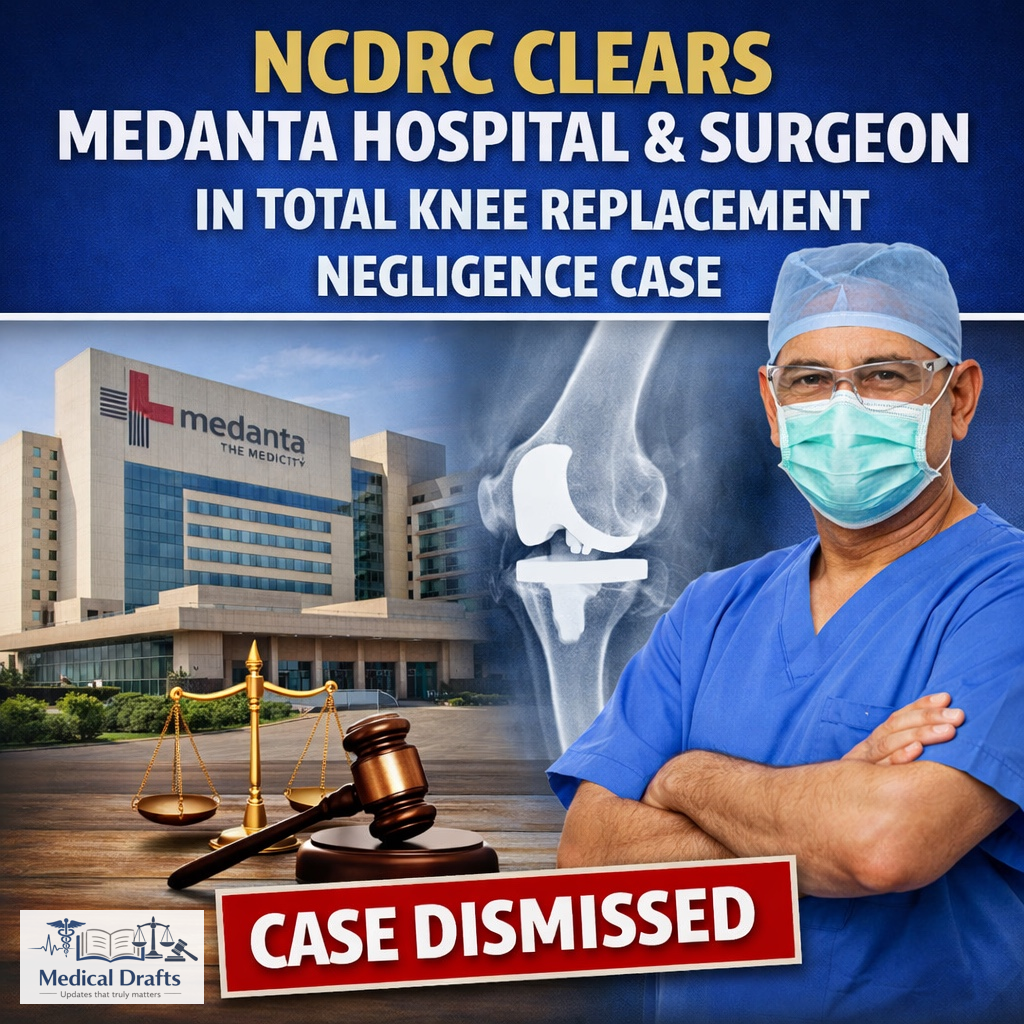
The complaint filed by the legal heirs of late Dr. Madhu Gupta (herself a doctor), sought over ₹1.08 crore in compensation. The final verdict? No negligence or deficiency in service was proved. This judgment reinforces a simple but powerful message for India’s booming joint replacement sector: known risks of surgery are not proof of negligence.
What Was the Medanta Knee Replacement Case All About?
This story goes back to February 2010.
Dr. Madhu Gupta, suffering from long standing Rheumatoid Arthritis (RA) and severe knee deformity (including dislocated patellae and significant instability), approached Medanta for relief. After thorough evaluation, she underwent bilateral Total Knee Replacement (TKR) surgery under combined spinal epidural anaesthesia.
Surgery itself was uneventful. She was discharged in stable condition, walking with support and advised regular physiotherapy.However, around three months later, she developed serous discharge from the left knee surgical site. Over the next 18 months, she required:
- Debridement and change of articular surface
- Revision surgery (Stage-1) after culture showed Staphylococcus aureus infection
- Removal of infected implant
- Further procedures at other hospitals, including AIIMS New Delhi
The patient alleged that:
- Junior doctors performed some procedures
- Anti tubercular drugs (including Rifampicin) were given without proper confirmation of TB
- Post operative care was deficient
- These issues forced her to close her own hospital/clinic, causing huge financial and emotional loss
She filed a complaint before the Haryana State Consumer Disputes Redressal Commission seeking ₹10 lakh (medical costs) + ₹10 lakh (physical suffering) + ₹5 lakh (mental agony) + ₹20 lakh (loss of income) + litigation costs totalling well over ₹1 crore when interest was added.
What Did the Courts Actually Find?
Haryana State Commission (2017): Dismissed the complaint outright.
NCDRC (March 25, 2026): Upheld the dismissal in a detailed order by Presiding Member Dr. Inder Jit Singh and Member Dr. Sudhir Kumar Jain.
Key observations from the NCDRC bench:
- “Medical negligence should not be inferred in a casual manner… it must be established with cogent, rational and convincing evidence.”
- Post surgical infection and persistent discharge are known recognised risks of TKR, especially in patients with Rheumatoid Arthritis.
- The hospital and surgeon produced complete medical records showing informed consent, pre anaesthetic clearance, standard surgical protocols, culture sensitivity tests and appropriate antibiotic management.
- The complainant failed to produce any expert medical opinion proving deviation from standard care.
- The doctrine of res ipsa loquitur (negligence speaks for itself) does not apply automatically in complex orthopaedic cases.
- Doctors followed the Bolam Test principle treatment was in line with what a reasonably competent practitioner would do.
The Commission concluded:
“There is no evidence that the respondent failed to exercise due skill, care or diligence. The outcome was a result of complications, not negligence.”
Why This Ruling Matters in 2026 India
India is witnessing an explosion in joint replacement surgeries. With an ageing population and rising arthritis cases, over 2.5 lakh knee replacements are performed annually. At the same time, medical negligence complaints have surged.
This verdict sends three important signals:
- Complications ≠ Negligence
Infection rates in TKR can range from 1-3% even in the best centres. RA patients are at higher risk due to immune suppression and poor tissue quality. - Burden of Proof Lies on the Patient
Merely showing a bad outcome is not enough. Expert testimony is almost always required in complex surgical cases. - Proper Documentation Wins Cases
Medanta’s detailed records of counselling, consent, culture reports, and follow up proved decisive.
The Bigger Picture: Balancing Patient Rights and Doctor Confidence
India’s consumer courts have repeatedly cited Supreme Court precedents like Jacob Mathew vs State of Punjab and Kusum Sharma vs Batra Hospital. This Medanta ruling is the latest in a long line of judgments protecting honest medical practice while keeping the door open for genuine negligence claims.
As healthcare becomes more defensive (some surgeons now hesitate to take high risk cases), rulings like this help restore balance.
Bottom line: Medicine is not an exact science. When doctors act with reasonable skill and care even if the result is not perfect, law stands with them.
Final Thoughts
This NCDRC verdict is not just a win for Medanta and the orthopaedic community it’s a win for evidence based medicine and patient doctor trust.