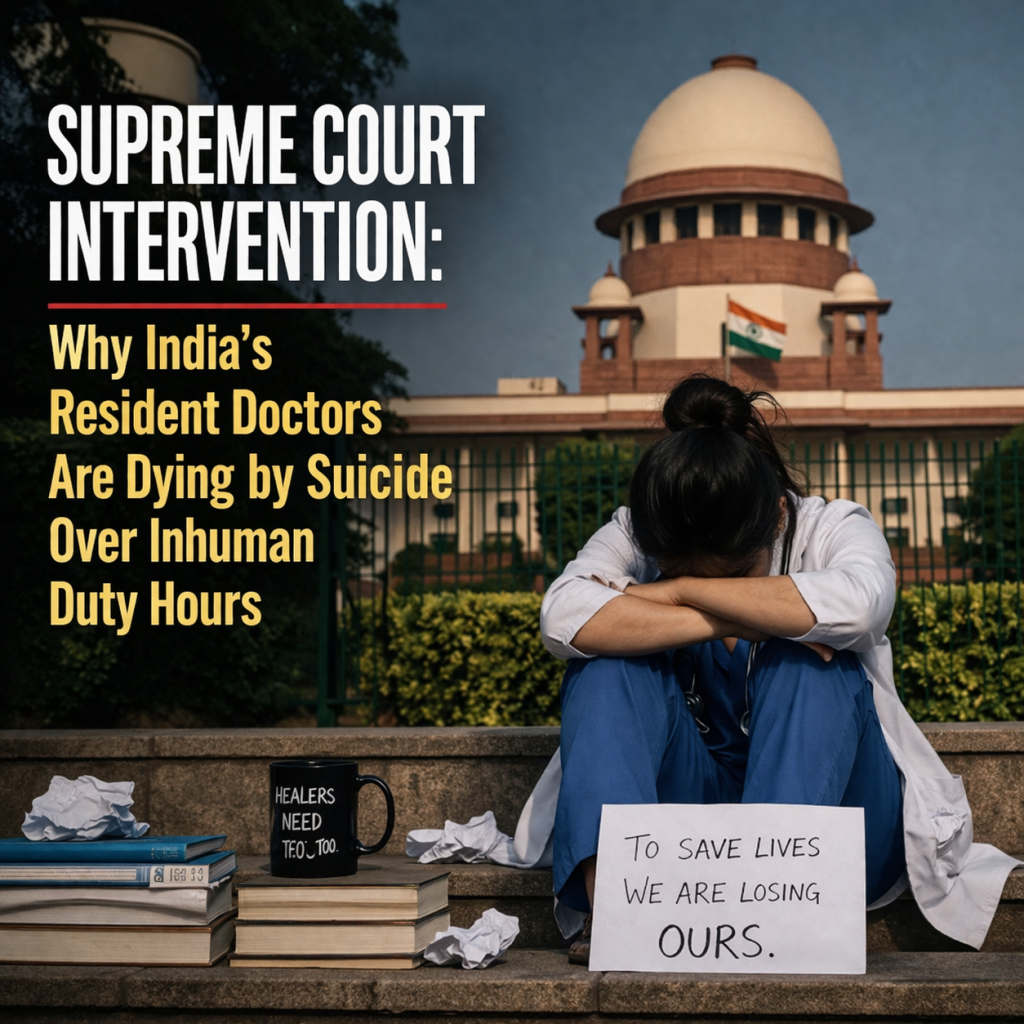
Supreme Court of India is once again stepping in where the system has failed its own. An intervention application has been filed in Writ Petition (Civil) No. 817 of 2025 originally moved by the United Doctors Front (UDF) demanding immediate enforcement of long ignored duty hour norms for resident doctors.
The reason? A growing wave of suicides among young postgraduate medical trainees who are pushed beyond human limits.
This isn’t just another headline. It’s a national emergency in the making. Behind the white coats and stethoscopes are exhausted 20 and 30 somethings battling 36 hour shifts, zero work life balance and a toxic culture that treats burnout as “part of the training.” Today, we break down what’s happening, why it’s happening, and why enforcing basic duty hour rules could be the difference between life and death for India’s next generation of doctors.
The Silent Epidemic: Numbers That Should Shock Us
Recent reports paint a grim picture:
- Over 25 resident doctors died by suicide in India in 2025 alone more than double the average annual figure in previous years.
- Parliamentary panels have flagged routine 24 to 36 hour continuous shifts in major government hospitals.
- Surveys show 75–83% of resident doctors report severe burnout, emotional exhaustion and mental fatigue.
- RTI data from the National Medical Commission reveals that between 2018 and 2023, at least 119 medical students and postgraduates took their own lives many citing overwork.
These aren’t statistics. These are bright young minds who survived NEET, cracked PG entrances and now find themselves trapped in a system that demands superhuman endurance while offering almost zero mental health support.
What the 1992 Guidelines Actually Say (And Why They’re Being Ignored)
Way back in 1992, the Government of India’s Uniform Central Residency Scheme laid down crystal clear rules:
- Maximum 12 hours of duty per day
- Maximum 48 hours per week
- One weekly off day
- Proper rest periods between shifts
Fast forward three decades. The National Medical Commission’s 2023 Post-Graduate Medical Education Regulations mention “reasonable working hours” but leave the definition vague and enforcement to the states.
Result? Most resident doctors routinely clock 70–100+ hours a week. Many describe 36 hour marathons as “normal.”
The intervention application now before the Supreme Court argues that this blatant violation of the 1992 norms is directly contributing to the mental health crisis and demands urgent, nationwide enforcement.
Why Long Hours Are Killing Doctors And Patients
The science is clear:
Sleep deprivation and chronic stress impair decision making, increase medical errors and destroy mental health. A doctor who hasn’t slept for 24 hours has the cognitive performance of someone legally drunk.
Yet India’s public hospitals run on the backs of overworked residents because of chronic faculty shortages and sky high patient loads.
The human cost is heartbreaking:
- Young doctors found in hostel rooms after long shifts.
- Families left devastated.
- A profession that once attracted the brightest now seeing talent flee abroad or quit altogether.
And let’s not forget the patients. Exhausted doctors are more likely to make mistakes. The very people we trust with our lives are being set up to fail.
The Legal Battle So Far
The United Doctors Front’s original petition (Writ Petition No. 817 of 2025) forced the Supreme Court to seek responses from the Centre, states, and the National Medical Commission. The recent intervention application moved by advocate Yedhukrishna Sanilkumar adds fresh urgency, asking the court to treat enforcement of duty hours as a fundamental rights issue under Article 21 (Right to Life and Dignity). This isn’t about luxury. It’s about basic dignity and survival.
What Real Change Would Look Like
Enforcing the 1992 norms isn’t rocket science. It requires:
- Strict nationwide guidelineswith clear penalties for violations.
- Increased staffing– more faculty positions and resident posts to reduce individual workload.
- Mental health support– mandatory counselling cells, helplines and destigmatization in every medical college.
- Monitoring mechanisms– digital attendance systems and independent audits.
- State-level accountability– the NMC has already told the Supreme Court that implementation lies with states. Time to make that meaningful.
Some states like Maharashtra have begun taking baby steps toward the 48 hour cap. Supreme Court can turn these isolated efforts into a national revolution.
A Message to Aspiring Doctors, Parents and Policymakers
If you’re a medical student dreaming of PG: know that change is coming but it needs your voice too. If you’re a parent: understand the hidden cost of “prestige” seats. If you’re a policymaker or administrator: next suicide could be prevented by a single circular you sign today. Doctors don’t need sympathy. They need systemic respect.
Time for Change Is Now
The Supreme Court’s intervention in this case could be the turning point India’s healthcare system desperately needs.
For too long, we’ve celebrated doctors as “gods in white coats” while treating them like machines. It’s time to treat them like human beings with rights, rest and respect because when doctors break, the entire healthcare system collapses.
What do you think? Should duty hour enforcement be made non negotiable across India? Share your views in the comments below.