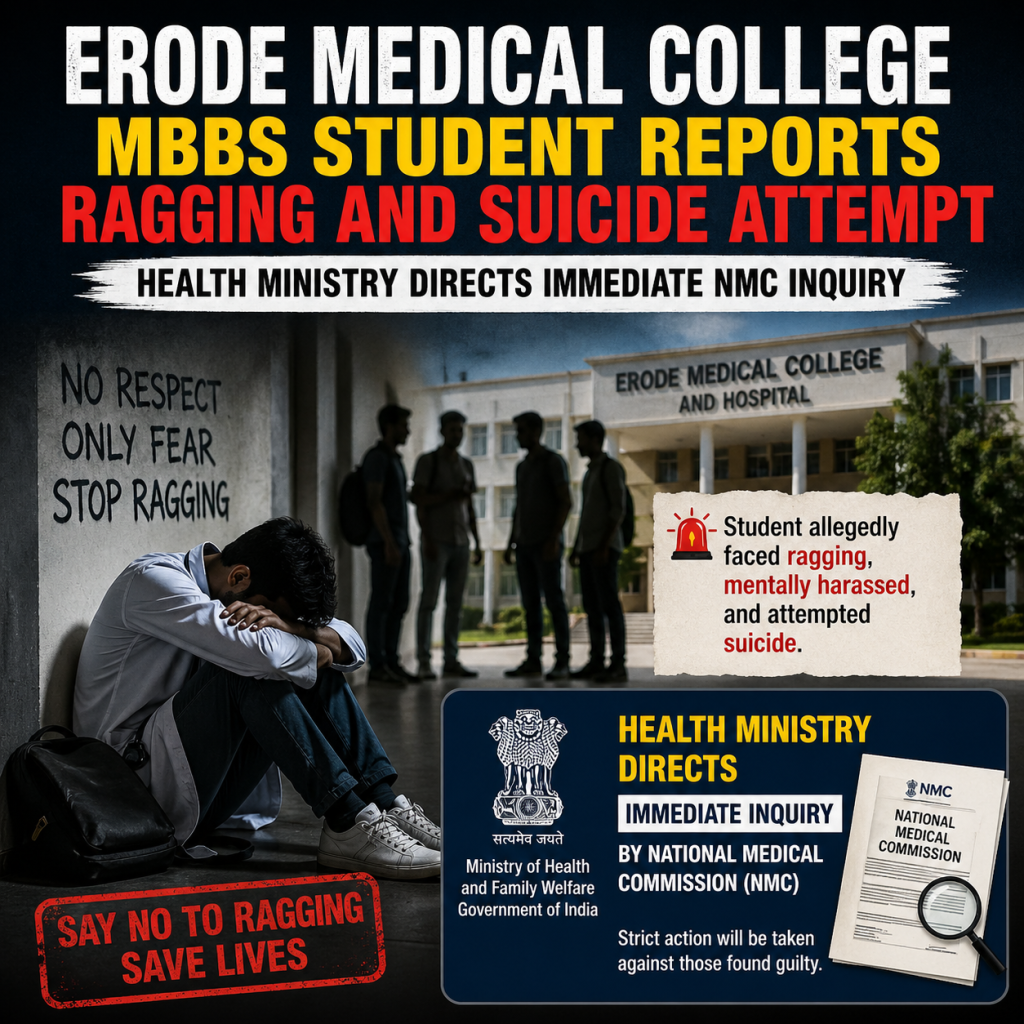
It started as another routine morning for many first year MBBS students across Tamil Nadu but for one young doctor in training at Erode Medical College, pressure of medical school turned into something far darker. According to reports emerging today, student has formally alleged that repeated ragging and targeted harassment left him with no choice but to attempt suicide. Union Health Ministry has now stepped in. It has asked National Medical Commission (NMC) and Tamil Nadu government to conduct a thorough inquiry without delay. This development has once again put the spotlight on ragging a practice that continues to haunt campuses even after decades of strict bans and awareness campaigns.
If you are a parent of an aspiring doctor, a current medical student or simply someone who cares about the future of healthcare in India, this story matters. Let’s unpack what we know, why these incidents keep happening, and most importantly, what can actually be done about it.
What Exactly Happened at Erode Medical College?
Complaint filed by the MBBS student, describes a pattern of ragging that allegedly began shortly after he joined the college. It reportedly included verbal abuse, forced participation in humiliating activities, social isolation and threats whenever he tried to resist or seek help. Over time, constant mental strain became unbearable, culminating in a suicide attempt. College authorities have not yet issued a detailed public statement but the health ministry’s swift intervention shows the seriousness with which the matter is being treated. Senior officials have made it clear that no stone will be left unturned. NMC which regulates medical education across the country has been asked to examine whether the college’s anti ragging mechanisms were functioning properly. This is not the first time a medical college in India has faced such accusations. What makes this case stand out is the direct involvement of the central health ministry at such an early stage.
Why Ragging Still Exists in Medical Colleges
Ragging is often misunderstood as harmless “freshers’ fun.” In reality, it is a form of power abuse that uses fear, humiliation and control. In high pressure environments like medical colleges, problem becomes worse for several reasons:
- Students live together in hostels for years with little privacy.
- A strict hierarchy exists between seniors and juniors, sometimes encouraged by the academic system itself.
- Long study hours, exams, and clinical postings already create extreme stress. Ragging adds another layer of trauma.
- Many students come from smaller towns and feel too intimidated to speak up against seniors who may be their future colleagues or teachers.
Medical students often describe ragging as starting small being asked to introduce themselves in silly ways or run errands and slowly escalating into verbal taunts about appearance, caste, language or family background. When complaints are ignored or victims are labelled “weak” cycle continues.
Health Ministry’s Response and What It Means
Ministry’s directive to the NMC and state government carries real weight. Under existing rules, every medical college must have an active anti ragging committee, a 24 hour helpline and clear punishment protocols. If the inquiry finds lapses, college could face penalties ranging from fines to loss of seats or even temporary derecognition. Past cases have shown that when central authorities step in early, investigations move faster and protective measures for the victim improve. Student in this case is reportedly receiving medical and psychological support. Authorities have also assured that his identity and safety will be protected during the probe.
Real Impact on Future Doctors
Medical education is already one of the toughest journeys a young person can take. Adding ragging on top of it can have lifelong consequences. Studies and counselling records from across India show that students who face severe ragging often suffer from anxiety, depression, sleep disorders, and loss of confidence. Some drop out. Others carry the trauma into their professional lives, affecting how they later treat patients.
A doctor who has been humiliated repeatedly may find it harder to stand up for patients or speak confidently in operating theatres. In that sense, unchecked ragging does not just harm one student it weakens the entire healthcare system.
How to Spot Ragging Before It Escalates
Many students and parents miss the early warning signs because they sound “normal” at first. Here are some red flags to watch for:
- Seniors demanding that juniors perform tasks unrelated to studies (cleaning rooms, buying food at odd hours, singing or dancing publicly).
- Constant mocking of a student’s accent, clothes, height, or family background.
- Threats like “If you complain, your life in this college will be hell.”
- Sudden isolation batchmates stop talking to the targeted student after seniors warn them.
- Repeated “orientation” sessions that feel more like interrogations than welcome events.
If any of these sound familiar, it is time to act even if the victim says “it’s okay, I can handle it.”
Practical Steps Students and Parents Can Take Today
For students facing trouble:
- Document everything. Keep screenshots of messages, note dates and times of incidents and save any witness names (even if you do not want to name them yet).
- Call the National Anti Ragging Helpline immediately: 1800-180-5522. It is toll free and confidential.
- Approach your college’s anti-ragging committee or the faculty member designated as counsellor. You do not need your parents’ permission to file a complaint.
- Reach out to trusted seniors from other batches or medical student associations that run peer-support groups.
- If you feel unsafe in the hostel, request a temporary room change while the matter is investigated.
For parents:
- Talk to your child regularly about hostel life not just academics. Ask open questions like “How are the seniors treating everyone?”
- Keep copies of the anti ragging affidavit that every student must sign.
- Know the contact numbers of the college principal, warden and anti ragging nodal officer.
- If your child shows sudden changes in behaviour (withdrawing, losing appetite, poor sleep), take it seriously and visit the campus if needed.
For colleges and teachers:
Institutions that truly want to stop ragging run regular workshops, install CCTV in common areas and make sure complaints are addressed within 24 hours. They also train seniors on positive leadership instead of letting old “traditions” continue.
What This Case Teaches Us
Every time a student reaches the point of attempting suicide, it is a failure of the system around him or her. Erode case is a reminder that rules on paper mean nothing if they are not enforced with speed and fairness. It also shows that students are increasingly willing to speak up a positive sign that the culture of silence is slowly breaking.
Health ministry’s involvement sends a strong message: the safety of medical students is now a national priority not just a college level issue.
Frequently Asked Questions
What is considered ragging under Indian law?
Any act that causes physical or mental harm, fear or shame to a student including teasing, forcing someone to do something against their will or creating a hostile environment is ragging. It is banned under UGC regulations and state laws.
Can I report ragging anonymously?
Yes, most helplines and many college portals allow anonymous complaints. However, providing some details helps authorities take faster action.
Will complaining affect my studies or career?
By law, colleges cannot take any action against a student who files a genuine complaint. In fact, victimisation of complainants is itself punishable.
How long does an inquiry usually take?
With central ministry involvement, inquiries are expected to be completed within weeks rather than months. Interim safety measures for the student are put in place immediately.
What support is available for mental health?
Most medical colleges now have counselling cells. You can also contact national helplines like iCall (9152987821) or AASRA (9820466726) for immediate emotional support.
Final Word
Young student at Erode Medical College dreamed of wearing a white coat and saving lives. No one should have to risk that dream because of bullying disguised as tradition. This incident is painful but it also gives us a chance to act. If you are a student reading this, know that you are not alone and that speaking up is an act of courage, not weakness. If you are a parent, stay connected and informed. If you work in medical education, use this moment to strengthen the safeguards in your own institution.
Ragging ends when enough people decide it must end. Let this be that moment. Stay safe, stay informed and never hesitate to reach out for help. Future of medicine depends on healthy, confident doctors and that starts with safe campuses today.
Disclaimer
This post is for informational and educational purposes only. It does not constitute medical advice, legal opinion or an official investigation. Readers should consult qualified healthcare professionals for personal health concerns. All details are drawn from media reports and outcomes of any official inquiry may provide further clarity.
Link: According to mews reports from The Hindu
https://www.thehindu.com/news/cities/Coimbatore/mbbs-student-alleges-ragging-administrative-inaction-at-erode-govt-college/article70912146.ece/amp/