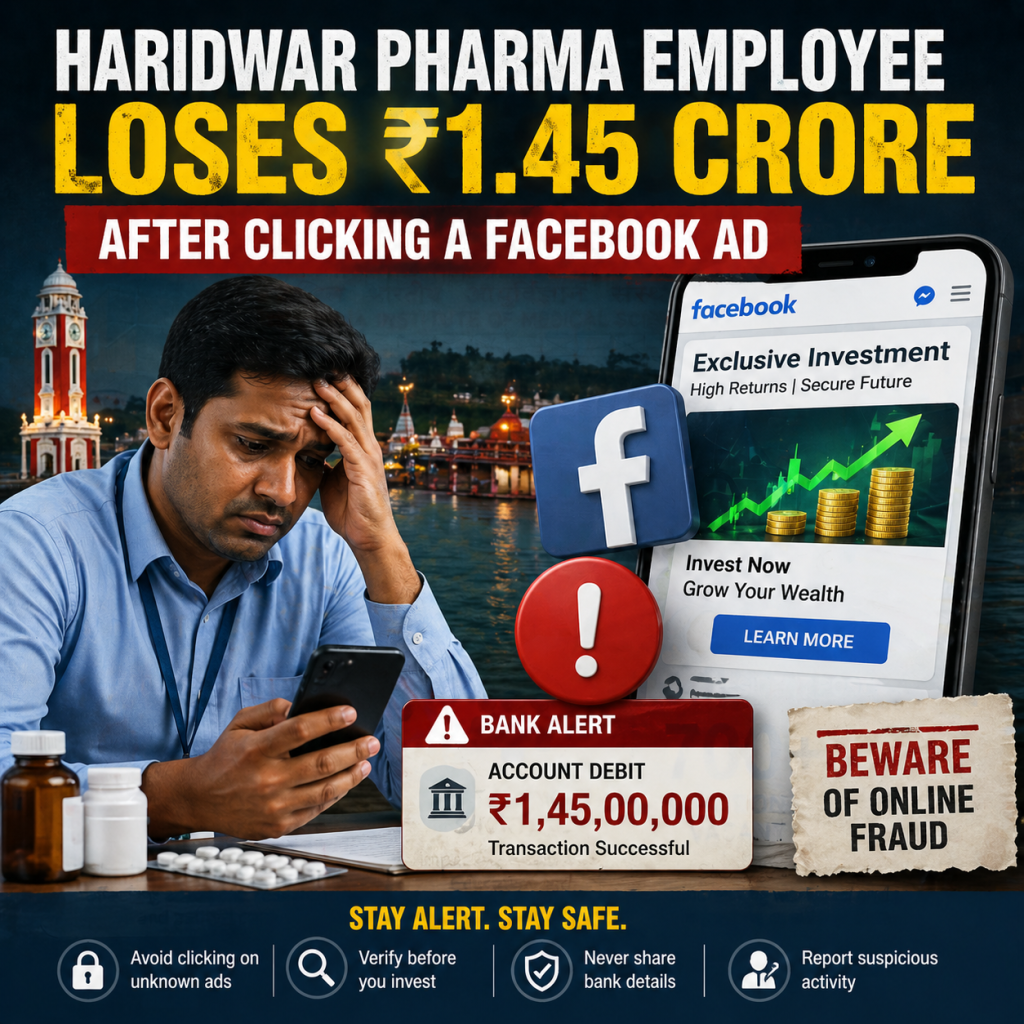
It started with an ordinary scroll on Facebook during a lunch break. By the time the dust settled, a pharmaceutical industry employee from Haridwar had lost his life savings ₹1.45 crore to a carefully crafted online investment scam, case reported to Sidcul Police Station in Uttarakhand and confirmed by local cyber cell officials on 30 April 2026 has sent ripples through professional circles. While the victim’s identity remains protected, the details that have emerged paint a clear picture of how modern fraudsters are targeting working professionals with precision. This isn’t just another scam story. It’s a wake up call about how easily trust can be manufactured online and what you can do to protect yourself and your family.
Incident: From a Single Click to Total Loss
According to the complaint filed by the victim, everything began in January 2026. While browsing Facebook, pharma employee who works at a unit in the Sidcul industrial area came across an advertisement promoting “high return share market opportunities” and “exclusive IPO access.” The ad looked professional. It featured clean graphics, testimonials, and promises of steady monthly gains that sounded realistic enough to spark curiosity. He clicked. Within minutes he was directed to a WhatsApp number, person on the other end introduced himself as a senior investment advisor managing a private group of “serious investors” employee was added to a closed WhatsApp group where members shared screenshots of supposed profits and discussed upcoming “sure shot” opportunities. Soon came the next step: downloading a custom trading application. The app wasn’t available on the official Google Play Store or Apple App Store. It was shared directly via a link. On the surface, it looked sophisticated real time charts, portfolio tracking and daily profit updates that showed small but consistent gains on the initial small investments the victim made.
Encouraged by these early “returns,” he transferred larger amounts over the following weeks and months, fraudsters always had a reason for the next transfer “special allocation,” “IPO subscription window closing soon” or “bonus shares for loyal members.” By the time he tried to withdraw his money in late March or early April, the app stopped working properly “advisors” became unreachable. WhatsApp group went silent. When he finally approached the cyber cell with his bank statements and transaction records, total stood at ₹1.45 crore. Sidcul Police Station registered the case under relevant sections of the Information Technology Act and Indian Penal Code. Investigation is currently underway with police examining digital footprints and bank trails.
How the Scam Actually Worked
Understanding the sequence helps reveal why even educated professionals fall for these traps:
- The Hook (Facebook Ad): Targeted advertising based on the victim’s likely interests (finance, career, middle class aspirations), ad used urgency and social proof.
- Trust Bridge (WhatsApp Group): Moving the conversation to a private platform creates a false sense of community. Seeing other “members” posting profit screenshots makes the opportunity feel legitimate.
- The Tool (Fake App): A professionally designed application that shows fake but believable profits. This psychological trick “small win” lowers natural caution and encourages bigger investments.
- Pressure Phase: Gradual escalation. Victims are nudged to invest more as “windows close” or “limited slots remain.” Emotional manipulation plays a bigger role than technical sophistication here.
- Disappearance: Once the target amount is reached communication stops, app may show errors or frozen balances. Victims are left with no recourse.
This pattern is now well documented across India. What makes this case particularly concerning is how quickly it moved from a casual scroll to life altering financial damage.
Why These Scams Target Professionals And Why They Work
Pharma employees, IT professionals, doctors and mid level managers often have steady incomes and some savings. They are busy, scroll social media for relaxation and may not have deep knowledge of stock market regulations.
Fraudsters exploit three powerful human tendencies:
- Hope for better returns: Everyone wants their money to grow faster than fixed deposits or mutual funds.
- Fear of missing out: The WhatsApp group creates artificial urgency and belonging.
- Trust in technology: A slick app interface feels more credible than a random phone call.
Initial small profits shown on the app are the most dangerous part. They activate the brain’s reward system and make the victim feel smart for “discovering” a good opportunity.
Practical Steps: How to Protect Yourself and Your Loved Ones
You don’t need to stop using social media. You just need better habits. Here’s what actually works:
Before you click any investment related ad:
- Pause for 30 seconds. Ask yourself: “Why is this being advertised to me specifically?”
- Check the advertiser’s page history and reviews. Legitimate financial platforms rarely rely on random Facebook ads.
Before joining any WhatsApp or Telegram investment group:
- Never join groups that promise “guaranteed” or “high fixed” returns. Real markets carry risk.
- Verify the person’s credentials independently not through the group itself.
Before downloading any trading app:
- Only use applications available on the official Google Play Store or Apple App Store.
- Cross check the app developer’s name and reviews on trusted sites.
- Never install apps shared via links or APK files.
Before transferring any money:
- Ask for SEBI registration number of the advisor or firm and verify it on the official SEBI website.
- Use only registered brokers and platforms for actual investments.
- Start with tiny test amounts if you must experiment never your life savings.
General daily habits that reduce risk dramatically:
- Enable two-factor authentication on all banking and investment accounts.
- Regularly review your bank statements for unfamiliar transactions.
- Talk to a family member or trusted friend before making any large or unusual investment decision.
- Bookmark official portals like cybercrime.gov.in for quick reporting.
Real-life scenario to remember:
A software engineer in Bengaluru received a similar Facebook ad in 2025. He almost joined the group but decided to first search the advisor’s name on Google along with the word “scam.” Multiple forum posts appeared warning about the same person. He blocked the number and reported the ad. That five minute search saved him from a potential loss of several lakhs.
Larger Trend and What Authorities Are Saying
Cases involving social media ads leading to investment fraud have increased steadily. Police across states report that many victims are first-time or casual investors who get drawn in by polished digital marketing. Sidcul police officials have confirmed that the investigation into this particular case is active. They are tracing the money trail and the digital identities behind the operation. Victims in similar past cases have sometimes recovered partial amounts when police act quickly and banks freeze accounts in time. The key lesson is speed: the sooner you report suspicious activity, the better the chances of recovery.
What You Should Do Right Now
If you or someone you know has clicked on similar ads or joined investment groups recently:
- Stop all communication with the group or “advisors” immediately.
- Do not make any further transfers even “small test” ones.
- Take screenshots of all conversations, app screens, and transaction records.
- Visit your nearest cyber cell or file a complaint at cybercrime.gov.in.
- Inform your bank immediately so they can monitor for suspicious activity.
Prevention is always easier than recovery.
Frequently Asked Questions
How did the Haridwar pharma employee lose money so quickly?
The scam used a fake app that displayed small, believable profits on early investments. This built false confidence, leading to larger transfers over several weeks until the total reached ₹1.45 crore.
Are all Facebook investment ads fake?
Not every ad is fraudulent, but the vast majority promising unusually high or “guaranteed” returns are. Always verify independently before engaging.
What makes a trading app trustworthy?
It should be available on official app stores, developed by a known registered company, and linked to SEBI registered brokers. Avoid apps shared only through personal links.
How long does it take for police to act on such complaints?
Response time varies but quick reporting with complete documents (bank statements, screenshots, transaction details) improves the chances of freezing accounts and tracing funds.
Can I recover money lost in such scams?
Partial recovery is possible in some cases if reported early and accounts are frozen promptly. Full recovery is difficult once funds are moved through multiple layers.
Final Thought
The ₹1.45 crore loss suffered by this Haridwar pharma employee is more than a statistic, it represents years of hard work, family security and future plans. Yet the same story repeats across India every week in different forms digital world offers incredible opportunities but it also rewards caution. Next time you see an ad promising easy wealth, remember this case. Pause and Verify. Talk to someone you trust. Your future self will thank you.
If this article helped you understand the risks or gave you practical steps to protect yourself, consider sharing it with colleagues, family members or friends who might be scrolling through similar ads right now. One informed person can prevent another heartbreaking loss. Stay safe, stay curious and stay one step ahead.
Disclaimer
This post is for informational and educational purposes only. It does not constitute medical advice, legal opinion or an official investigation. Readers should consult qualified healthcare professionals for personal health concerns. All details are drawn from media reports and outcomes of any official inquiry may provide further clarity.