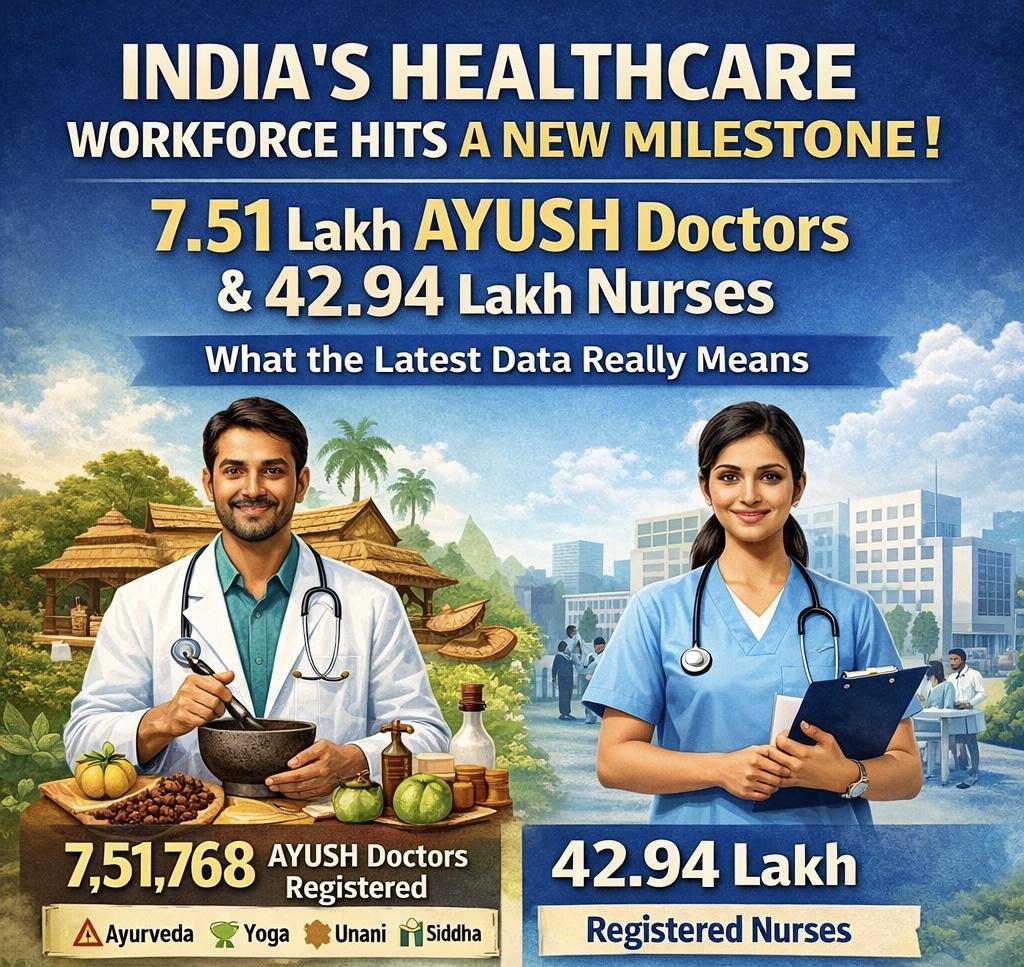
If you’ve been following India’s journey toward universal healthcare, the latest update is truly encouraging. On March 19, 2026, fresh parliamentary data presented by the Union Minister of State for Health and Family Welfare, Shri Prataprao Jadhav, highlighted a significant milestone: India now has 7,51,768 registered AYUSH doctors and 42.94 lakh registered nursing personnel.
These are not just impressive numbers,they reflect a growing, more inclusive healthcare system that blends traditional and modern medicine to serve over 1.4 billion people.
The Bigger Picture: Strengthening India’s Healthcare System
According to the Minister’s written reply in the Rajya Sabha, here’s a comprehensive breakdown:
Doctors in India
•AYUSH Practitioners: 7,51,768 (including Ayurveda, Yoga & Naturopathy, Unani, Siddha, and Homoeopathy)
•Allopathic Doctors: 13,88,185 registered
•Doctor-Population Ratio: Assuming 80% availability, India achieves a ratio of 1 doctor per 811 people, surpassing the World Health Organization (WHO) benchmark of 1:1,000.
Nursing Workforce
•Registered Nursing Personnel: 42.94 lakh (as of March 31, 2025, per the Indian Nursing Council)
•Estimated Active Workforce: Around 34.35 lakh (based on 80% availability)
•Annual Output: Approximately 3.87 lakh new nurses graduate each year from over 5,253 institutions.
Additionally, India has reached 49.45 health workers per 10,000 population, exceeding the WHO threshold of 44.5. This marks a significant step forward in strengthening healthcare delivery across the country.
Why AYUSH Doctors Are More Relevant Than Ever
AYUSH systems are no longer viewed as “alternative” medicine,they are increasingly becoming an integral part of mainstream healthcare.These practitioners play a vital role, especially in rural and underserved areas, by offering preventive and holistic care. Government initiatives such as the National AYUSH Mission and the integration of AYUSH services into primary health centres have improved accessibility and credibility.
Today, patients can benefit from a more integrated approach combining modern diagnostics with traditional therapies like Ayurveda or Homoeopathy. This model promotes both treatment and long-term wellness.
Nursing: The Backbone of Healthcare
Nurses are the foundation of the healthcare system. From intensive care units to vaccination campaigns and home-based care, their role is indispensable.
With 42.94 lakh registered professionals, India is making steady progress in addressing its long-standing shortage of nursing staff. The expansion of infrastructure is also noteworthy, including:
•157 new nursing colleges co-located with medical colleges
•Increased training capacity across the country
The government is also focusing on improving healthcare infrastructure through initiatives like Ayushman Arogya Mandirs, community health centres, and district hospitals. The long-term goal is to achieve one hospital bed per 1,000 population, as per Indian Public Health Standards (IPHS 2022).
What This Means for Citizens
These developments translate into real benefits for the public:
•Shorter waiting times at hospitals and clinics
•Improved access to healthcare in rural and remote areas
•Better preparedness for public health emergencies
•More options for integrated and personalized care
However challenges still remain. These include uneven distribution of healthcare professionals between urban and rural areas, the gap between registered and actively practicing personnel, and the need for continuous training and skill development.
The Road Ahead
India’s investment in healthcare human resources is clearly yielding results. The number of medical colleges has increased from 387 in 2014 to 818 today, along with a substantial rise in MBBS and postgraduate seats.
The latest parliamentary data, building on earlier government reports, indicates that India is not just increasing numbers,it is creating a more balanced and inclusive healthcare ecosystem.
Final Thoughts
Healthcare is the true wealth of a nation, and these milestones offer a reason for optimism. Whether you are a patient seeking affordable care, a student aspiring to join the medical field, or simply someone concerned about the country’s future, this growing workforce is working for all of us.
The question remains:
Is India closing its healthcare gap or is there still a long way to go?
Sources: Health Ministry Parliamentary Reply (March 2026), Medical Dialogues, and official PIB updates.