NEET PG 2025 saw drastic cut off reduction leading to PG seats being allotted at negative and single/double digit marks out of 800 across India. The trend has sparked a nationwide debate on merit, reservation policy, falling standards in medical colleges, and the future quality of specialist doctors in India’s healthcare system.
NEET PG 2025: When Vacant Seats, Reservation Debate, and Falling Cut Offs Collided
NEET PG 2025 has become one of the most controversial postgraduate admission cycles in India’s medical history. With qualifying percentiles drastically reduced and seats allotted at extremely low and even negative marks, the counselling outcome has triggered nationwide debate. Doctors, faculty, and students are now questioning not just the examination system but also deeper issues involving merit, reservation, falling academic standards, and long term patient safety.
This year’s counselling data has exposed structural cracks in India’s postgraduate medical education system that can no longer be ignored.
Collapse of Traditional Cut Offs
For the 2025 academic session, qualifying percentiles were sharply reduced across all categories to ensure that postgraduate seats did not remain vacant after multiple counselling rounds. The General and EWS qualifying percentile dropped from the traditional 50th percentile to around the 7th percentile. The General PwD percentile fell to nearly the 5th percentile, while for SC, ST, and OBC categories the qualifying percentile was effectively reduced to zero.
As a result, the minimum qualifying marks dropped dramatically. Candidates with extremely low scores became eligible for counselling, and the entry barrier that once filtered postgraduate aspirants weakened significantly.
When Round 3 Results Were Declared
The third round seat allotment results of NEET PG 2025 counselling were officially declared on 3 February 2026 by the Medical Counselling Committee. The provisional result was released on February 3, followed by a revised and final allotment shortly after to address discrepancies and updates in the seat matrix. This round became the most controversial phase of counselling, as the impact of drastically reduced qualifying percentiles became visible for the first time, with candidates securing postgraduate seats at extremely low and even negative marks across several branches and colleges.
Seats Allotted at Negative and Single/Double Digit Marks
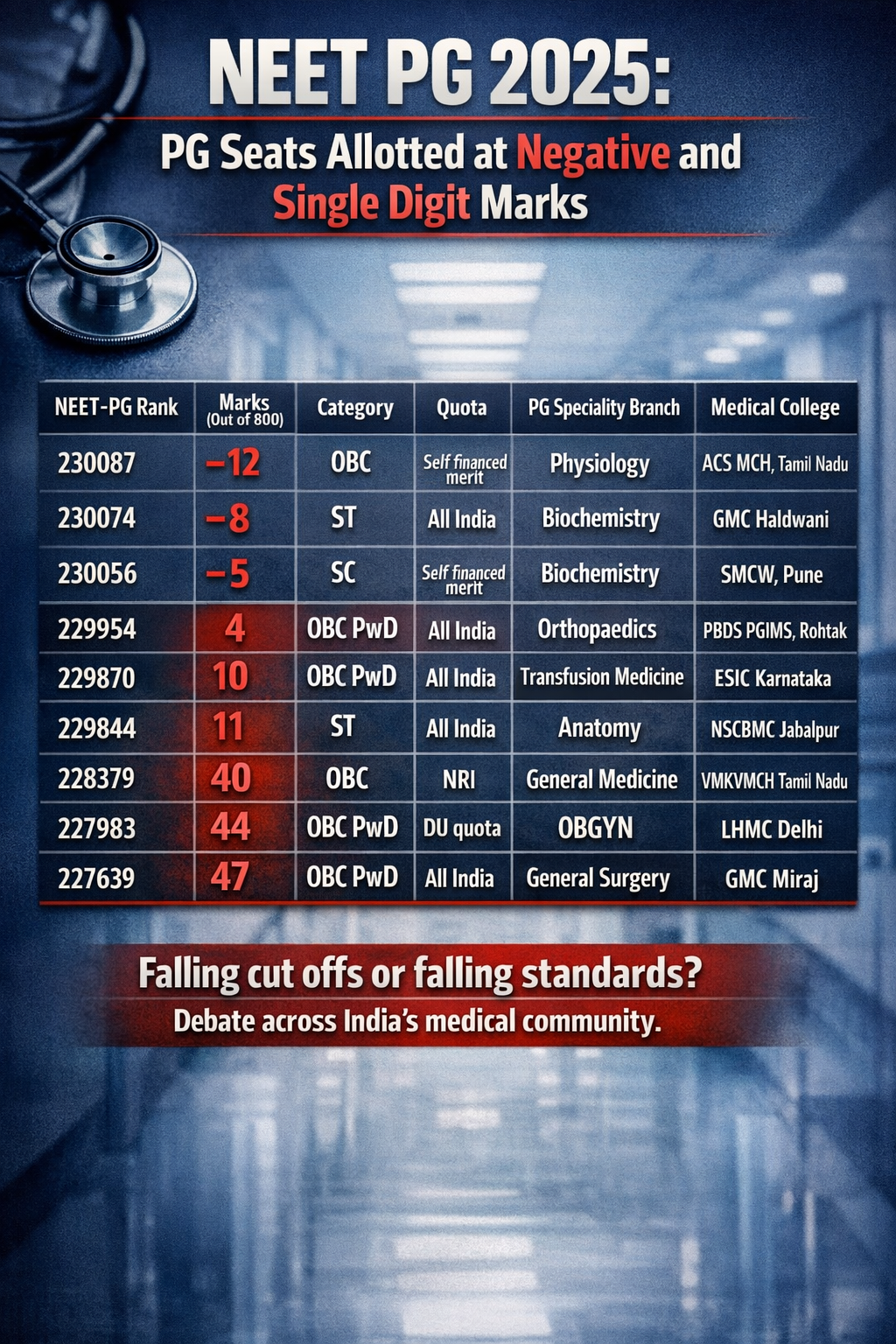
Actual counselling data shows that postgraduate seats across India were filled at shockingly low marks. A candidate with minus 12 marks secured a Physiology seat under self financed merit. Biochemistry seats in government and private colleges were allotted at minus 8 and minus 5 marks.
In clinical branches, the situation was equally striking. An MS Orthopaedics seat in a government medical college was allotted at just 4 marks. Transfusion Medicine was allotted at 10 marks and Anatomy at 11 marks. Major clinical specialties were also affected. General Medicine seats were allotted around 40 marks, while Obstetrics and Gynaecology and General Surgery seats were secured at 44 and 47 marks respectively in well known institutions.
These figures would have been unimaginable a few years ago. The fact that such scores now secure postgraduate medical seats indicates a major shift in competition and selection standards.
Why Did This Happen
The primary reason is the rapid expansion of postgraduate medical seats in India over the last decade without proportional alignment to demand, infrastructure, or workforce planning. While seat numbers have increased significantly, student preferences remain concentrated in a few high demand branches and premier institutes. Many other specialties and colleges continue to face vacancies even after several rounds of counselling.
At the same time, a growing number of Indian medical graduates are exploring foreign licensing pathways such as USMLE, PLAB, and AMC. This has further reduced competition for certain domestic PG seats. To prevent large numbers of seats from remaining vacant, authorities lowered qualifying percentiles drastically, allowing more candidates to enter the counselling pool.
Falling Competition and Academic Standards
The concern now extends beyond just filling seats. Entry level competition for many postgraduate programs has fallen sharply. When candidates enter postgraduate training with extremely low theoretical preparation, teaching departments are forced to compensate for this gap.
Many government medical colleges already face faculty shortages, high patient load, and limited academic supervision. In such settings, maintaining uniform specialist training standards becomes difficult. Over time, this risks gradual erosion of academic culture, clinical competence, and confidence in the training system.
Merit Versus Reservation Debate Reignites
The current situation has also reignited the long standing debate around merit and reservation in postgraduate medical education. Reservation was introduced to ensure social justice and representation for historically disadvantaged communities. At the undergraduate level, it has significantly improved diversity within the medical profession.
However, postgraduate medical training involves advanced clinical responsibility and direct impact on patient outcomes. Many doctors now question whether the same structure should continue unchanged at the PG level, especially when combined with drastically reduced qualifying cut offs.
Some argue that postgraduate admissions should prioritise competence and merit more strongly, as all candidates at this stage already hold an MBBS degree and license to practice. Others maintain that representation in specialist fields remains important and that removing reservation at the PG level could reverse gains in diversity.
The debate is no longer about whether reservation should exist, but about how to balance equity with competence in highly specialised medical training.
Workforce Planning Failure at the Core
Beyond merit and reservation, NEET PG 2025 highlights a deeper workforce planning failure. India now produces a large number of postgraduate seats without clear alignment to healthcare needs, infrastructure capacity, or student interest.
While competition remains intense for a few elite branches and colleges, many specialties struggle to attract candidates. Lowering cut offs has become an administrative tool to fill seats rather than a solution to systemic imbalance. This approach ensures occupancy but does not necessarily strengthen the healthcare system.
Risks to Training Quality and Patient Safety
Medical education directly affects patient care. Specialists trained today will be responsible for complex surgeries, critical decisions, and management of life threatening conditions tomorrow. If entry standards decline without simultaneous strengthening of training and exit evaluation, the long term consequences may affect patient safety and public trust.
The issue is not about individual candidates but about systemic standards. A healthcare system must ensure that every specialist graduating from its institutions meets a minimum level of competence and confidence.
The Need for Structural Reforms
The NEET PG 2025 situation should serve as a wake up call rather than a temporary controversy. Policymakers must evaluate whether qualifying cut offs should have a reasonable minimum floor, whether the current reservation structure in postgraduate education requires review, and how training quality can be strengthened across institutions.
Uniform national exit examinations, stricter accreditation of medical colleges, better faculty strength, and realistic workforce planning are essential. Inclusion and representation must coexist with strong academic and clinical competence.
Conclusion
NEET PG 2025 has exposed uncomfortable realities about falling competition, declining cut offs, and structural imbalances in India’s postgraduate medical education system. The allocation of seats at extremely low and negative marks reflects deeper issues involving merit, reservation policy, seat expansion, and workforce planning.
India must now confront a critical question. How can the system ensure both social justice and high standards in specialist medical training. The answer will shape not only the future of medical education but also the quality of healthcare delivered to millions of patients in the years ahead.
The National Testing Agency has officially announced the new date for the NEET UG 2026 re examination after cancelling the earlier exam due to the alleged paper leak controversy. The re exam will now be conducted on June 21, 2026, affecting more than 22 lakh medical aspirants across India.
PMOS, previously known as PCOS, is a newly renamed condition that better reflects its hormonal and metabolic effects beyond the ovaries. The change from Polycystic Ovary Syndrome to Polyendocrine Metabolic Ovarian Syndrome highlights its association with insulin resistance, obesity, fertility issues, and long term health risks affecting millions of women worldwide.
A doctor in Bhilwara allegedly attempted suicide by consuming phenyl after accusing a private hospital operator of financial exploitation, unpaid salary, mental harassment, and police inaction. The incident has sparked concern over workplace conditions and disputes in the medical profession.