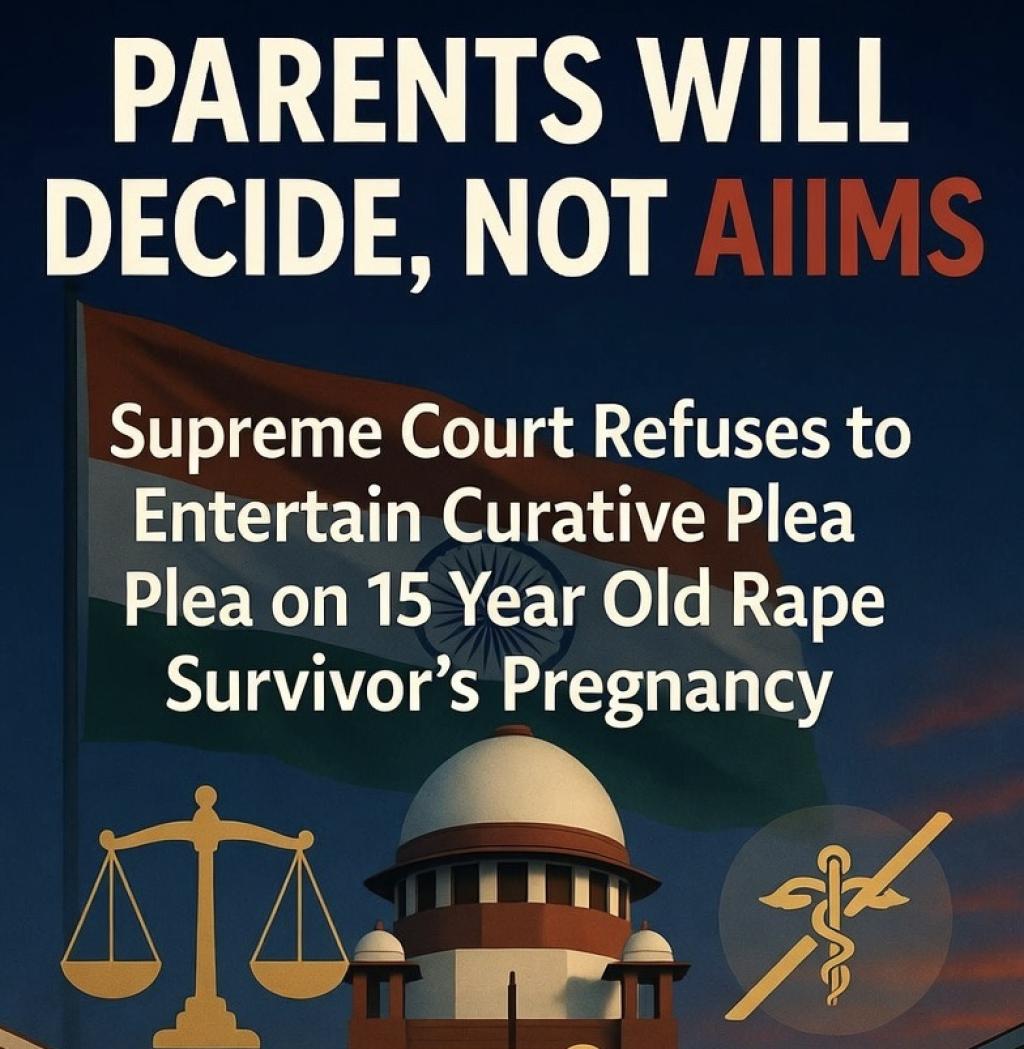
Supreme Court of India delivered a clear message today: medical institutions like AIIMS cannot override the choices of a minor and her family in sensitive pregnancy matters. In a brief but firm hearing, a bench led by Chief Justice Surya Kant and Justice Joymalya Bagchi declined to hear a curative petition filed by AIIMS, hospital had sought to revisit an earlier order that permitted termination of a 30 week pregnancy of a 15 year old girl who became pregnant after rape.
This decision does not create brand new law overnight. Instead it reinforces an important principle that has been evolving through Indian courts for years, person directly affected along with her family, should have the final say after receiving complete and honest medical information. Court stressed that AIIMS’s role is to enable informed choice not to impose its institutional view.
Case Background
A 15 year old girl from Delhi discovered she was pregnant following a sexual assault. By the time the pregnancy came to light and the family approached the courts, it had reached approximately 30 weeks well into the third trimester, family after considering medical advice and the girl’s mental state, requested termination.
On April 24, 2026 a two judge bench of Justices B.V. Nagarathna and Ujjal Bhuyan examined the matter and directed AIIMS to carry out the procedure, subject to necessary medical safeguards. The bench noted that forcing continuation of an unwanted pregnancy in such circumstances would undermine the minor’s constitutional rights, particularly her right to dignity and bodily autonomy under Article 21. AIIMS concerned about the advanced stage of pregnancy, the viability of the foetus and questions of medical ethics, first filed a review petition that was dismissed. The hospital then approached the Supreme Court through a curative petition, a rare legal remedy used only when all other avenues have been exhausted and a grave injustice is claimed.
What Unfolded in Today’s Hearing
During the short hearing on April 30, bench made its position unambiguous. It refused to entertain the curative petition. Chief Justice Kant and Justice Bagchi observed that the hospital could and should provide full medical reports, explain risks and outcomes clearly, and offer counselling but ultimate decision rests with the girl and her parents. In plain terms, Court said institutions cannot “choose for the citizens.” family must be given complete information so they can decide what is best for their situation, bench also noted the lifelong trauma a child rape survivor carries and observed that unwanted pregnancies should not be forced upon anyone especially a minor.
Court further suggested that the Central Government consider amending Medical Termination of Pregnancy (MTP) Act to remove strict gestational limits in cases involving rape survivors. The reasoning was practical: many such pregnancies are discovered late because victims are often afraid or unable to disclose the assault immediately. By the time legal and medical processes begin pregnancy may already be advanced.
Why the Distinction Between “Hospital Advises” and “Hospital Decides” Matters
Hospitals and doctors bring essential medical expertise. They can explain foetal development, potential health risks to the mother, neonatal care possibilities and long term outcomes. That information is crucial. However, final call on continuing or ending a pregnancy especially one resulting from trauma involves deeply personal, emotional and ethical considerations that no institution can fully stand in for.
Today’s ruling draws a bright line: AIIMS can present the medical picture in detail but it cannot substitute its judgment for that of the minor and her family. This protects both the patient’s autonomy and the doctor patient relationship. It also prevents hospitals from becoming unwilling arbiters in complex moral questions. For context, Indian law already recognises special categories under the MTP Act (amended in 2021). Termination up to 24 weeks is permitted in cases of rape, minors, or when the woman’s physical or mental health is at serious risk. Beyond that limit, courts have historically stepped in on a case by case basis. Today’s observations push for a more responsive legal framework that accounts for the realities of trauma and delayed reporting.
Practical Implications for Families Facing Similar Situations
Cases like this are rare but heartbreaking. When a minor becomes pregnant after assault, families often face multiple pressures at once: fear of social stigma, concerns about the girl’s physical and mental health, financial strain and uncertainty about legal processes.
A typical real life scenario might look like this: A family in a small town learns their 14 or 15 year old daughter is pregnant after an assault that occurred months earlier. They hesitate to approach authorities because of shame and fear of community backlash. By the time they reach a hospital or lawyer, the pregnancy is already 26–30 weeks. Medical boards may give conflicting opinions, family feels trapped between legal limits, medical advice, and their daughter’s visible distress. Today’s Supreme Court ruling offers clarity in such moments. It tells families and hospitals alike that the law prioritises informed consent by those most affected. It also signals that courts will not automatically side with institutional reluctance when the minor’s well being is at stake.
Practical Steps for Families Navigating Difficult Pregnancy Decisions
If you or someone you know is in a comparable situation consider these general steps (always consult qualified professionals for your specific case):
- Seek immediate medical evaluation at a government hospital or recognised medical facility. Request a detailed medical board opinion that includes both physical and mental health assessments.
- Contact legal aid early. Many states have free legal services authorities and NGOs that specialise in sexual violence cases. They can guide you through filing petitions under the Protection of Children from Sexual Offences (POCSO) Act and MTP framework.
- Prioritise psychological support. Rape trauma often manifests as depression, anxiety or self harm risk. Counselling for both survivor and family members helps everyone process the situation more clearly.
- Document everything. Keep records of medical reports, counselling sessions, and communications with authorities. These become important if court intervention is needed.
- Know your rights. A minor cannot be forced to continue a pregnancy against her will when it results from assault. Courts have repeatedly upheld this principle.
Helplines such as Childline (1098) and women’s helplines can provide initial guidance and referrals. Local legal aid cells attached to district courts are another accessible starting point.
Frequently Asked Questions
What exactly is a curative petition?
It is an extraordinary remedy available only after review petitions are dismissed. It is not a routine appeal but a last-resort request claiming that the earlier order caused grave injustice.
Can minors legally access abortion services in India?
Yes, MTP Act permits termination for minors in cases of rape or when continuation poses risk to physical or mental health. Court permission may be required for advanced pregnancies.
Does this ruling change the law for all women?
No, it applies to the specific facts of this case and reinforces existing principles of autonomy. However, Court’s suggestion to amend the law for rape survivors could influence future policy.
What if doctors refuse to perform the procedure?
Hospitals must follow court orders. Non compliance can lead to contempt proceedings as Court indicated in related observations today.
Where can survivors and families find confidential support?
Government hospitals, legal aid authorities, NGOs working on sexual violence and helplines like 1098 (Childline) or state women’s helplines are good starting points.
A Final Reflection
Today’s Supreme Court decision does not resolve every difficult question surrounding late-term pregnancies or reproductive choices. What it does do is reaffirm a core idea: in matters of profound personal trauma, the people living through the experience guided by complete medical information deserve the space to decide their path forward.
For families, victims, doctors and policymakers alike ruling is a reminder that laws work best when they remain responsive to human realities. Trauma does not follow neat timelines. Dignity and informed consent are not abstract ideals; they shape real outcomes in real lives. If this article has helped clarify legal and human dimensions of the case consider sharing it with someone who might benefit from understanding their rights and if you or a loved one are facing a challenging situation reaching out to a trusted medical professional or legal aid service is often the most important first step. Knowledge and timely support can make an enormous difference when every choice feels heavy.
Stay informed. Stay compassionate. law continues to evolve but the need for clear, respectful processes remains constant.
Disclaimer
This post is for informational and educational purposes only. It does not constitute medical advice, legal opinion or an official investigation. Readers should consult qualified healthcare professionals for personal health concerns. All details are drawn from media reports and outcomes of any official inquiry may provide further clarity.
Link: According to news report from The Indian Express
https://indianexpress.com/article/legal-news/supreme-court-aiims-30-week-abortion-minor-case-10663833/lite/