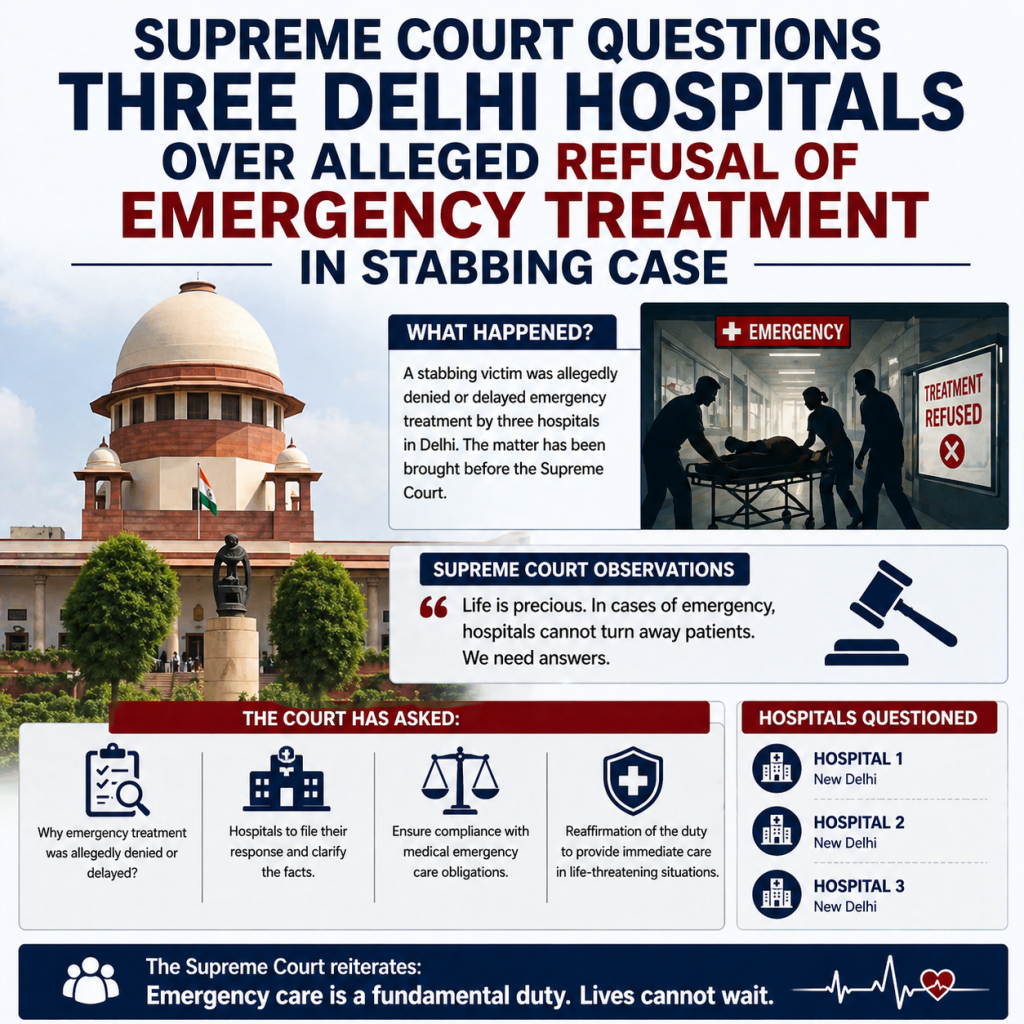
On the morning of April 28, 2026 Supreme Court of India did something it rarely does without a formal petition: it stepped in on its own to ask a direct, uncomfortable question.
“Why was emergency treatment not provided?”
Case involves a woman advocate who was allegedly attacked and stabbed multiple times by her husband in Delhi. She arrived at three different hospitals in a critical state. According to the court record, all three facilities reportedly declined to admit or stabilise her, citing the seriousness of her injuries. She was eventually taken to AIIMS, where she received immediate care. Her condition is now described as stable. Her husband has been arrested and is in judicial custody.
This single incident has sparked a larger conversation about what hospitals both government and private are actually required to do when someone walks (or is carried) through their doors in a life threatening emergency.
What Exactly Happened: A Clear Timeline
Late on April 25 or early April 26, 2026 woman advocate was allegedly assaulted at her residence. She sustained multiple stab wounds to vital areas of her body. Family members rushed her to the nearest medical facilities.
According to the Supreme Court’s observations:
- Kailash Hospital
- Guru Teg Bahadur (GTB) Hospital
- RK Hospital
…all reportedly refused to provide emergency treatment or admission.
The patient was later shifted to AIIMS in the early hours of the morning. Doctors there stabilised her, and she was later moved to a private facility for further care. An FIR was registered, and the accused husband was taken into custody the same night.
Supreme Court led by Chief Justice Surya Kant and Justice Joymalya Bagchi took suo motu cognizance meaning the court itself initiated proceedings without waiting for a formal petition. Bench expressed concern that emergency care which should be immediate and non negotiable appeared to have been withheld.
Why the Supreme Court’s Question Matters So Much
In India, right to emergency medical treatment is not a favour it is a fundamental right protected under Article 21 of the Constitution (Right to Life). Over the years, Supreme Court has repeatedly clarified that hospitals cannot refuse to stabilise a patient in an emergency simply because the case is “too serious,” “the patient cannot pay immediately” or “beds are full.”
The 1996 judgment in Paschim Banga Khet Mazdoor Samity vs State of West Bengalremains the landmark ruling on this issue, court had then held that the state has a constitutional obligation to provide emergency medical care. That principle still stands today. In this latest case, bench did not stop at expressing concern. It directed the investigating officer to examine the circumstances thoroughly and submit a detailed report. This is not just about one incident it is about setting a precedent that hospitals cannot pick and choose whom they treat when life is at stake.
Three Hospitals: What We Know So Far
All three facilities named in the proceedings are well known in Delhi:
- Kailash Hospital(a private multi-specialty hospital)
- Guru Teg Bahadur Hospital(a major government hospital under the Delhi government)
- RK Hospital(another private facility)
Court did not accuse any hospital of wrongdoing in its initial order. It simply asked for an explanation: why was emergency treatment not provided when patient was in a critical condition? The hospitals will now have the opportunity to present their side during the investigation.This balanced approach is important. It prevents knee jerk conclusions while still holding institutions accountable.
What the Law Actually Says About Emergency Care
Many people assume that only government hospitals are obligated to treat emergencies. That is not entirely correct. Under Indian law and Supreme Court precedents:
- Every hospital government or private has a duty to provide immediate stabilisationin life threatening situations.
- Refusal can amount to a violation of the patient’s fundamental right to life.
- Hospitals can later transfer the patient once stabilised, but they cannot turn the patient away at the door.
- In cases where payment is an issue, treatment must still begin; billing can be sorted out afterwards.
Real life example: In 2018, similar incident in Uttar Pradesh involving a road accident victim led to the hospital being pulled up by National Human Rights Commission, victim later received compensation and hospital faced strict directions.
Another scenario many families face: A child with high fever and breathing difficulty arrives at a private hospital at 2 a.m. hospital says “we don’t have a paediatrician on duty right now.” According to court rulings, hospital must still provide initial assessment and stabilisation before referring the child elsewhere.
Practical Steps: What Should You Do If a Hospital Refuses Emergency Treatment?
This is where this story becomes useful for ordinary readers. Here’s a clear, actionable guide:
- Stay calm but assertive
Politely but firmly state that this is an emergency and request immediate assessment. Ask to speak with the duty doctor or the medical superintendent. - Document everything
Note the exact time, the name of the staff member who refused, and the reason given. If possible, record a short video (many people now do this legally in public spaces). Written refusal on hospital letterhead is even better. - Call for help immediately
Dial 108 (national ambulance emergency number) or 102. Inform them that a hospital has refused treatment. Police can also be called (dial 100) refusal of emergency care is a cognizable issue in many states. - Ask for a referral in writing
If the hospital insists on transferring, demand a written referral mentioning the patient’s condition and the reason for transfer. This creates a paper trail. - Escalate quickly
- Contact the hospital’s grievance cell or medical superintendent.
- File a complaint with the District Consumer Disputes Redressal Commission (consumer court) emergency refusal cases are often heard on priority.
- In extreme cases approach High Court or file a complaint with the State Medical Council.
Pro tip:Keep a small emergency card in your wallet or phone with your blood group, allergies and emergency contacts. In chaotic situations, this small piece of paper can save precious minutes.
How This Case Fits Into a Larger Pattern
This is not an isolated incident. Over the past few years, courts across India have dealt with multiple cases of hospitals allegedly refusing emergency care whether for accident victims, pregnant women in labour or patients with cardiac emergencies. Each time, the judiciary has reinforced the same message: life comes first.
Current Supreme Court proceedings add fresh weight to that message. By taking suo motu notice, the court has signalled that it will not wait for someone else to bring such matters to its attention.
What Patients and Families Can Learn From This
Awareness is the first line of defence. Most people do not know their rights until they are in the middle of a crisis. Here are three simple habits that can help:
- Know the nearest 24×7 emergency facilitiesin your area both government and private.
- Understand that “we are full” is not always a valid reasonfor outright refusal in a genuine emergency.
- Build a small support networka neighbour, relative or friend who can accompany you and help with documentation if needed.
FAQ: Your Questions Answered
Q1: What does “suo motu cognizance” mean?
It means the Supreme Court or High Court has taken up a matter on its own without any formal petition being filed. The court acts because it believes the issue is serious enough to warrant immediate attention.
Q2: Can a private hospital legally refuse emergency treatment?
No, while private hospitals can have their own admission policies for non-emergency cases, they cannot refuse to stabilise a patient whose life is in immediate danger. Doing so can invite legal action.
Q3: What if the hospital says they don’t have the required specialist?
They must still provide initial life saving measures (airway management, bleeding control, oxygen, IV fluids etc.) and arrange an urgent transfer with proper documentation.
Q4: How long does it usually take for such complaints to be resolved?
Consumer court cases involving emergency refusal are often fast tracked and can see interim orders within weeks. Full resolution may take a few months depending on evidence.
Q5: Is there any compensation possible for the patient or family?
Yes, courts have in the past awarded compensation when hospitals were found to have violated the right to emergency care. The amount depends on the facts of each case.
Final Thoughts: Why This Story Deserves Your Attention
Supreme Court’s question “Why was emergency treatment not provided?” is not just about one woman advocate or three hospitals in Delhi. It is about every person who might one day need urgent medical help at an odd hour, in an unfamiliar city or when money is tight.
Healthcare in India has made remarkable progress, yet gaps remain. Cases like this remind us that the system works best when institutions are held accountable and when citizens know their rights. If you ever find yourself or a loved one in a similar situation, remember: you have the right to ask for immediate care. Document calmly, escalate quickly, and know that the law stands with the patient in genuine emergencies.
Stay informed, Stay prepared and if this article helped you understand your rights a little better consider sharing it with family or friends. One informed citizen can make a real difference when it matters most.
Disclaimer
This post is for informational and educational purposes only. It does not constitute medical advice, legal opinion or an official investigation. Readers should consult qualified healthcare professionals for personal health concerns. All details are drawn from media reports and outcomes of any official inquiry may provide further clarity.
Link: According to new report from NDTV
https://www.ndtv.com/india-news/supreme-court-orders-probe-into-3-delhi-hospitals-denying-treatment-to-stabbed-advocate-11414532/amp/1