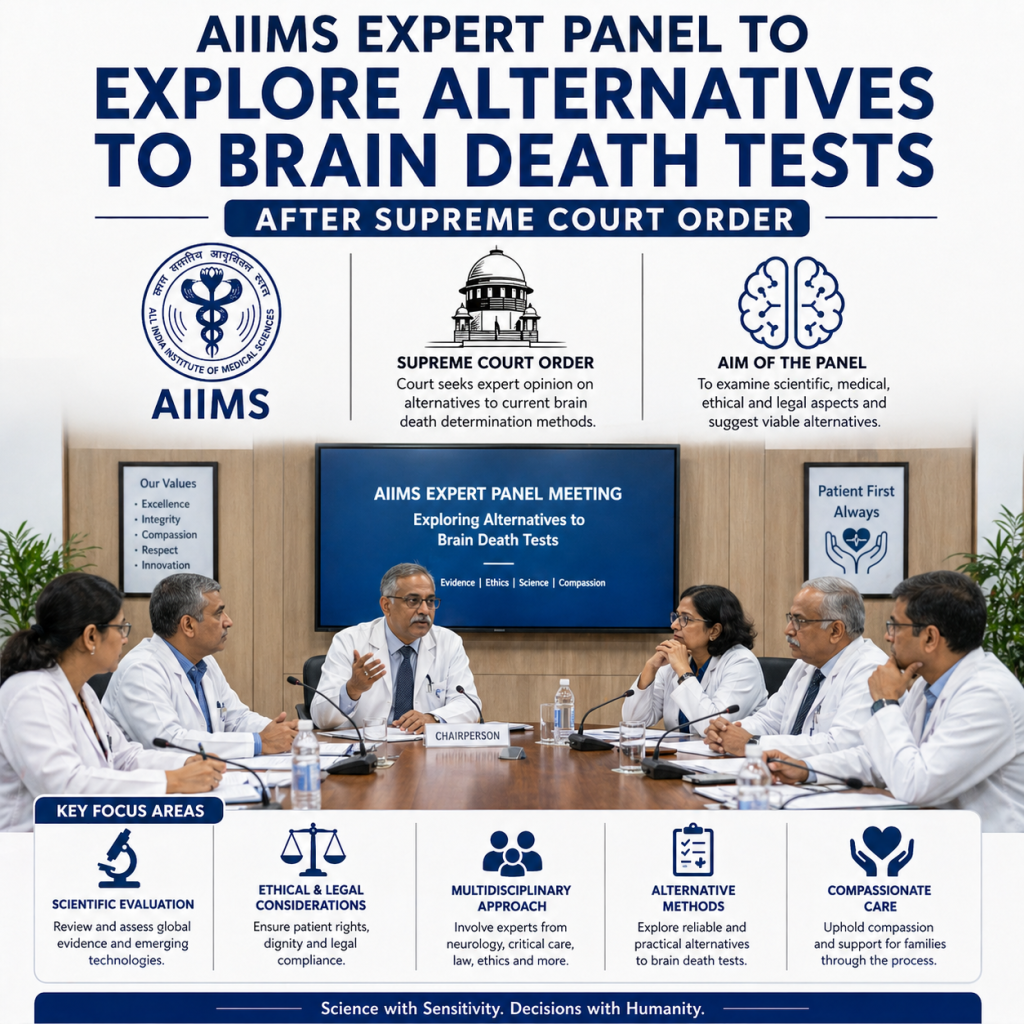
On 28 April 2026, Supreme Court of India took a significant step that could reshape how doctors and families handle some of most difficult moments in healthcare. Court has asked the All India Institute of Medical Sciences (AIIMS) in New Delhi to set up a panel of experts. Their job? To carefully study and suggest better ways to confirm when a person’s brain has stopped functioning permanently what we currently call “brain death.”
This is not a sudden decision. It comes after years of quiet conversations in hospitals, courtrooms and homes across India. For many families, moment a doctor says “brain death” feels confusing, painful and final. Court’s move shows it wants clearer, more acceptable methods that respect both medical science and human emotions.
Let’s understand what this actually means in plain language and why it could matter to you or someone you love.
What Exactly Is Brain Death?
Brain death is a legal and medical way of saying a person has died, even if their heart is still beating with the help of machines. It happens when the brain including the brainstem that controls breathing and basic reflexes has stopped working completely and will never recover.
Unlike a coma where a person might still have some brain activity and could possibly wake up brain death means there is no chance of recovery. Doctors confirm it through a series of tests: checking for reflexes doing an apnea test (to see if the person can breathe on their own) and sometimes using scans.
In India, this declaration is governed by the Transplantation of Human Organs and Tissues Act. Two senior doctors not involved in the patient’s care, must agree. Only then can life support be withdrawn or organs be considered for donation. Many people still mix it up with being “brain dead” in movies or with deep comas. That confusion often leads to heartbreak in real hospital corridors.
Why Is the Supreme Court Asking for Alternatives Now?
Court’s directive to AIIMS is simple but powerful: look at whether we can find more reliable, less controversial ways to confirm permanent loss of brain function. Several reasons sit behind this. Families sometimes struggle to accept the current tests, especially when a loved one looks peaceful on a ventilator. Cultural and religious beliefs play a big role for some idea of stopping the heart feels more “natural” than stopping the brain. There are also cases where slight variations in how tests are done across hospitals create doubt.
Medical technology has advanced too. Newer brain scans, blood flow studies and monitoring tools exist that weren’t widely available when the original guidelines were written decades ago, expert committee will examine whether these can be safely added or used instead of older methods. This is not about making organ donation harder or easier. It is about building trust. When families feel the process is fair and transparent, they are more likely to make informed choices whether that means continuing support or agreeing to donation.
How an Expert Committee at AIIMS Could Help
AIIMS is India’s premier medical institute. The committee will likely include neurologists, critical care specialists, ethicists, legal experts and perhaps representatives from patient groups. Their task is not to rush changes but to study evidence from India and other countries, talk to doctors on the ground and suggest practical improvements.
Possible areas they might explore:
- Adding advanced imaging like CT angiography or EEG monitoring in more hospitals
- Standardising the exact steps doctors must follow across states
- Creating clearer ways to explain the diagnosis to families in simple Hindi and regional languages
- Looking at how other countries like the UK, USA or Japan handle similar situations
Any recommendations would eventually need approval from the government and medical councils before becoming law. This careful process is what makes the Court’s approach balanced.
Real Life Situations Where This Matters
Imagine a 28 year old man from a small town in Uttar Pradesh who meets with a road accident. He is rushed to a district hospital, then transferred to a bigger centre in Lucknow. After 48 hours on ventilator, doctors say tests show brain death. His parents are devastated. They have never heard the term before. Some relatives suggest “maybe he will wake up if we pray more.” family argues for three days while the body is kept artificially alive. In another case, a young mother in Kerala is declared brain dead after a stroke. Her husband wants to honour her wish (she had once said she wanted to donate organs), but her parents feel the current tests are not enough proof. The disagreement tears the family apart at the worst possible time. These stories are not rare. Every year, thousands of families face similar moments. Clearer guidelines and better communication tools could reduce such pain. They could also increase the number of organs available for transplant currently, India has one of the lowest organ donation rates in the world despite having excellent surgeons.
What This Means for Organ Donation in India
Organ donation saves lives. One brain dead donor can give a new heart, lungs, liver, kidneys and corneas to multiple people waiting on lists that stretch for years. Supreme Court’s move does not stop donations. It actually aims to make the system stronger by increasing public confidence. If families trust the process, more people may register as donors and more families may agree when the moment comes.
Hospitals are already required to counsel families sensitively. The new committee could recommend training programmes for doctors and counsellors so they explain brain death without sounding cold or rushed.
Practical Steps Families Can Take Today
While the expert committee does its work (which may take months), here is what you can do right now:
- Talk openly at home.Sit with your parents, spouse, and adult children. Ask: “If something happens to me and doctors say my brain has stopped working forever, what would you want?” These conversations are uncomfortable but prevent later confusion.
- Consider a living will or advance directive.This is a simple legal document where you state your wishes about life support and organ donation. Many hospitals now accept them. You can get formats from the Ministry of Health website or local lawyers.
- Register as an organ donor.It takes two minutes on the National Organ and Tissue Transplant Organisation (NOTTO) portal. Carry the donor card in your wallet. Tell your family their consent still matters at the time.
- Ask questions in hospital.If a loved one is critical, request clear explanations. Ask for the names of the two doctors who will certify brain death. Request to see the test results explained in your language.
- Know your rights.You can ask for a second opinion or transfer to another hospital if you have doubts. The law allows time for families to process the news.
Common Questions People Ask
What is the difference between brain death and coma?
In a coma, some brain activity may still exist and recovery is sometimes possible. In brain death, all brain function has permanently stopped there is no coming back.
Will this Supreme Court order change organ donation rules immediately?
No, expert committee will study and recommend. Any actual change in law or hospital practice will take time and government approval.
Can families refuse the brain death test?
Doctors must follow legal procedure, but families can ask for more time to understand or seek counselling. Hospitals usually involve social workers or religious advisors when needed.
How long does the brain death certification process take?
It usually involves two sets of tests six hours apart, plus the apnea test, whole process can take 12–24 hours depending on the hospital’s protocol.
What if I want to donate organs but my family disagrees?
In India, family consent is still required even if you have registered as a donor. That is why talking to them in advance is so important.
Looking Ahead with Hope and Clarity
Supreme Court’s request to AIIMS is not just about tests and machines. It is about compassion. It recognises that behind every medical decision stands a family carrying grief, hope, faith, and fear. Medical science moves forward but the human heart needs time and understanding. By asking experts to find better ways to confirm brain death, Court is trying to reduce suffering on both sides for the doctors who must deliver hard news and for the families who must receive it. This development invites all of us to think about our own end of life wishes. It reminds us that planning ahead is an act of love, not fear.
If you have elderly parents or a spouse with health conditions, start that conversation this week. If you believe in organ donation, register today and tell your family why it matters to you and if someone you know is going through a hospital crisis right now, share this information gently it might help them ask the right questions. Change in law takes time but awareness can begin today. Supreme Court has opened a door. It is up to us doctors, families and citizens to walk through it with care honesty and humanity.
Disclaimer
This post is for informational and educational purposes only. It does not constitute medical advice, legal opinion or an official investigation. Readers should consult qualified healthcare professionals for personal health concerns. All details are drawn from media reports and outcomes of any official inquiry may provide further clarity.
Link: According to news report from Live Law
https://www.livelaw.in/amp/top-stories/supreme-court-plea-against-brain-death-aiims-to-constitute-expert-committee-to-consider-alternatives-for-verification-532054