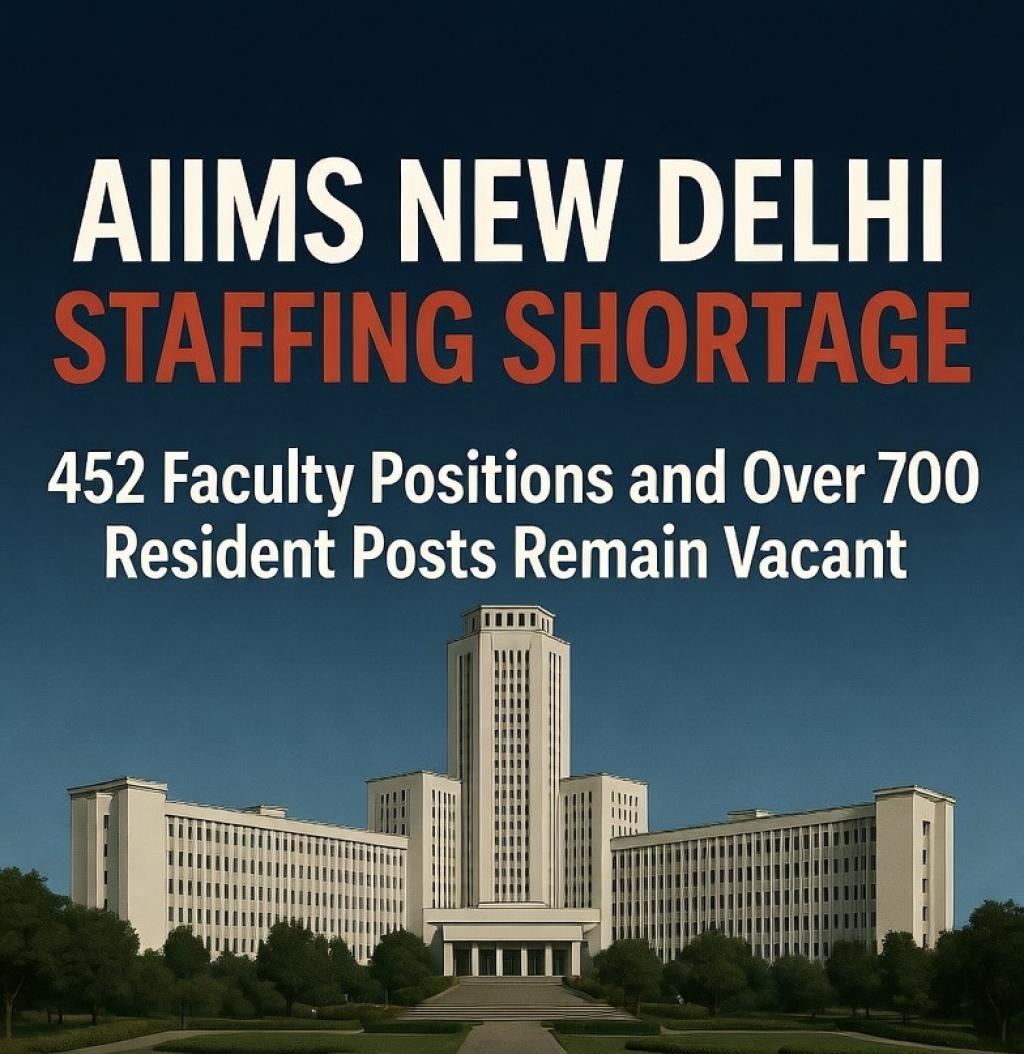
If you’ve ever waited hours for a specialist appointment at one of India’s busiest government hospitals, you know how frustrating the experience can feel. At AIIMS New Delhi, country’s flagship medical institute that frustration has a clear number attached to it right now: 452 faculty positions sit empty, along with more than 700 Senior Resident (SR) and Junior Resident (JR) posts. A recent review by the Parliamentary Standing Committee on Health and Family Welfare examined the situation closely and put forward a set of straightforward recommendations aimed at fixing the gaps without adding unnecessary layers of bureaucracy. This isn’t just a headline about empty chairs, it directly touches how quickly patients get care, how well young doctors are trained and how sustainable India’s top public healthcare institution can remain in the years ahead.
Real Scale of the Vacancy Problem
AIIMS New Delhi handles thousands of patients every single day across departments like cardiology, oncology, neurology and emergency medicine. Faculty members professors, associate professors and assistant professors are the backbone of both advanced treatment and teaching. When 452 of these roles stay unfilled, the remaining doctors carry heavier loads while medical students and residents lose out on consistent guidance. Senior Residents (SRs) are typically post graduate doctors who manage wards, perform procedures and supervise juniors. Junior Residents (JR) are fresh MBBS graduates who form the first line of patient interaction. Together, these resident doctors handle the bulk of 24 hour care, record keeping and emergency responses. With over 700 such posts vacant, shifts become longer, handovers get rushed and the risk of burnout rises for everyone still on duty.
The numbers didn’t appear overnight. Recruitment processes in central government institutions involve multiple approval stages, written tests, interviews and medical fitness checks. Delays compound when candidates receive better offers from private hospitals or decide to pursue opportunities abroad. Add to that the natural attrition from retirements and transfers and you end up with the current gap.
What the Parliamentary Committee Actually Found and Recommended
Committee didn’t just list problems, they spent time speaking with hospital administrators, current faculty, resident associations and patient representatives. Their report highlights three main pressure points:
- Slow recruitment timelines — Advertisements for posts often take months to appear, and the entire selection cycle can stretch beyond a year.
- Compensation and support gaps — While AIIMS offers prestige and research opportunities, take home pay and on campus housing sometimes lag behind what mid-career doctors can earn elsewhere.
- Workload imbalance — Remaining staff manage both clinical duties and teaching responsibilities, leaving little room for research or personal development.
Instead of vague suggestions, committee outlined concrete steps:
- Streamline hiring by creating a rolling advertisement system so departments can fill posts as soon as someone retires or leaves rather than waiting for annual cycles.
- Introduce targeted incentives such as research seed grants, faster promotions for high performing faculty and improved family accommodation for residents posted in high-pressure departments.
- Pilot a “visiting specialist” program where retired AIIMS faculty or experts from other institutes can contribute part-time for fixed periods, easing immediate pressure while permanent recruitment continues.
- Strengthen mentorship structures so that every new resident has a dedicated faculty guide, reducing errors and improving training quality even when numbers are short.
- Use digital tools more effectively for example structured telemedicine follow ups for stable patients so that in person slots are reserved for those who truly need them.
These ideas focus on practical fixes rather than massive budget increases, which makes them more likely to see real movement in the coming months.
How the Shortage Shows Up in Real Patient Stories
Consider a typical Tuesday morning in the cardiology outpatient department. Normally, three consultants might see 120–150 patients between them. With two faculty posts vacant, remaining doctor plus senior residents end up seeing nearly 200 cases. Each consultation gets five to seven minutes instead of the ideal fifteen. A patient with new chest pain might wait an extra week for an angiogram slot simply because the reporting team is stretched thin. On the education side, final year MBBS students who used to rotate through small group teaching sessions now often find themselves in larger batches with less direct supervision. One resident I spoke with (names withheld for privacy) described finishing a 36nhour shift and still needing to prepare a seminar the next morning because the assigned faculty member was covering two departments simultaneously. These aren’t isolated incidents. Multiply them across 20 plus clinical departments and you begin to see why both patient satisfaction scores and resident retention have become talking points in recent internal reviews.
What This Means for Aspiring Doctors and Current Patients
If you’re a medical student dreaming of training at AIIMS, the vacancy situation actually creates a mixed picture. On one hand, you’ll gain exposure to an unmatched volume of complex cases. On the other you may need to be more proactive about seeking mentorship and protecting your own learning time.
For patients, practical takeaway is simple: plan ahead. Book follow up appointments as early as possible, carry all previous reports, and don’t hesitate to ask the resident doctor on duty for a clear timeline on when a senior consultant will review your case. Many departments have started sharing expected wait times on their notice boards and website a small but useful improvement born out of necessity. Hospitals across India face similar recruitment challenges but AIIMS New Delhi’s visibility makes every vacancy here feel more urgent. The good news is that the committee’s recommendations align with steps already being tested at newer AIIMS campuses in places like Raebareli and Mangalagiri where faster hiring models are showing early promise.
Practical Steps That Could Help Right Now
While larger policy changes take time, here are small actions that patients, families, and even young doctors can take today:
- Patients: Use the AIIMS online portal to track appointment status and opt for tele-consultation where suitable. This frees physical slots for urgent cases.
- Resident doctors: Document workload patterns and share anonymized feedback through official resident welfare channels, the committee specifically asked for better data on shift lengths and leave utilization.
- Medical students: Form peer study groups and request structured case discussions with available faculty. Proactive learners often get more out of limited teaching time.
- General public: Follow verified updates from the Ministry of Health rather than unverified social media claims. Accurate information reduces panic and helps maintain trust in the public health system.
FAQ: Quick Answers to Common Questions
What exactly are SR and JR posts?
Senior Residents are doctors who have completed their post graduation and handle advanced clinical work. Junior Residents are fresh graduates doing their compulsory rotating internship or first year residency. Both groups are essential for round the clock hospital functioning.
Will these vacancies affect emergency care?
Emergency services continue to operate, but response times and specialist availability can vary. hospital has redeployed staff and is prioritizing critical cases, yet the strain is noticeable during peak hours.
How long might it take to fill these posts?
If the committee’s streamlined recruitment suggestions are adopted quickly, some departments could see partial relief within six to nine months. Full resolution will likely take 18–24 months.
Does this shortage exist only at AIIMS New Delhi?
Similar gaps appear at several other central government medical colleges, though the scale at AIIMS New Delhi is larger because of its patient load and national reputation.
Can private hospitals help fill the gap?
Committee suggested limited public private collaboration for specific super specialty procedures on a case by case basis but core clinical teaching and emergency care will remain under government oversight.
Looking Ahead: Why This Matters Beyond One Hospital
India’s healthcare system is expanding rapidly with new medical colleges and hospitals opening every year. Yet the quality of training and patient care still depends heavily on institutions like AIIMS New Delhi setting the benchmark. When faculty and resident numbers fall short, the ripple effects reach medical graduates across the country and patients who travel from smaller towns hoping for world class treatment, Parliamentary Committee’s report is ultimately a reminder that fixing healthcare isn’t only about building more buildings, it’s about keeping talented people inside the system with fair processes, reasonable workloads and genuine respect for their time.
If you’re a patient who has experienced long waits at AIIMS or any government hospital, your feedback through official channels matters more than ever. If you’re a doctor or student considering a career in public service, understanding these realities helps you prepare and advocate effectively.
Stay informed, ask questions and support practical reforms, health of millions depends on getting these details right one filled post at a time.
Disclaimer
This post is for informational and educational purposes only. It does not constitute medical advice, legal opinion or an official investigation. Readers should consult qualified healthcare professionals for personal health concerns. All details are drawn from media reports and outcomes of any official inquiry may provide further clarity.
Link: According to news report from Medical Dialogues
https://medicaldialogues.in/amp/news/health/doctors/452-faculty-over-700-sr-jr-posts-vacant-at-aiims-new-delhi-parliamentary-committee-gives-recommendations-169622