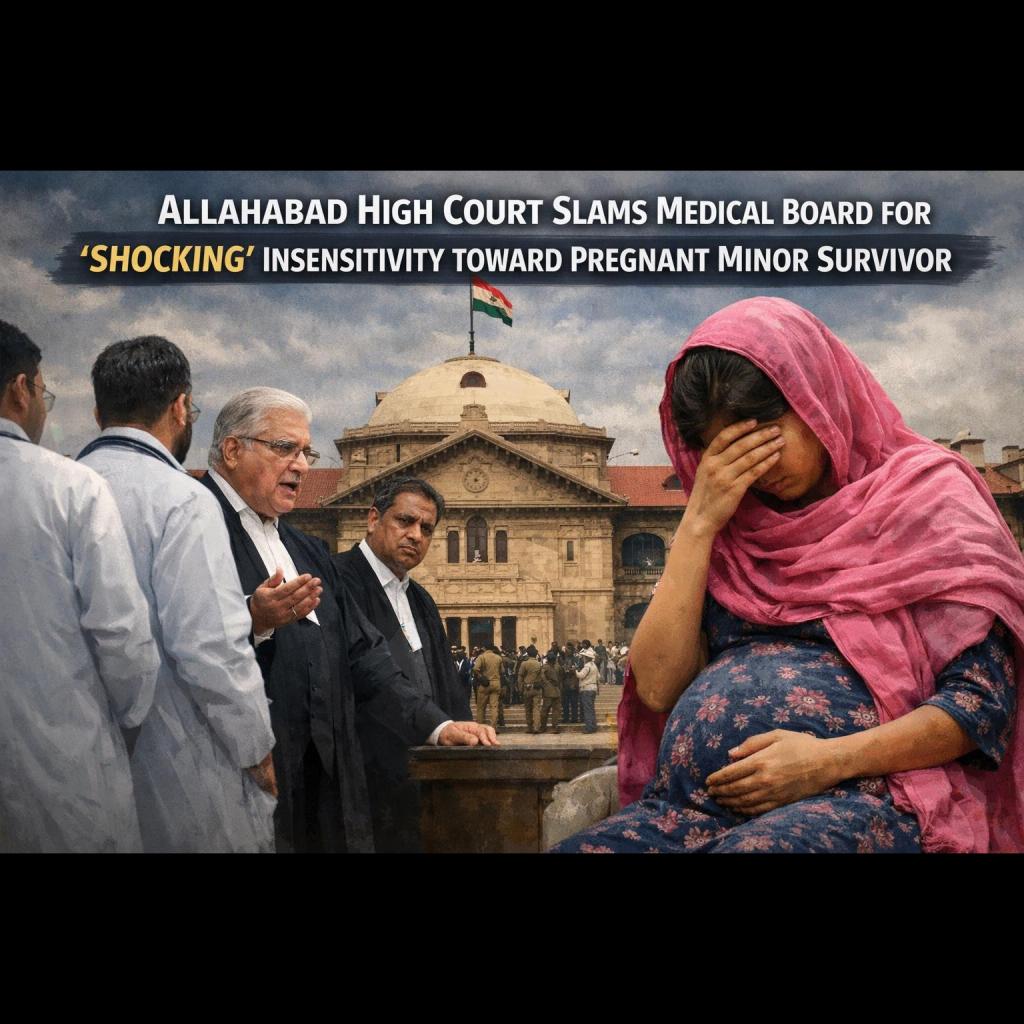
In a scathing indictment of how sensitive cases involving minor survivors of sexual violence are sometimes handled, the Allahabad High Court recently described a Medical Board’s counselling approach as “shocking” and wholly inadequate. The order passed in mid-March 2026, once again highlights the urgent need for genuine sensitivity, proper psychological support and strict adherence to protocols in cases involving pregnant minors,most of whom are victims under the POCSO Act.
The Case in Brief
The matter reached the High Court when a pregnant minor (a girl below 18 years of age) sought judicial permission for medical termination of pregnancy (MTP), as the pregnancy had advanced beyond the usual statutory limit under the Medical Termination of Pregnancy Act, 1971 (as amended). Such petitions are routinely filed in High Courts across India when pregnancies exceed 20–24 weeks, particularly in cases involving minors and survivors of sexual assault.
The Court constituted a Medical Board to examine the girl and provide a report on:
•Her physical and mental health status
•The risks associated with continuing or terminating the pregnancy
•Her psychological readiness and counseling needs
However, what followed fell far short of expectations.
The Court’s Strong Rebuke: “Shocking” Insensitivity
According to legal reports, the bench, comprising Justice Atul Sreedharan and Justice Siddharth Nandan, expressed serious concern over the Medical Board’s approach. The counseling provided was found to be mechanical, superficial and lacking empathy.
The Court took strong exception to the Board’s cursory handling of the situation, reportedly limited to generic assurances such as “Aapka khayal rakha jayega” (“You will be taken care of”), without meaningfully engaging with the survivor’s trauma, mental health condition, or emotional needs. For a minor who has already endured sexual violence, such a response is not merely inadequate it risks causing further psychological harm.
The bench observed that treating such cases as routine medical formalities defeats the very purpose of the law. The MTP Act, particularly after the 2021 amendments, along with POCSO guidelines, emphasizes holistic care encompassing physical, psychological, and social dimensions. The Court termed the Board’s handling “shocking” and stressed that a mere checkbox approach is unacceptable in matters involving deep trauma.
The judges also summoned the Chief Medical Officer (CMO) of the concerned district to explain these lapses.
Court’s Directions: A Fresh Start with Oversight
Refusing to rely on the flawed report, the Court directed:
•A fresh medical examination and report by a newly constituted Medical Board
•Active oversight and monitoring by the District Legal Services Authority (DALSA) to ensure sensitivity and compliance with legal and ethical standards
•Proper and meaningful psychological evaluation and counseling for the minor
This intervention is significant. By involving DALSA a statutory body tasked with providing free legal aid and ensuring access to justice the Court has attempted to introduce accountability and prevent further insensitivity.
Why This Matters: A Pattern, Not an Isolated Incident
This case is not an isolated one. High Courts across India, including those in Allahabad, Gujarat, and Delhi, frequently deal with similar petitions. These cases often reveal systemic shortcomings such as:
•Delays in registering FIRs or initiating action under POCSO
•Hesitation or delay by Medical Boards in providing opinions
•Lack of adequate mental health support
•Judicial burden leading to hurried proceedings
In late 2025, the Allahabad High Court had already taken suo motu cognizance of delays in termination cases involving rape survivors, initiating a public interest litigation to frame guidelines and improve institutional response. The present order appears to be a continuation of that concern, reflecting judicial frustration over recurring lapses.
The Bigger Picture: Survivors Deserve Better
For a pregnant minor who is a survivor of sexual violence, every institutional interaction whether with the police, medical professionals, counselors or the judiciary can either support healing or deepen trauma. Insensitive counseling is not merely poor practice; it can amount to secondary victimization.
The legal framework is already in place. The 2021 amendments to the MTP Act expanded access to termination up to 24 weeks for specific categories, including rape survivors, and emphasized mental health considerations. Judicial precedents and government guidelines also mandate trauma-informed care.
Yet, the gap between law and implementation remains significant. Medical professionals must undergo mandatory training in gender-sensitive and trauma-informed approaches. Institutions must treat psychological care as equally important as physical examination. Oversight mechanisms like DALSA should ideally be involved from the outset, rather than only after judicial intervention.
Final Thoughts
The Allahabad High Court’s strong observations serve as a wake up call not just for one Medical Board or district authority, but for the entire system responsible for handling such cases. Empathy cannot be optional.
When the system fails a minor at her most vulnerable, judicial intervention becomes necessary but it should not have to be the norm. Survivors deserve a system that protects, supports, and respects their dignity from the very first point of contact. Until that becomes a reality, such judicial reprimands will continue to surface.
What do you think?Have institutions become sufficiently sensitized to the needs of survivors of gender-based violence, or are courts still the primary drivers of accountability and reform?
Sources:LiveLaw.in (March 16, 2026 report) and related legal updates.
Note:All identifying details have been omitted to protect the privacy of the minor, in accordance with legal and ethical standards in POCSO and MTP cases.