The Traditional Path and Emerging Parallel Systems
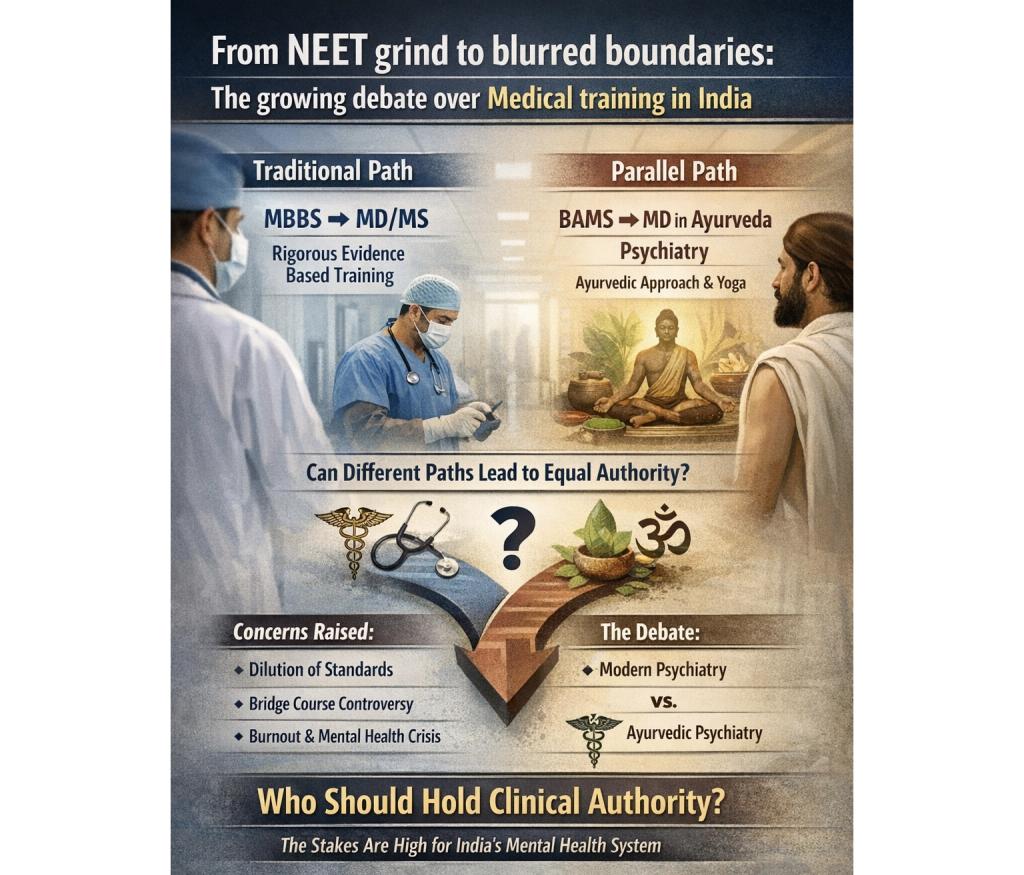
The journey to becoming MD/ MS traditionally begins with cracking NEET-UG, followed by five and half years of MBBS, and then clearing competitive exams like INI-CET or NEET-PG to secure an MD/MS seat. It is a path marked by intense competition, not forgetting to mention toxic residency including long working hours, and rigorous evidence based clinical training.
At premier institutes like the National Institute of Mental Health and Neurosciences (NIMHANS), MBBS graduates pursue MD Psychiatry through structured residency programs, forming the backbone of the country’s mental healthcare system.Running parallel to this, however there is a lesser known pathway.
NIMHANS also offers a postgraduate degree in Ayurveda, MD in Manovigyan Evam Manasa Roga a three year course open to BAMS graduates. The course focuses on mental health through an Ayurvedic framework, sometimes incorporating yoga and limited elements of modern psychiatric understanding.
On paper, this represents integrative medicine. On the ground, it has triggered a growing debate.
Differences in Training and the Question of Clinical Authority
An MBBS graduate undergoes years of training in neurobiology, psychopharmacology, emergency psychiatry, and evidence based clinical protocols. In contrast, a BAMS graduate, primarily trained in traditional medicine, can enter a parallel postgraduate pathway in mental health, sometimes within the same institution.This raises a critical question: can two fundamentally different systems of education produce equivalent clinical authority? How could two different medical and paramedical degree holder, in the end practice same medicine?
NIMHANS continues to hold its reputation as one of India’s most prestigious mental health institutions. Yet, the coexistence of modern psychiatry and Ayurvedic psychiatry degrees under the same umbrella has led to what many describe as a prestige paradox, where institutional credibility may be seen as lending equal weight to different knowledge systems.
Policy, Bridge Courses and Systemic Challenges
Beyond degree programs, NMC, government authorities have also betrayed doctors in the past with similar short-term certificate courses aimed at expanding mental healthcare access, including training for AYUSH practitioners and other healthcare personnel. While these initiatives attempt to address workforce shortages, concerns remain about dilution of standards if not strictly regulated. In other words, through some so called bridge courses, para medical professionals are certificate fit to practice allopathic medicine and worse, even perform surgeries. Throughly disregarding five and half years of extensive and extreme learning and methodologies just to ressolve shortage of doctors in government health care bodies.
Where the role of the National Medical Commission is to reform medical education and environment,MBBS students and postgraduate residents continue to face intense competition, limited postgraduate seats, heavy workloads, and rising concerns over burnout and mental health. Not forgetting to mention increasing suicide rates.Despite this, there has been little visible reform addressing these systemic issues.
Instead policy directions have often focused on integration and bridge models that allow overlap between different systems of medicine. Critics argue that such approaches sidestep the urgent need to strengthen the existing framework of allopathic medical education.
The Stakes, Risks and the Way Forward
At its core, this debate extends beyond academics. Psychiatry involves managing vulnerable patients dealing with severe mental illness, addiction, and crisis situations where clinical decisions can have life altering consequences.The central concern remains whether uniform clinical authority can be justified when training pathways are fundamentally different???
India’s need for more mental health professionals is undeniable. However, expansion without clear standardisation and accountability risks is clearly dangerous to general population, a tragic loss or let’s say a punch in gut to all doctors shedding sweat and blood for health and welfare. Integration may be a future direction, but without clarity and safeguards, it may blur the definition of what it means to be a specialist. In medicine, the value of a degree ultimately depends on the depth and rigour of the training behind it.