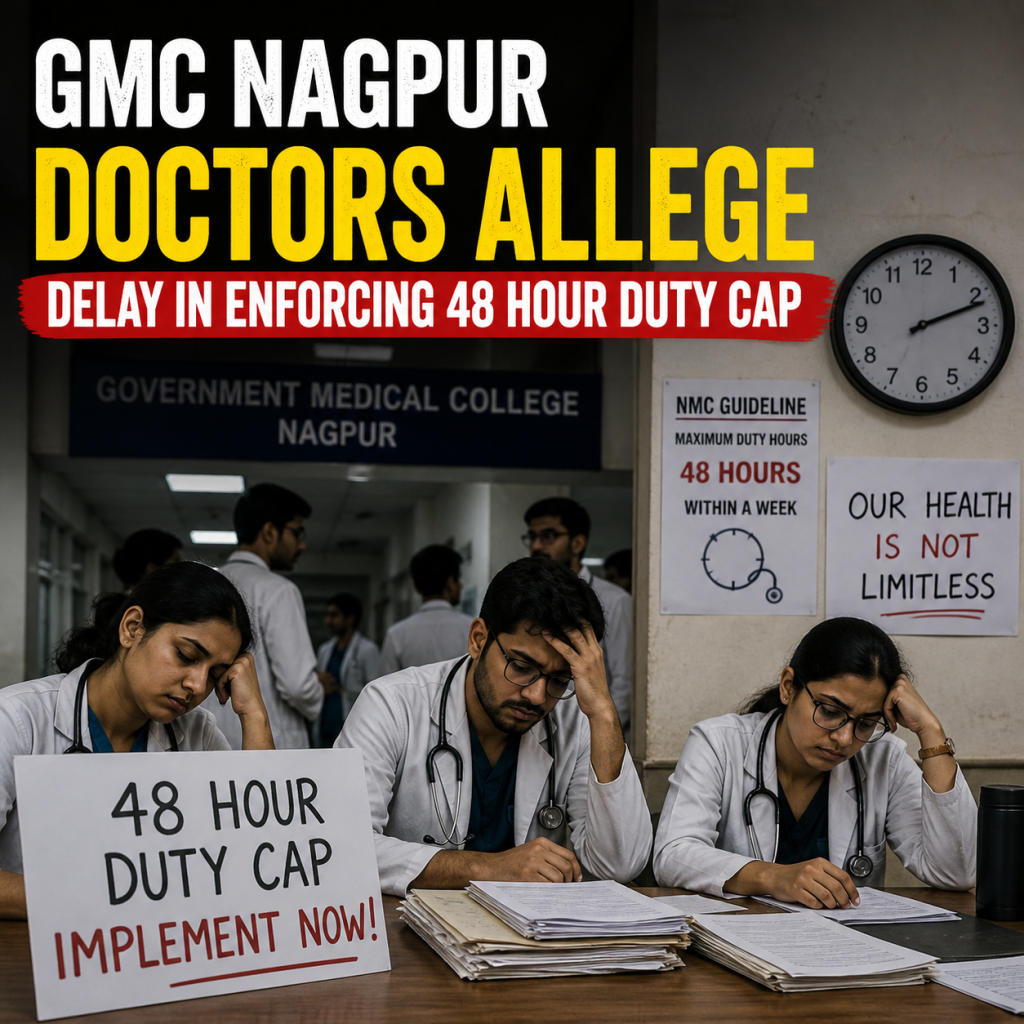
Imagine finishing a 36 hour shift in a busy government hospital emergency room. Your eyes burn, your mind fogs and every decision feels heavier than the last. Now picture this happening week after week, with barely enough time to eat or rest properly. For many resident doctors in India, this is not imagination, it is daily reality.
At Government Medical College (GMC) Nagpur, a group of doctors has recently voiced serious concerns. They allege that the college has still not put in place the 48-hour duty cap that is meant to protect both their health and the safety of patients. The issue has quietly simmered for months, but fresh voices are now bringing it into the open. This is not just another headline about long working hours. It touches on something deeper: how we treat the people who treat us when we are most vulnerable.
What Exactly Are Doctors at GMC Nagpur Saying?
According to several resident doctors and interns who spoke on condition of anonymity (a common practice when raising concerns in hierarchical medical setups), the 48 hour duty cap remains more on paper than in practice. They describe rosters where continuous duty stretches well beyond recommended limitsnwith insufficient compensatory off days. Some report working 70–80 hours in a single week without proper breaks between shifts.
One senior resident shared a typical week: “We start on Monday morning and by Wednesday night we are still on the floor. The ‘48 hour rule’ is mentioned in orientation, but the actual schedule rarely reflects it.” Another doctor pointed out that while the college administration has formed committees and held meetings, visible changes in daily duty allocation have been minimal, college administration when approached has stated that implementation is “under active review” and that efforts are being made to balance patient load with doctor welfare. No official denial or confirmation of full compliance has been issued yet. This back and forth is familiar in many government medical institutions across the country.
Understanding the 48 Hour Duty Cap
The 48nhour duty cap is not an arbitrary number. It stems from growing recognition both in India and globally that excessive working hours harm everyone involved. The guideline aims to limit total duty time so that doctors get adequate rest usually interpreted as no more than 48 hours of work spread across a week with mandatory rest periods and at least one full day off.
Why 48 hours? Research in sleep medicine and occupational health shows that after 16–18 hours without sleep, a person’s performance drops to levels comparable to being legally drunk. For doctors making life or death calls that drop can be catastrophic. The rule also draws from international standards used in countries with better doctor retention and lower burnout rates.
In the Indian context, National Medical Commission (NMC) and various state health departments have issued circulars encouraging medical colleges to adopt reasonable duty hour limits. The 48 hour framework is one such benchmark being discussed and in some places partially implemented. GMC Nagpur is not the first institution to face questions about compliance similar concerns have surfaced at other government colleges in Maharashtra and beyond but the current allegations highlight how uneven the rollout remains.
Real Human Cost: A Day in the Life
Let’s make this concrete with a realistic scenario based on patterns reported by doctors across similar institutions.
Dr. Priya (name changed), a second year resident in the medicine department at a busy government college, begins her week on Monday at 8 AM. She is on call through Tuesday night. By Wednesday afternoon she has already logged 40 hours. Thursday brings another full shift. By Saturday she is exhausted, yet she still has to present cases in the morning meeting and handle outpatient duty in the afternoon. She misses her younger sister’s birthday. She skips meals. Her back aches from standing for hours. Most importantly, she notices herself double checking simple calculations twice because her concentration wavers. “I once gave the wrong dose of a common antibiotic because I misread the chart after 28 hours awake,” she recalls quietly. “Fortunately, the nurse caught it. What if next time no one does?” Stories like Priya’s are not rare. They explain why doctor burnout rates in India remain high and why patient safety advocates keep raising the alarm. Tired doctors make more errors, show less empathy, and are more likely to suffer mental health struggles themselves. The ripple effect reaches families, colleagues and ultimately every patient who walks through the hospital door.
Why Patient Safety and Doctor Welfare Are Two Sides of the Same Coin
When duty hours go unchecked, quality of care suffers in subtle but measurable ways. Studies from various countries show that extended shifts correlate with higher rates of diagnostic mistakes, medication errors and even procedural complications. In a high volume government hospital like GMC Nagpur where patient inflow is heavy and resources are stretched, these risks multiply.
On the flip side doctors who work within reasonable limits report better focus, quicker recovery between shifts and greater job satisfaction. Hospitals that have successfully capped hours often see lower absenteeism and fewer complaints from both staff and patients. This is why the 48-hour cap is not merely a “doctor welfare” issue. It is a public health issue. Every person who has ever waited in a government hospital OPD or emergency room benefits when the doctor treating them is alert and rested.
Practical Steps Medical Colleges Can Take Right Now
Compliance does not require magic. Many institutions have made meaningful progress with simple, low-cost changes:
- Digital roster management — Use scheduling software that automatically flags violations of the 48 hour limit and suggests fair redistribution of duties. Several affordable Indian startups offer such tools tailored for hospitals.
- Mandatory rest protocols — Enforce at least 8–10 hours between shifts and guarantee one full 24 hour off day every week. Post the roster publicly so everyone can see it.
- Increase support staff — Hire more junior residents, nursing assistants and administrative help to reduce the load on senior doctors. This also gives trainees better learning opportunities instead of pure service work.
- Wellness check ins — Monthly anonymous surveys and access to counseling services. Early signs of burnout can be addressed before they become crises.
- Transparent grievance system — Create a safe channel (perhaps through the medical education unit) where doctors can report schedule violations without fear of retaliation.
GMC Nagpur already has the infrastructure and experienced faculty to lead on this. Implementing these steps would not only address the current allegations but could set an example for other colleges in the region.
What Aspiring Doctors and Medical Students Should Know
If you are preparing for NEET-PG or already in residency, understanding duty hour realities matters. Ask during counseling or college visits: “How strictly is the duty roster followed? What is the average weekly hours for residents in your department?” Self care is not optional. Simple habits protecting sleep on off days, short power naps when allowed, staying hydrated, and maintaining a support network make a real difference. Many senior doctors now openly discuss therapy and peer support groups, removing the old stigma around mental health in the profession.
FAQ: Quick Answers to Common Questions
What is the 48-hour duty cap exactly?
It is a guideline that limits total working hours for resident doctors to around 48 hours per week on average, with required rest periods between shifts. The goal is to reduce fatigue and improve both doctor well being and patient safety.
Why are doctors at GMC Nagpur raising this issue now?
They allege that despite earlier assurances and policy discussions, daily rosters continue to exceed the recommended limits, leading to chronic overwork without adequate compensation or recovery time.
Does long duty hours really affect patient care?
Yes, fatigue impairs concentration, decision making speed and attention to detail. Multiple international studies link extended shifts with higher rates of medical errors and lower patient satisfaction scores.
Can individual doctors do anything if their college is non compliant?
They can document their schedules raise concerns through official channels (medical education unit, ethics committee or resident welfare association) and if needed approach state medical councils or the NMC. Collective respectful advocacy has worked in several other colleges.
Are similar complaints common across India?
Yes, while some private and government colleges have made progress, uneven implementation remains a nationwide challenge. The situation at GMC Nagpur reflects broader conversations happening in medical education circles.
Moving Forward Together
The allegations at GMC Nagpur are a reminder that rules on paper mean little without consistent, transparent execution. Doctors dedicate years of their lives to learning how to heal others. They deserve schedules that let them do their job safely and sustainably. For patients and families, this issue matters because rested doctors provide better care. For medical students, it shapes the kind of professionals they will become. For administrators and policymakers, it is an opportunity to lead rather than react.
If you are a doctor or student reading this, consider speaking up constructively within your institution change often starts with one clear documented voice. If you work in healthcare administration, look at your own rosters today and ask whether they truly respect the 48 hour spirit and if you are simply someone who values good healthcare, remember that supporting reasonable working conditions for doctors is one of the most practical ways to protect the quality of care you and your loved ones receive. Healthcare is a human system. When we take care of the humans at its center, everyone wins. The conversation at GMC Nagpur is not ending here, it is an invitation to do better starting now. What changes would you like to see in how our medical colleges manage doctor duty hours? Your perspective matters.
Disclaimer
This post is for informational and educational purposes only. It does not constitute medical advice, legal opinion or an official investigation. Readers should consult qualified healthcare professionals for personal health concerns. All details are drawn from media reports and outcomes of any official inquiry may provide further clarity.
Link: According to news report from Medical Dialogues https://medicaldialogues.in/amp/news/health/doctors/gmc-nagpur-yet-to-follow-48-hour-duty-cap-doctors-allege-non-compliance-169740