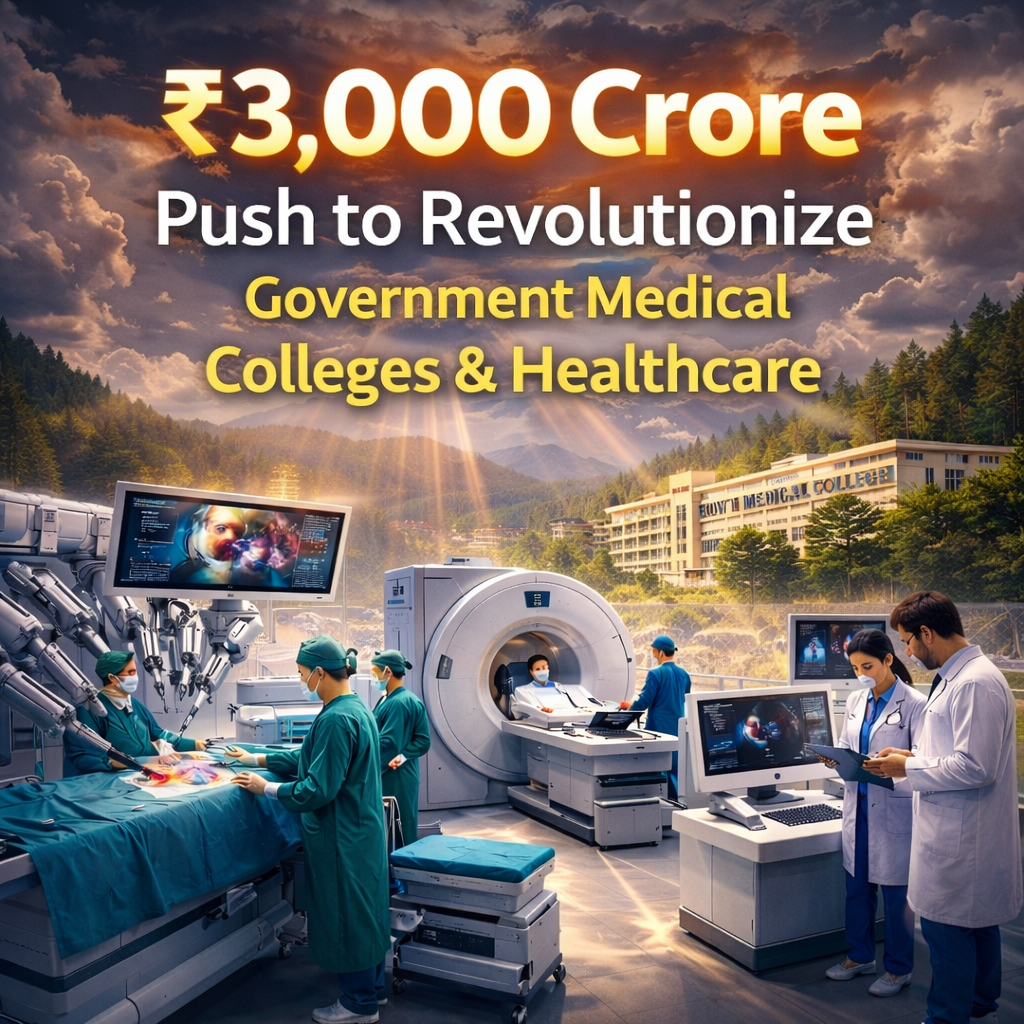
In the scenic hills of Himachal Pradesh, access to quality healthcare has often required long journeys to bigger cities or even out of state facilities. However, a significant transformation is now underway.
Chief Minister Thakur Sukhvinder Singh Sukhuhas announced a massive investment of nearly ₹3,000 crore to upgrade government medical colleges and healthcare institutions with state-of-the-art equipment and advanced technology. This initiative, highlighted in recent legislative sessions and media reports, reflects the state’s commitment to building a world class public healthcare system comparable to premier institutions like AIIMS Delhi.
The Big Announcement: What Does ₹3,000 Crore Mean for Healthcare?
The ₹3,000 crore investment is not just a headline figure it represents a strategic allocation aimed at transforming healthcare infrastructure across the state. The funds will be used to procure high end medical machinery, replace outdated equipment (especially those older than 15 years) and introduce cutting edge technology in government medical institutions.
The rollout is planned over the coming years, with a strong focus on rapid upgrades within the next eight months.
Key Highlights:
•Modernization of Medical Colleges:
Major institutions such as Indira Gandhi Medical College (IGMC) Shimla, Dr. Rajendra Prasad Government Medical College Tanda, Shri Lal Bahadur Shastri Government Medical College Nerchowk and colleges in Nahan, Hamirpur, and Chamba will receive world class equipment.
•Introduction of Advanced Technology:
Facilities will be equipped with robotic surgery systems, 3-Tesla MRI machines, LINAC units for radiation therapy, PET scan machines, and other advanced tools.
•AIIMS-Level Standards:
The government aims to elevate zonal hospitals, Primary Health Centres (PHCs), and Community Health Centres (CHCs) to AIIMS-like standards within the next three years.
The Chief Minister has stated that “around ₹3,000 crore will be spent on installing high end medical equipment and machinery,” with visible upgrades expected in medical colleges within months. Notably, ₹1,617 crore has already been approved for the first phase of modernization, covering the period from April 2026 to 2031.
Beyond Equipment: Building a Stronger Healthcare Ecosystem
This initiative goes beyond infrastructure upgrades. The government is also focusing on strengthening the overall healthcare ecosystem to ensure better accessibility, efficiency and outcomes.
Key Reforms Include:
•Expansion of Robotic Surgery:
Robotic surgery facilities are already operational in Chamiyana (Shimla), Tanda, and Nerchowk (inaugurated in March 2026 at a cost of ₹28.44 crore). Plans are underway to extend these services to IGMC Shimla and Hamirpur. Early results have been highly promising, with hundreds of successful procedures completed.
•Faculty and Staffing Enhancement:
Recruitment drives are underway to fill vacancies for doctors, paramedics, and technicians. More than 100 professors have already been appointed at Tanda Medical College, along with an increase in senior residency positions.
•Improved Medical Education and Training:
The government is introducing postgraduate (PG) courses in more departments, easing regulatory requirements where necessary. Stipends for senior residents have been significantly increased from ₹40,000 to ₹1 lakh, and up to ₹1.30 lakh for super specialists. Doctors are also being trained in advanced medical technologies.
•Patient Centric Initiatives:
Efforts are being made to reduce the need for patients to seek treatment outside the state. Tele oncology services, specialized departments (such as cardiology at Nerchowk), and uninterrupted funding aim to ensure better care within Himachal Pradesh.
Despite financial challenges including the loss of the Revenue Deficit Grant, which has reduced the state’s budget by approximately ₹10,000 crore annually the government has assured that spending on healthcare and education will remain unaffected.
Why This Matters for Himachal Pradesh
Himachal Pradesh currently has more medical colleges than required, but many have struggled due to faculty shortages and outdated infrastructure. As the Chief Minister himself noted, the state may only need three to four well-equipped institutions but they must be of the highest quality.
This ₹3,000 crore initiative addresses that issue directly by prioritizing quality over quantity.
For residents in remote and rural areas, the impact could be transformative:
•Faster and more accurate diagnoses
•Access to minimally invasive surgeries
•Improved cancer care and emergency services
•Reduced dependence on cities like Delhi and Chandigarh
For medical students and professionals, the upgrades promise better training facilities, improved working conditions, and enhanced career opportunities.
A Step Toward the Future
As Himachal Pradesh navigates financial constraints, this ambitious healthcare modernization drive stands out as a forward-thinking and impactful initiative. If implemented effectively, it could set a benchmark not only for other hill states but also for larger regions facing similar healthcare access challenges.The big question remains will this investment truly bridge the urban rural healthcare divide in Himachal Pradesh?
Sources:Reports from Medical Dialogues, The Tribune, ANI, UNI India, and other updates (March 2026). All figures and statements are based on public announcements by Chief Minister Sukhvinder Singh Sukhu.