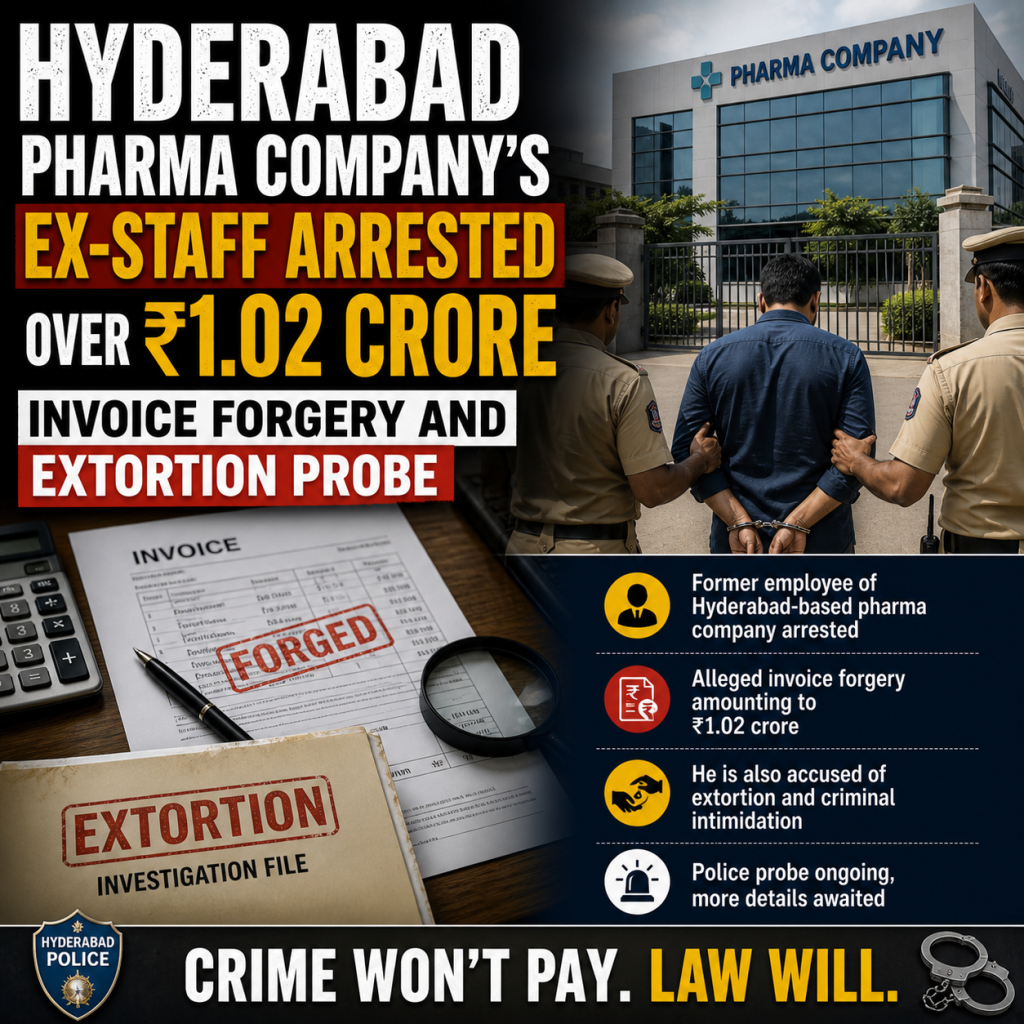
On April 30, 2026 police in Hyderabad took three former employees of NovaPharm India Ltd. into custody, arrests followed weeks of quiet investigation into claims that the men had run a coordinated scheme to extract large sums of money from the company’s distributors by using fake invoices, forged digital signatures and subtle threats of regulatory trouble.
Accused identified by police as 38 year old Rajesh Patel (former regional sales manager), 34 year old Meera Iyer (ex-accounts executive) and 41 year old Suresh Rao (former logistics coordinator) worked at the company until early 2025. According to First Information Report (FIR) registered at Cyber Crime Police Station, they are alleged to have siphoned off approximately ₹1.02 crore between September 2025 and March 2026.
How Alleged Scheme Unfolded
Operation was not a crude grab for cash. Instead, it relied on the trust and familiarity the three men had built during their years at NovaPharm. Distributors across Maharashtra, Telangana and Karnataka began receiving emails and WhatsApp messages that looked completely legitimate, messages carried scanned copies of purchase orders and tax invoices bearing the company’s official letterhead, digital signatures and even the correct GST numbers. Only problem: supplies mentioned in those documents had never been dispatched.
When a distributor called the company to check, response was often delayed or routed through the accused, who would “confirm” the transaction and press for immediate payment “to avoid stock outs.” In a few cases, the men reportedly hinted that raising too many questions could lead to “unnecessary scrutiny” from drug inspectors, a thinly veiled reference to possible compliance issues they themselves had quietly inserted into internal records.
One distributor in Pune who wished to remain unnamed, later told investigators: “I had dealt with Rajesh for four years. When he said the payment was urgent and the invoice was already processed, I didn’t think twice. By the time I realised something was wrong, almost ₹18 lakh had moved.”
Scheme began to unravel in late March 2026 when an internal audit flagged duplicate payments and invoices that did not match actual dispatch records. NovaPharm’s management filed a complaint with the Telangana Cyber Security Bureau and the Economic Offences Wing. Forensic examination of email servers, bank statements, and recovered laptops reportedly showed a clear trail linking the three former colleagues to at least 27 fake transactions.
Legal Charges and Current Status
Police have invoked sections of the Indian Penal Code relating to extortion (Section 383), forgery (Section 463), cheating (Section 420) and criminal conspiracy (Section 120-B). If convicted, accused could face up to ten years in prison along with heavy fines. As of May 1, 2026 all three men are in judicial custody. Their bail application is scheduled for hearing on May 5. Investigators say they are still tracing final movement of funds and checking whether any other employees or external parties were involved. So far roughly ₹68 lakh has been frozen in various bank accounts, and police are working with banks to recover the rest.
NovaPharm issued a brief statement on May 1 confirming that “appropriate legal action has been initiated and the company is fully cooperating with law enforcement agencies.” statement added that an independent forensic audit is underway and that no patient safety or drug quality issues have been identified.
Why Insider Fraud Hits the Pharma Sector Hard
India’s pharmaceutical industry is worth more than $50 billion and supplies a large share of the world’s generic medicines. Yet many mid sized companies still rely heavily on manual processes, long standing personal relationships with distributors, and decentralised sales teams. These factors create opportunities for people who know the system inside out.
Extortion in this setting rarely involves guns or physical threats. It often takes the form of “soft pressure” fear that a small compliance lapse could trigger a visit from regulators, or that a trusted contact might quietly damage a distributor’s reputation. When the people applying that pressure are ex-employees who still know passwords, vendor lists, and internal workflows, detection becomes difficult. Similar patterns have appeared in other sectors logistics, textiles, even educational institutions but pharma carries an extra layer of public responsibility. Even when no medicines are actually tampered with repeated news of financial misconduct can shake confidence in the entire supply chain.
Practical Steps Companies Can Take Today
This case offers clear lessons for any business that deals with distributors, invoices, and regulatory paperwork. Here are actions that actually work in real organisations:
- Segregate duties and rotate access
No single person should be able to create an invoice, approve payment, and dispatch goods. Many companies now use role-based access in their ERP systems and automatically rotate approval rights every six months. - Run surprise data analytics checks
Simple tools can flag invoices that match previous patterns, arrive at odd hours or involve vendors with sudden spikes in business. One mid-sized pharma firm in Gujarat caught a ₹40 lakh fraud last year simply by setting alerts for any invoice above ₹5 lakh that lacked a matching goods receipt note. - Create a real whistleblower channel
Anonymous hotlines or encrypted reporting forms work only when employees believe nothing bad will happen to them. Companies that publicise successful internal resolutions (without naming people) tend to see more reports. - Verify before you pay every time
A quick phone call to the listed contact number on the company website, rather than the number on the invoice takes two minutes and can save lakhs. Many frauds collapse at this single step. - Document everything and archive emails
In the NovaPharm case, old email threads proved decisive. Keeping seven year archives of all sales and finance communication is now standard advice from forensic accountants.
What Employees Should Know
If you work in sales, accounts or supply chain, you may one day notice small irregularities an invoice that doesn’t feel right, a colleague asking you to “just approve this one quickly.” Safest response is simple: document what you see, note the date and time and raise it through the official channel your company provides.
Never confront the person directly; that can tip them off and sometimes puts you at legal risk. Most large and mid sized pharma companies now have ethics committees or external ombudsmen precisely for these situations. Using them protects both the company and you.
Frequently Asked Questions
What exactly does “extortion” mean in this case?
It refers to demanding money by creating fear in this instance, fear that a distributor’s business could face regulatory trouble or loss of supply if they did not pay the fake invoices.
Did any medicines get compromised?
No, both company and state drug control department have confirmed that all batches in the market meet quality standards, fraud was purely financial.
How common is this kind of insider fraud in Indian pharma?
Exact numbers are hard to come by because many cases are settled privately, but forensic firms report a steady rise in matters involving ex-employees and fake documentation, especially in companies with high distributor turnover.
Can a whistleblower be protected if they report something like this?
Yes, Companies Act and the Whistle Blowers Protection Act provide safeguards against retaliation. Many companies also sign confidentiality agreements that protect the identity of the person who raises the concern.
What should a distributor do if they suspect fake invoices?
Contact the company’s official finance or legal head using numbers listed on the company website never contact details that arrived with the suspicious invoice. Keep records of every communication.
A Final Reflection
Cases like the one involving the three former NovaPharm employees remind us that trust is the most valuable currency in any business, especially one that touches public health. When that trust is broken from within, damage goes beyond balance sheets, it touches the quiet confidence millions of patients place in the medicines they buy.Investigation is still young. More facts may emerge in the coming weeks. What remains clear, however is that simple, consistent safeguards, clear processes, regular checks and the courage to speak up can prevent most such incidents before they grow into crore rupee problems.
If you work in pharma, distribution or any sector that handles invoices and approvals, take a quiet moment this week to ask: “Could something like this happen here?” Then do one concrete thing review an access list, test your whistleblower channel, or simply talk to your team about what “doing the right thing” looks like when pressure mounts because in the end, best protection against fraud is not a better lock on the door. It is a culture where people choose integrity even when no one is watching.
Disclaimer
This post is for informational and educational purposes only. It does not constitute medical advice, legal opinion or an official investigation. Readers should consult qualified healthcare professionals for personal health concerns. All details are drawn from media reports and outcomes of any official inquiry may provide further clarity.
Also read:
https://timesofindia.indiatimes.com/city/delhi/former-staff-of-pharma-firm-accused-of-using-forged-documents-to-secure-govt-tenders/amp_articleshow/130652079.cms