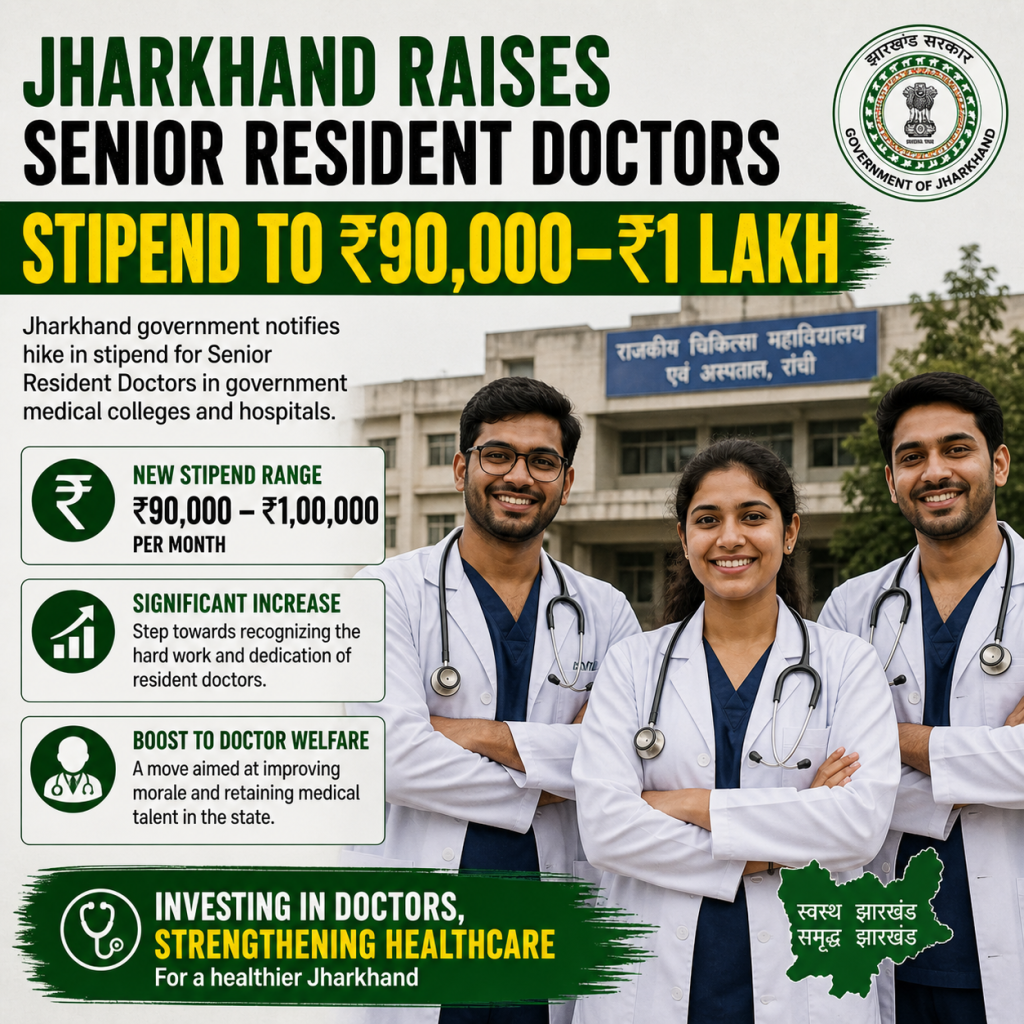
In late April 2026, Jharkhand government quietly rolled out one of the most noticeable updates for postgraduate medical trainees in recent years. Senior resident doctors those who have completed their MBBS and are now pursuing specialty training will now receive a stepped up monthly stipend that starts at ₹90,000 in year one, moves to ₹95,000 in year two and reaches ₹1,00,000 in the final year. For many young doctors, this is more than just extra cash in the bank. It is recognition that the years spent in hospitals, managing night shifts, handling emergencies, and balancing studies deserve better financial support, move comes at a time when living costs in most Indian cities have climbed steadily, student loans remain a reality for many and the pressure to perform at a high level never really lets up.
What New Stipend Structure Actually Looks Like
Revised pay is straightforward and progressive:
- First-year senior residents: ₹90,000 per month
- Second-year senior residents: ₹95,000 per month
- Third-year senior residents: ₹1,00,000 per month
These figures are the base stipend. Doctors may still receive additional benefits such as house rent allowance in some postings, medical coverage and leave travel concessions, depending on the specific hospital or medical college. The increase is expected to apply across government medical colleges and district hospitals that run senior residency programmes in Jharkhand. Compared with the previous rates (which were lower and had remained unchanged for several years), new scale adds roughly ₹15,000–20,000 more per month in the early years and up to ₹25,000–30,000 more in the final year. For a doctor supporting a family or repaying education loans, that difference can meaningfully change monthly budgeting.
Why Senior Residents Matter and Why Their Pay Has Been a Long Standing Concern
Senior residents are the backbone of any teaching hospital. After finishing their MBBS, they spend three years (sometimes more) learning to become specialists in fields such as medicine, surgery, paediatrics, obstetrics or orthopaedics. During this period they see patients, perform procedures, teach juniors and often work 80–100 hours a week. Unlike private sector jobs, these positions come with a fixed stipend rather than a market salary. In many states, that stipend has not kept pace with inflation or the rising cost of living in tier-2 and tier-3 cities. Rent groceries, transportation and exam preparation books add up quickly. Many residents also send money home to support parents or younger siblings. Jharkhand’s decision to raise the stipend is therefore being viewed as a practical step to reduce financial stress during these critical training years. Lower stress often translates into better focus, fewer errors and ultimately safer patient care.
A Closer Look at the Timing and Broader Context
Announcement arrives as several states are reviewing how they attract and retain medical talent. Some larger states and metropolitan areas already offer higher stipends, sometimes crossing ₹1 lakh even in the first year. Jharkhand’s new structure brings it closer to those benchmarks without reaching the very top of the list. Health department officials have indicated that the revision is part of a larger effort to strengthen the public healthcare system in the state. Jharkhand has been working to expand medical education infrastructure, open new colleges, and improve services in rural and semi urban areas. Competitive stipends are one way to encourage doctors to choose government postings over immediate private practice or migration to bigger cities.
Real Life Impact: How the Extra Money Could Help
Consider Dr. Ankit, a hypothetical second year senior resident posted at a government medical college in Ranchi. With the old stipend he was managing rent of ₹18,000 food and travel at ₹12,000 and sending ₹15,000 home every month. After basic expenses and loan instalments, very little remained for savings or emergencies with the revised ₹95,000 he now has breathing room. He can increase the amount sent home, start a small emergency fund, or even enrol in an online super specialty entrance coaching module without worrying about every rupee. Small changes like these reduce the constant mental load that many residents carry.
Another example: Dr. Meera in her final year, plans to appear for NEET-SS (super specialty entrance exam) after completing residency. The extra ₹25,000–30,000 per month in her third year could cover coaching fees travel for mock tests and a few months of focused study leave without taking on additional debt. These are the kinds of practical differences that add up over three years.
What This Means for Medical Students Planning Their Future
If you are a final year MBBS student or an intern thinking about senior residency, the Jharkhand update is worth factoring into your decision making. Here are a few points to consider:
- Location versus pay: Jharkhand now offers a more attractive financial package than many smaller states. If you are open to working outside metro cities, combination of structured training and improved stipend becomes compelling.
- Work life balance: Government hospitals in smaller states sometimes have slightly lower patient loads in certain departments compared with overcrowded metros though this varies by institution.
- Long term career path: Completing senior residency in a government setup can open doors to faculty positions, specialist roles in state health services or easier transitions into private practice later.
Students should keep an eye on official notifications from the Jharkhand health department and the respective medical colleges for application windows, seat availability, and counselling schedules. Eligibility usually requires a valid NEET-PG score and completion of internship.
Potential Challenges and How the State Might Address Them
Any policy change brings questions. Will the increased stipend be paid on time every month? Will it apply uniformly across all districts, or will there be differences between Ranchi and more remote postings? How will the state fund the additional outgo?
These are legitimate concerns. Past experience in several states shows that timely disbursement and clear communication from the administration make a big difference in how doctors perceive such announcements. If Jharkhand implements the hike smoothly and pairs it with better hostel facilities or academic support, positive impact will be even greater. On the positive side move signals that the state values its medical workforce. That message itself can help with morale and long term retention.
Financial Planning Tips for Residents Receiving the New Stipend
Even with higher pay, smart money habits remain important during residency. Here are a few practical suggestions:
- Track every expense for the first three months — Use a simple app or spreadsheet. You may be surprised where small leaks occur.
- Build an emergency fund first — Aim for at least three months of basic expenses before increasing discretionary spending.
- Prioritise high interest debt — If you have education loans, consider putting extra money toward the principal rather than new purchases.
- Invest in yourself strategically — A portion can go toward quality study materials, online courses or attending conferences that actually advance your career.
- Plan for post-residency life — Final year stipend bump is a good time to start a small systematic investment plan that continues after you finish training.
These habits started early can set the foundation for financial stability once you move into a consultant or faculty role.
How Jharkhand’s Move Fits Into the Larger Picture of Indian Medical Training
Across India, conversation around resident pay has been gaining momentum. Several states have revised stipends in the last three to four years and professional bodies have been advocating for minimum standards. Jharkhand’s decision adds to that momentum. It also highlights a simple truth: when states treat senior residents fairly, they are more likely to stay in the public system serve underserved areas and contribute to training the next generation of doctors. In a country that still faces shortages of specialists in many regions, every positive step counts.
FAQ: Common Questions About the Jharkhand Senior Resident Stipend Hike
Q1: Does the new stipend apply to all senior residents in Jharkhand or only government colleges?
Revision primarily covers senior residency positions under the state health department and government medical colleges. Private institutions set their own pay scales though some may choose to match or exceed the government rates to stay competitive.
Q2: Will there be any deduction or tax on the new stipend amount?
Like most stipends, these amounts are subject to applicable income tax rules. Residents should check with the accounts section of their institute for exact TDS details and keep records for filing returns.
Q3: How does Jharkhand’s new scale compare with neighbouring states?
While exact figures vary, revised structure now places Jharkhand among the better paying options for non metro government postings. It is higher than several eastern and central states but still below the highest paying metropolitan centres.
Q4: When will the increased stipend actually start reaching doctors accounts?
Implementation usually begins from the month the government order is issued or from the next academic session, whichever is specified in the official notification. Doctors should confirm the effective date with their institute’s administration.
Q5: Should I choose Jharkhand for senior residency just because of the higher stipend?
Pay is important but it should not be the only factor. Consider the clinical exposure, faculty quality, patient diversity, research opportunities and personal comfort with the location. A well rounded training experience matters more for long term career growth than stipend alone.
Final Thoughts: A Step in the Right Direction
Jharkhand government’s decision to raise stipends for senior resident doctors is more than a line item in a budget. It is a signal that the state recognises the long hours, emotional labour, and financial pressures that come with medical training. For doctors who will benefit, it offers a little more dignity and a little less worry during three demanding years. For medical students watching from the sidelines, it is a reminder that policies can and do change and that choosing where to train is a decision worth researching thoroughly. For policymakers elsewhere, it serves as an example that investing in the people who deliver healthcare ultimately strengthens the entire system.
If you are a current resident, an aspiring specialist, or simply someone who cares about the future of healthcare in India, stay informed about such updates. Read official notifications, talk to seniors who have worked in different states, and plan your finances and career moves with both eyes open.Jharkhand has taken a meaningful step, real test now lies in smooth implementation and continued support for the doctors who serve the state’s people every day that more than any single number, will determine how successful this initiative ultimately proves to be.
Disclaimer
This post is for informational and educational purposes only. It does not constitute medical advice, legal opinion or an official investigation. Readers should consult qualified healthcare professionals for personal health concerns. All details are drawn from media reports and outcomes of any official inquiry may provide further clarity.