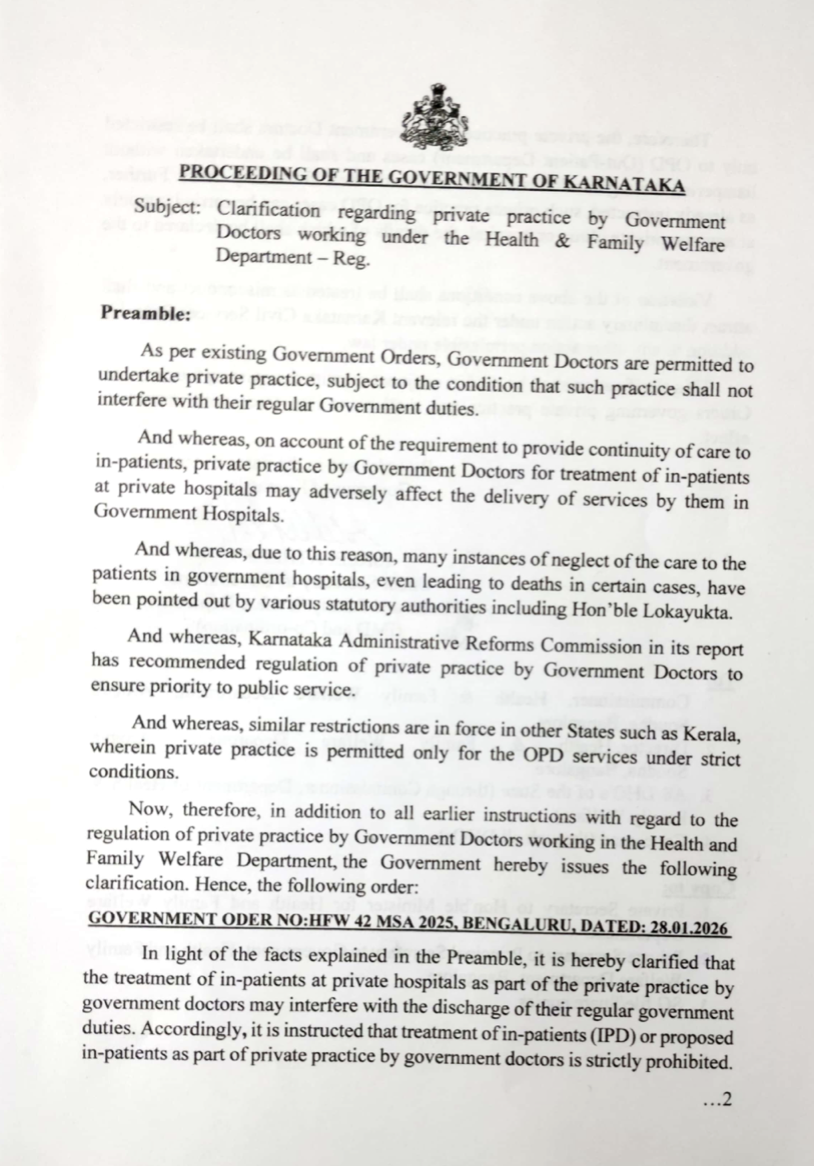
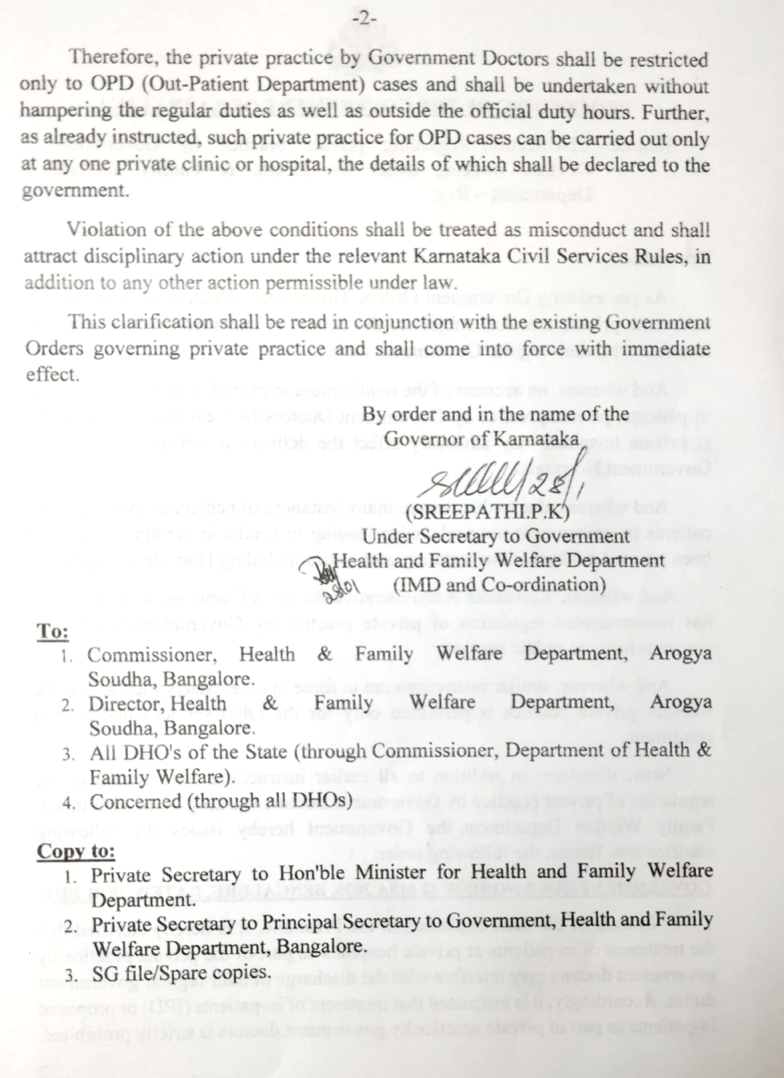
The Karnataka government has restricted private practice by government doctors to outpatient services only, banning private inpatient treatment. This 2026 order aims to prevent neglect of duties in government hospitals and strengthen public healthcare accountability. A detailed medico legal analysis of the policy, its legal implications, and impact on specialists and private hospitals.
Redrawing the Clinical Legal Boundary on Private Practice
The Health and Family Welfare Department, Government of Karnataka, through Government Order No. HFW 42 MSA 2025 dated 28.01.2026, has drawn a clear clinical legal boundary on private practice by government doctors. Under this clarification, government doctors are prohibited from providing private inpatient care as part of private practice. Private practice is now restricted strictly to outpatient services, to be undertaken outside official duty hours and without affecting regular government duties.
Why the Issue Arose
The clarification does not arise from opposition to private medicine. The preamble acknowledges that private practice by government doctors was already permitted under existing orders, provided it did not interfere with official duties. The trigger for intervention is the recognition that private inpatient care requires sustained continuity, prolonged engagement, and on call responsibility, which may adversely affect service delivery in government hospitals.
The order anchors this position in documented accountability concerns. It records multiple instances of neglect in government hospitals, including cases leading to deaths, highlighted by statutory authorities. It also cites recommendations calling for tighter regulation of private practice to ensure primacy of public service obligations. The State is therefore recording that tolerance of dual inpatient roles produced outcomes it considers unacceptable.
This approach aligns with broader Indian health systems concerns. Policy bodies have repeatedly flagged that dual practice, absenteeism, and divided clinical availability weaken staffing and service readiness, especially in district and frontline facilities.
The order also refers to comparative state practice, specifically Kerala, where private practice by government doctors is permitted only for outpatient services under strict conditions. This reference signals adoption of a tested administrative model that simplifies monitoring by limiting private practice to outpatient work at a single declared site.
The Directives
The clarification explicitly states that treatment of inpatients or proposed inpatients in private hospitals by government doctors as part of private practice is strictly prohibited, as such activity may interfere with regular government duties.
Permitted private practice is limited to outpatient cases only. It must be undertaken outside official duty hours, must not hamper regular government duties, and may be carried out only at one declared private clinic or hospital.
Violation of these conditions is to be treated as misconduct, attracting disciplinary action under the relevant Karnataka Civil Services Rules, in addition to any other action permissible under law. The clarification operates alongside existing government orders and comes into force with immediate effect.
Two medico legal issues arise from the drafting. First, the term proposed inpatients is not defined. The order does not clarify when an outpatient interaction becomes involvement with a proposed inpatient, whether through pre admission counselling, admission scheduling, pre operative clearance, investigation orders, telephonic instructions, or being named as the admitting consultant. This ambiguity is likely to generate disciplinary disputes unless clarified through departmental SOPs.
Second, the clarification must be read with existing conduct law. The Karnataka Government Servants Conduct Rules already prohibit doctors from having financial interests in private hospitals, nursing homes, diagnostic laboratories, or pharmacies, and tightly condition outside duty hours hospital practice. The January 2026 clarification further narrows this space to outpatient only practice within the Health and Family Welfare framework.
Who Is Implicated
The order applies to government doctors under the Health and Family Welfare Department of Karnataka. This is significant because doctors under the medical education stream often function under different administrative frameworks. The addressees, including the Commissioner, Director, and District Health Officers, indicate an enforcement structure firmly located within the Health and Family Welfare administration.
The greatest impact will be on inpatient dependent specialists such as surgeons, obstetricians, anaesthetists, and procedural physicians whose private practice relies on admissions and inpatient continuity. For these practitioners, outpatient only permission represents a structural disruption.
Private hospitals and nursing homes are indirectly affected. Although the directive is addressed to government doctors, institutions that relied on them for inpatient care will need to reorganise rosters, admitting privileges, and continuity arrangements. Once violations are classified as misconduct, administrative tolerance or inaction itself becomes a governance risk.
Medico Legal Dimensions
The State has positioned the issue as service misconduct rather than a criminal offence by default. This classification determines the initial legal response.
The Supreme Court has clarified that charging professional fees for examination or treatment is not, by itself, illegal gratification, and that medical treatment does not automatically amount to trade under IPC Section 168. In such cases, disciplinary proceedings under service rules may follow, but criminal prosecution under anti corruption or IPC provisions would require additional criminal elements. Where private practice involves quid pro quo for official acts, such as payments linked to admissions in government hospitals, criminal law may apply.
The Karnataka Civil Services Rules provide a wide disciplinary spectrum, ranging from censure and withholding of increments to compulsory retirement, removal, or dismissal. A finding of misconduct therefore carries serious career consequences.
Conduct regulation also extends beyond time restrictions. Existing rules prohibit financial interests in private healthcare entities and restrict accommodating paying patients at one’s residence. These provisions often become decisive once disciplinary proceedings commence.
Uncertainty over what constitutes treatment of a private inpatient will drive disputes. In practice, disciplinary outcomes will depend on documentation, call records, rosters, and case sheets rather than stated intent.
Courts have generally shown restraint in this area, treating regulation of private practice by government doctors as a matter governed by applicable service rules. Judicial intervention has focused on correct application of those rules rather than broad policy or moral considerations.
Dr Ankur Bisht is a forensic expert, graduated from KMC, Manipal. He as a keen interest in the field of medical law, negligence and medical jurisprudence.Firm believer of doctors unity and empowerment he strives to serve the community by making it legally secure.
The National Testing Agency has officially announced the new date for the NEET UG 2026 re examination after cancelling the earlier exam due to the alleged paper leak controversy. The re exam will now be conducted on June 21, 2026, affecting more than 22 lakh medical aspirants across India.
PMOS, previously known as PCOS, is a newly renamed condition that better reflects its hormonal and metabolic effects beyond the ovaries. The change from Polycystic Ovary Syndrome to Polyendocrine Metabolic Ovarian Syndrome highlights its association with insulin resistance, obesity, fertility issues, and long term health risks affecting millions of women worldwide.
A doctor in Bhilwara allegedly attempted suicide by consuming phenyl after accusing a private hospital operator of financial exploitation, unpaid salary, mental harassment, and police inaction. The incident has sparked concern over workplace conditions and disputes in the medical profession.