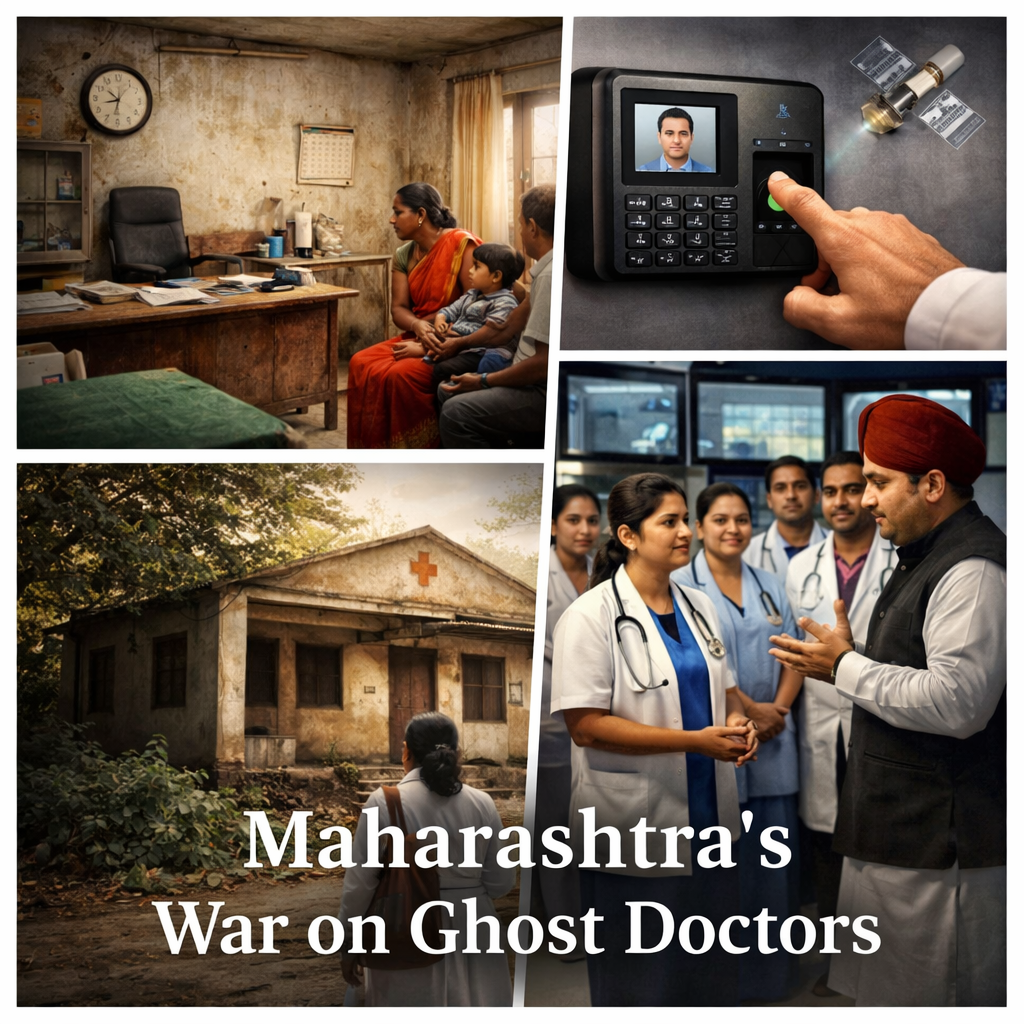
Imagine this: you are in a rural village in Maharashtra at 10 a.m. on a Tuesday. Your child has a high fever. You rush to the nearest Primary Health Centre (PHC). The doors are open but the doctor is no where to be found. The nurse shrugs and says, “Sir is on emergency leave.”
Sound familiar?
For millions of Maharashtra’s poorest citizens, this is not a rare incident,it is routine. A recent announcement in the Legislative Council has finally addressed this long-standing issue head-on.Public Health and Family Welfare Minister Prakash Abitkar made it clear that the state government has launched a serious crackdown on unauthorized absenteeism in government hospitals. The numbers are striking:
•710 doctors have been issued show cause notices
•Disciplinary action has been initiated against 442 doctors
•58 medical officers have been terminated
This is not just a one-time action,it signals the beginning of a broader reform effort.
The Bigger Picture: Beyond Punishment
Minister Abitkar emphasized that this crackdown is part of a wider push for transparency and systemic reform. Alongside disciplinary action, the government has introduced several key measures:
•Technology overhaul: Biometric, facial recognition, and GPS-based attendance systems will track doctors in real time, reducing the possibility of proxy attendance.
•Expanded health coverage: The Ayushman Bharat and Mahatma Phule Jan Arogya Yojana schemes now cover 2,399 ailments, up from 1,359. Hospitals have been instructed not to charge patients extra under any circumstances.
•Cancer care initiatives: Plans include vaccination drives for girls, a screening proposal for individuals above 30 (submitted to the Asian Development Bank), and phased development of day-care treatment centres.
•Transparent procurement: The Maharashtra Medical Goods Procurement Authority, established in 2023, aims to centralize purchases and curb corruption.
•Action against quacks: A high-powered task force has been formed to crack down on unregistered practitioners and illegal nursing homes.
In one legislative session, the government acknowledged a critical truth: absentee doctors, fake practitioners, opaque procurement systems, and limited insurance coverage are all interconnected issues within a broken system.
Why Do Doctors Go Absent? The Hard Reality
Doctor absenteeism is not a new problem. A 2011 Harvard study found that nearly 40% of government doctors across India were absent on any given day. While Maharashtra was not the worst affected, rural districts have consistently struggled.
The reasons are complex:
•Private practice incentives: Many doctors supplement their income through private clinics, especially when rural postings offer limited facilities and opportunities.
•Poor infrastructure and safety: Remote PHCs often lack staff quarters, internet connectivity, and adequate security particularly affecting female doctors.
•Political influence in postings: Transfers and postings are sometimes influenced by external pressures rather than merit or need.
•Workplace challenges: Delayed promotions, heavy workloads, and burnout contribute to dissatisfaction.
A similar crackdown in 2025 led to the termination of over 400 doctors for prolonged absence, indicating that the issue is deeply rooted and persistent.
The Good, the Risky, and the Unknown
The Good
A zero tolerance approach sends a strong message. Public funds pay these salaries, and patients especially women, children, and rural populations deserve reliable healthcare. The use of technology, such as GPS tracking and facial recognition, could significantly improve accountability if implemented effectively. Expanded insurance coverage is also a major step forward.
The Risky
Will the system be able to replace terminated doctors quickly? Maharashtra already faces a shortage of government doctors, particularly in rural areas. Additionally, technological systems may face challenges such as poor internet connectivity, power outages, and concerns about data privacy.
The Unknown
Will these reforms lead to measurable improvements in health outcomes? Attendance is only one part of the problem. Issues such as diagnostics, drug supply, and quality of care remain equally important.
A Government Focused on Basics
The administration led by Chief Minister Devendra Fadnavis appears to be focusing on strengthening governance fundamentals. This is not about high-visibility infrastructure projects it is about fixing the core systems that sustain public services.
This crackdown is both necessary and overdue. For too long, public healthcare has been treated as a formality rather than a responsibility. However, removing absentee doctors is only the first step. The real test lies ahead:
- Will rural PHCs consistently have doctors present during working hours?
- Will the new attendance systems function reliably in challenging conditions?
- Will patients experience a noticeable improvement in care?
If implemented effectively, Maharashtra could set an example for other states. If not, it risks becoming another short-lived reform effort.
Let’s Talk
Have you ever faced a situation where a doctor was unavailable when you needed care? Was it in a city hospital or a rural PHC? How long did it take to receive treatment?
To policymakers: continue the momentum.To doctors who serve diligently in difficult conditions: you have our respect.To those who neglect their duties: accountability is long overdue.Public healthcare is not just about infrastructure or funding,it is about reliability. It is about showing up.
This reform may not solve everything, but it is a step in the right direction.