Why Transparency in Stipends Matters
Stipends for medical interns and postgraduate residents have been a long-standing issue in India. These payments are not merely allowances or pocket money they are crucial financial support that helps young doctors manage their living expenses during demanding training periods.
The issue gained national attention after important rulings by the Supreme Court of India, including cases such as:
•State of Uttar Pradesh & Ors. vs. Miss Bhavna Tiwari & Ors.
•Abhishek Yadav & Ors. vs. Army College of Medical Sciences & Ors.
These rulings emphasized that medical interns and resident doctors should receive fair and uniform stipends.
To ensure transparency, the National Medical Commissionissued a public notice in July 2025directing all medical colleges in India to publish stipend details for interns and residents on their official websites.The objective was simple: students should know what stipend they will receive before choosing a medical college.
Stipends in India vary widely. Some government colleges offer reasonable payments often around ₹20,000–₹30,000 per month for interns while some private colleges either pay very little or delay payments. When colleges fail to disclose these details, it raises concerns about possible exploitation.
Despite repeated reminders from the NMC, several institutions failed to apply.
The NMC Crackdown
On March 12, 2026, the National Medical Commissionreviewed compliance reports from medical colleges across the country. The review revealed that seven institutions had failed to disclose stipend information, violating several regulatory provisions.
These violations include rules under:
•National Medical Commission Act 2019
•Postgraduate Medical Education Regulations 2023
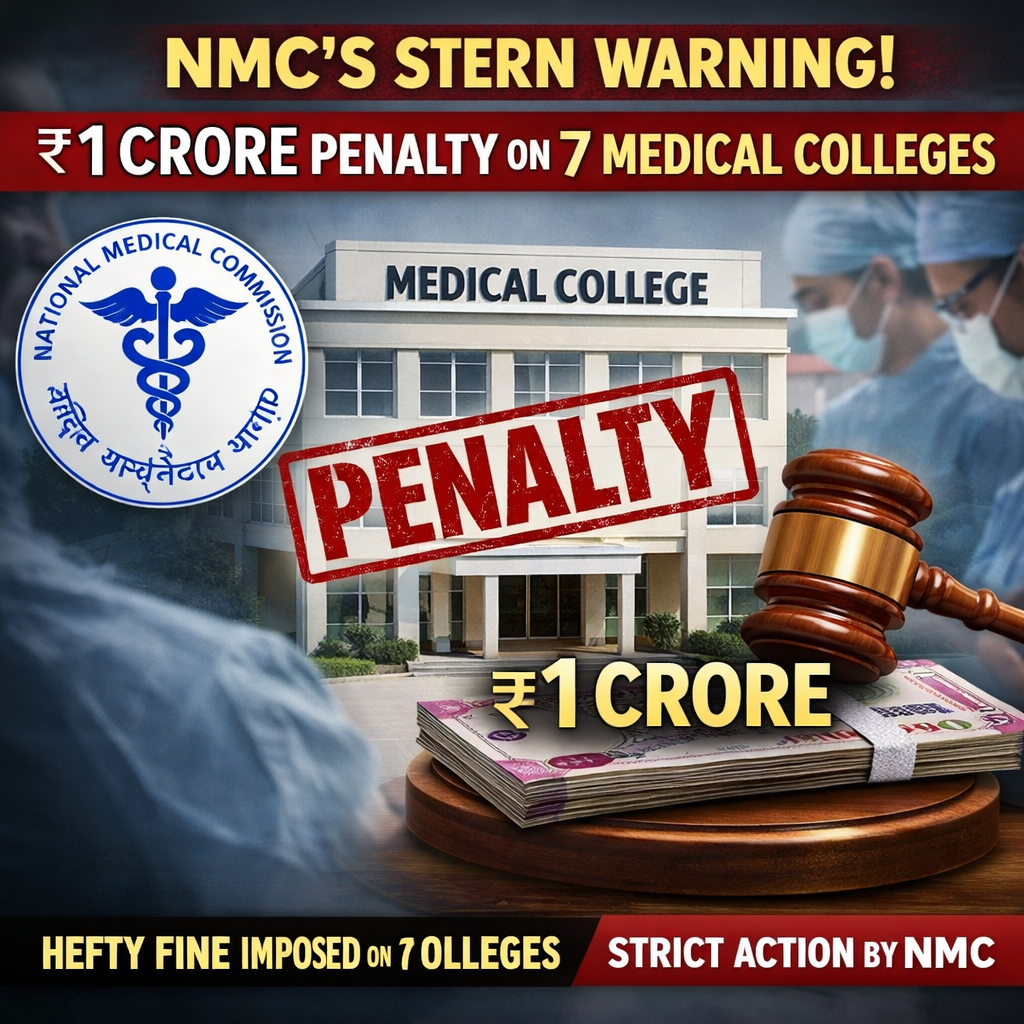
As a result, the NMC imposed a ₹1 crore penalty on each of the seven colleges, payable immediately.The commission also warned that continued non-compliance could lead to stronger action, including:
•Suspension of admissions
•Withdrawal of recognition
•Other regulatory penalties
This move clearly signals that the NMC is serious about enforcing transparency and protecting medical trainees.
The Colleges Penalized by NMC
The following seven medical colleges have been fined:
1.Akash Institute of Medical Sciences and Research Centre, Devanahalli, Karnataka – A private institution known for modern infrastructure.
2.Dumka Medical College, Jharkhand – A government college serving a large tribal population.
3.Government Medical College Barmer, Rajasthan – A state run institution in a remote desert region.
4.Government Medical College Ongole, Andhra Pradesh – A relatively new government medical college focused on rural healthcare.
5.RKDF Medical College Hospital and Research Centre, Bhopal, Madhya Pradesh – A private institution under the RKDF group.
6.Prasad Institute of Medical Sciences, Lucknow, Uttar Pradesh – A growing private college in the state.
7.Pt. B. D. Sharma Postgraduate Institute of Medical Sciences, Rohtak, Haryana – A well-known government medical institute, making its inclusion on this list particularly surprising.
The list includes both government and private institutions, showing that the NMC’s action is not limited to any single category of college.
Why This Decision Is Important
This penalty is not just about collecting fines it represents a major step toward improving accountability in India’s medical education system.
1. Better Decision-Making for Students
When stipend information is publicly available, students can compare institutions more effectively before choosing a college.
2. Pressure for Fair Payments
If colleges continue to violate stipend rules, they risk heavier penalties. This may push institutions to standardize payments and follow the guidelines more strictly.
3. Support for Student Advocacy
Medical student groups and organizations like the Indian Medical Associationhave long raised concerns about delayed or unpaid stipends. The NMC’s action strengthens their demands for fair treatment.
However, there is also a concern that some private colleges might attempt to compensate for the penalty by increasing tuition fees, which could place additional financial pressure on students and families.
Reactions and Future Impact
Since the announcement, the issue has been widely discussed on social media platforms and in education circles. Many experts are calling this decision a wake-up call for medical colleges across India.
Students currently studying or interning at these institutions should regularly check their college websites for updated stipend information and report ongoing violations to the National Medical Commissionif necessary.
For aspiring medical students, this situation highlights an important lesson: always research beyond rankings. Before selecting a college, check:
•Stipend policies
•Faculty and infrastructure
•Regulatory compliance
•Student reviews
These factors can significantly affect your training experience.
Final Thoughts
The NMC’s ₹1 crore penalty sends a clear message: transparency and fairness in medical education are no longer optional they are mandatory.This step could bring long-needed reforms to stipend policies and improve the working conditions of young doctors across India.
What do you think about this decision?
Do you believe the penalty is strong enough, or should the NMC take even stricter action?Share your thoughts in the comments and stay informed because the landscape of medical education in India is changing rapidly.