The issue has raised a larger question: while maintaining high standards in medical education is essential, is it fair to apply strict rules to students who studied during an unprecedented global crisis?
What the NMC Notice Says
On March 5, 2026, the Under-Graduate Medical Education Board (UGMEB) of the National Medical Commission released a public notice clarifying how online medical training should be handled for FMGs Doctors
According to the notice, online classes cannot replace the hands on clinical training required in medical education. Medicine is a practical field that requires direct interaction with patients, clinical exposure, and hospital-based training. Therefore, any part of the MBBS course completed through online learning must be compensated with equivalent onsite training at the foreign medical university.
The notice further states that this compensation must involve an actual extension of the study period. Simply issuing a certificate claiming that the online training was “adjusted” is not considered valid under the Foreign Medical Graduate Licence Regulations, 2021.
Foreign universities must clearly document:
•The subjects that were taught during the compensated training
•The duration of the additional onsite education
•Mandatory clerkships and clinical postings
These details will be verified by State Medical Councils before granting registration.
For students who were admitted on or before November 18, 2021 the date when the FMGE regulations came into effect there is still a possibility of being assessed under the older screening system if they complete proper onsite compensation and a foreign internship.
The NMC argues that this policy is necessary to maintain the quality of medical education and ensure that every doctor entering the Indian healthcare system has sufficient clinical experience.
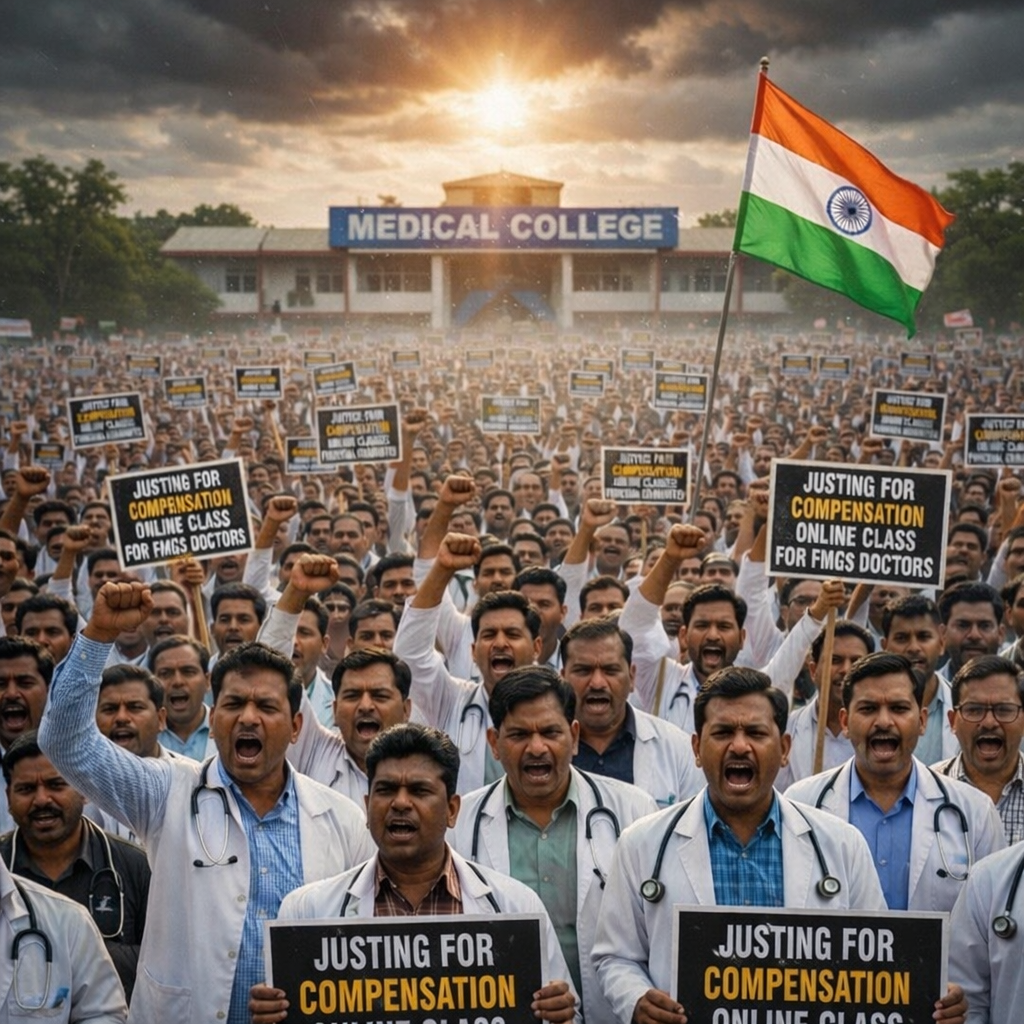
Why FMGs Doctors Are Protesting
Despite the NMC’s emphasis on quality, the reaction from FMGs and medical student groups has been strong. Many believe the rule is unfair and difficult to implement.
Organizations such as the All India Medical Students Association (AIMSA) have written to Union Health Minister Jagat Prakash Nadda demanding the withdrawal of the notice.
Several major concerns have been raised.
First, the pandemic affected medical education globally. During COVID-19, online classes were conducted not only in foreign universities but also in many Indian medical colleges. FMGs argue that if Indian students are not required to compensate for online training, then imposing such rules only on foreign graduates creates an unequal standard.
Second, many FMGs doctor have already completed their degrees and cleared the Foreign Medical Graduate Examination (FMGE), which itself has a relatively low pass rate. Some have even repeated internships in India to meet regulatory requirements. Asking them to return to their foreign universities for additional onsite training after graduation can be extremely difficult due to visa issues, financial costs, or universities that no longer offer the same programs.
Third, the rule could significantly delay medical careers. Without proper documentation of onsite compensation, students may face difficulties obtaining internship approval or permanent registration from State Medical Councils.
For many FMGs, this feels like another hurdle in an already challenging journey to practice medicine in India.
A Larger Policy Question
The controversy highlights a deeper challenge in regulating foreign medical education.
On one hand, the NMC’s position is understandable. Clinical exposure and hands-on training are fundamental parts of medical education. A doctor must develop practical skills, patient communication abilities, and clinical judgment skills that cannot be fully taught through online classes.
On the other hand, the circumstances of 2020–2022 were extraordinary. The COVID-19 pandemic disrupted universities worldwide, and students had little control over how their courses were delivered. Applying strict rules retroactively could be seen as unfair to students who simply adapted to a global emergency.
There is also a broader issue of parity. If online learning during the pandemic was accepted in Indian medical colleges, critics argue that similar flexibility should be extended to FMGs.
What Could Be a Balanced Solution?
A balanced approach may be possible. Instead of requiring students to return to foreign universities, regulators could allow supervised clinical training or clerkships within India to compensate for the missing practical exposure. This would maintain educational standards while avoiding unnecessary logistical and financial burdens.
Another option could be granting exemptions or special provisions for pandemic batches, recognizing that their situation was unique.
Conclusion
The debate around the NMC notice reflects a complex balance between maintaining high medical standards and ensuring fairness for students affected by a global crisis.
The National Medical Commission is right to emphasize the importance of hands-on clinical training. However, many argue that the policy should also acknowledge the extraordinary circumstances faced by pandemic era students.
As discussions continue and pressure grows from student groups and medical associations, the coming weeks may determine whether the notice is modified, withdrawn, or implemented with certain relaxations.
For thousands of Foreign Medical Graduates waiting to begin their careers, the outcome of this debate could shape their future in India’s healthcare system.