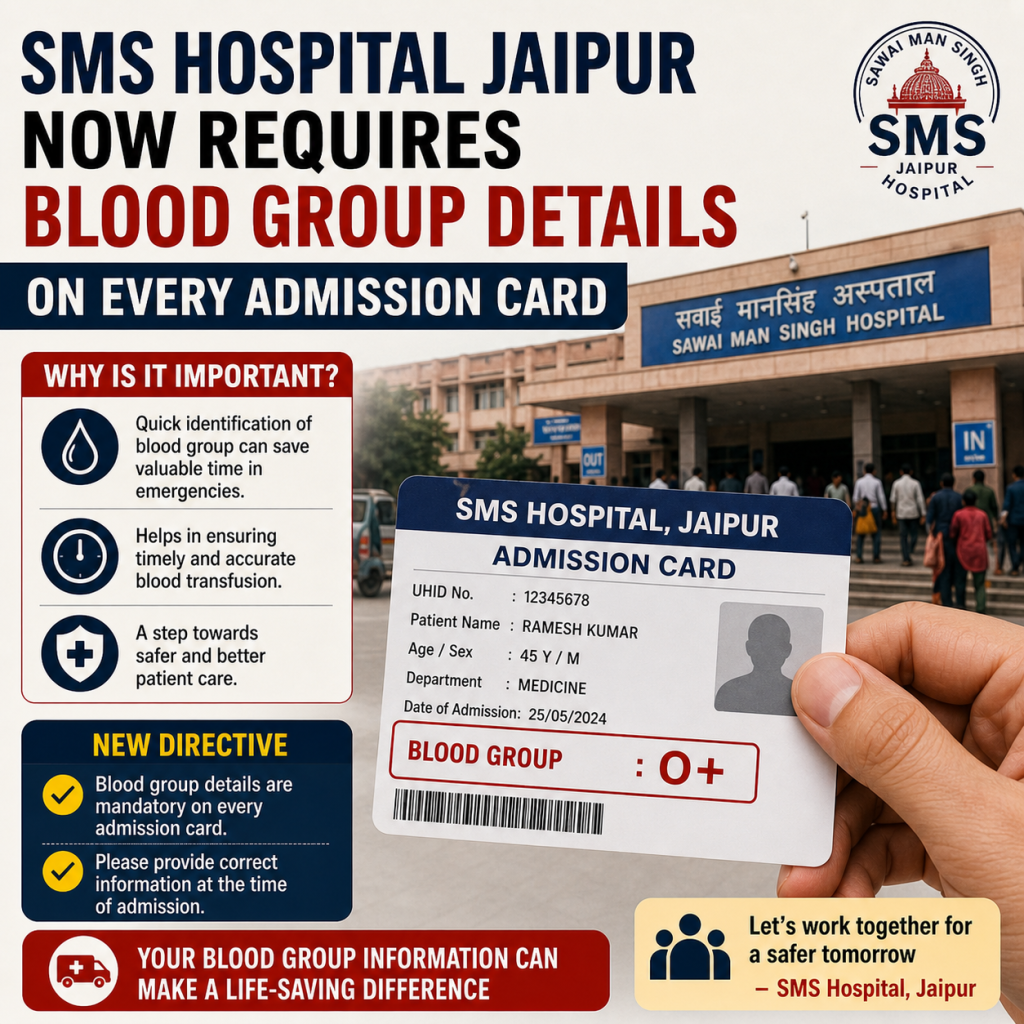
If you or a family member ever needs hospital care in Rajasthan’s capital, there’s one small but important detail that just became non negotiable at Sawai Man Singh (SMS) Hospital. From this week every admitted patient’s blood group must be recorded in clear, bold letters on the admission ticket and entered into the hospital’s electronic system right away. This isn’t just another form to fill. It’s a direct response to a string of preventable mistakes that have shaken trust in government healthcare across the state. Hospital administrators say the goal is simple: make sure the right blood reaches the right patient every single time.
What Exactly Changed at SMS Hospital?
The new directive issued by the hospital administration to all professors, unit heads and resident doctors puts blood group verification at the top of the priority list.
Here’s how it works in practice:
- On admission staff confirm or test the patient’s blood group.
- The result is written in bold, easy to read letterson the physical admission card.
- The same information is uploaded immediately to the Integrated Hospital Management System (iHMS).
- Before any blood or blood product is issued, the blood bank cross checks the request against the stored record.
If there’s any mismatch, system flags it before the blood leaves the bank. Treating doctors in the wards now carry direct responsibility for ensuring this step is never skipped. The move applies to every patient who might need blood or blood components during their stay from accident victims and surgery patients to those with medical conditions requiring transfusions.
Why This Rule Was Needed: A Look at Recent Cases
Over the past two years, Rajasthan’s government hospitals have dealt with several serious transfusion related incidents. While each case had its own circumstances, they all pointed to gaps in verification.
In February 2024, a 23 year old man injured in a road accident at SMS Hospital received incompatible blood and did not survive. Later that year, a similar error occurred at another facility when a young patient’s details were mixed up.
In May 2025, pregnant woman from Niwai admitted to SMS Hospital received the wrong blood type and tragically passed away. December 2025 brought two more incidents: a 10 year old boy from Deeg district given incompatible blood at JK Lon Hospital and a woman at PBM Hospital in Udaipur who was transfused with the incorrect group.
Most recently in March 2026, a 23 year old woman at Zenana Hospital in Jaipur was given the wrong blood type. Staff caught the error in time and stopped the transfusion before serious harm occurred. Officials describe this as the sixth such incident reported in the state within two years.
These events weren’t caused by a single point of failure. Name confusion, rushed paperwork during emergencies and manual checks that missed small details all played a role. The new system aims to close those gaps by adding both a clear visual cue on paper and an automatic digital check.
How the New Protocol Protects Patients Step by Step
Let’s walk through what a typical admission looks like under the updated rules.
- Arrival and Initial Assessment
Whether it’s an emergency or a planned admission, the first step now includes confirming the patient’s blood group. If records are unavailable, a quick test is done on the spot. - Bold Recording on the Admission Ticket
The result for example “Blood Group: O Positive” is written in large, clear letters. This makes it impossible to overlook even in a busy ward. - Instant Digital Upload
The same information goes into the iHMS software. This creates a permanent, searchable record that travels with the patient across departments. - Pre Transfusion Cross Check
When a doctor orders blood, blood bank doesn’t just look at the requisition form. They verify against the stored group in the system. Any difference triggers an immediate alert. - Final Responsibility with the Ward Team
Treating physician must personally confirm the match before the transfusion begins.
This layered approach paper + digital + human oversight is designed to catch errors at multiple points.
Understanding Blood Groups in Simple Terms
Many people know their blood group is important but aren’t sure why. Here’s a quick, no jargon explanation.
Your blood type (A, B, AB, or O) and Rh factor (positive or negative) act like a lock and key. Giving someone the wrong type is like forcing the wrong key into a lock, it can cause the body to attack the donated blood. This reaction can range from mild fever to life threatening complications.
In busy hospitals especially during night shifts or mass casualty situations, tired staff working with handwritten notes sometimes miss small differences. A single letter or “+” versus “–” can make the difference between life and death, bold print rule and digital backup remove that guesswork.
What Patients and Families Can Do Right Now
While the hospital has taken responsibility for the system, patients and relatives still play a vital role. Here are practical steps anyone can take:
Before Admission
- Know your blood group. If you don’t, most government labs and many private diagnostic centers offer the test for a small fee (often under ₹200). Keep a photo of the report on your phone.
At the Hospital
- When you receive the admission ticket, check that the blood group is written clearly in bold. If it’s missing or hard to read, politely ask the staff to correct it immediately.
- Ask the admitting nurse or doctor: “Has my blood group been uploaded to the system?” A simple yes should come with confirmation.
During Your Stay
- If a transfusion is recommended, feel free to ask: “Can you show me the cross check on the system?” Most doctors appreciate informed patients.
- Carry a small medical card or wear a bracelet that lists your blood type, allergies, and emergency contacts. These low cost items have helped in many real emergencies.
For Planned Surgeries
- If you know in advance that blood might be needed, get your group confirmed a few days earlier and carry the report. This gives the hospital extra time to prepare compatible units.
One family in Jaipur shared how a similar check saved their relative during a complicated delivery last year. The mother’s rare blood type was flagged early, and the right units were ready before any emergency arose. Small actions like these add up.
Broader Lessons for Healthcare Across India
SMS Hospital’s decision sends a clear message: even small process improvements can prevent big tragedies. Other states and private hospitals are already watching. Some have begun reviewing their own transfusion protocols after hearing about these incidents.
Real value lies in combining simple human readable steps (bold writing) with technology (digital cross checking). This hybrid approach works even when computers are slow or staff are stretched thin. It also highlights the need for ongoing training. Regular drills on transfusion safety better lighting in emergency areas and clear handover protocols between shifts can further reduce risk.
Frequently Asked Questions
Does this rule apply only to SMS Hospital?
Right now it is specific to SMS Hospital in Jaipur. However, health department officials have indicated they may extend similar guidelines to other government facilities in Rajasthan if the results are positive.
What if my blood group was recorded wrong earlier?
New protocol requires fresh confirmation or testing on admission. If you suspect an old record is incorrect, inform the staff immediately so they can retest.
Can blood group change over time?
No, your blood group remains the same throughout life. The only exception is in very rare medical situations like bone marrow transplants, which your doctor will already know about.
How long does the blood group test take?
A standard test usually takes 15–30 minutes. In true emergencies, hospitals keep O-negative blood (the universal donor type) ready as a bridge until the patient’s exact group is confirmed.
Will this slow down emergency care?
Hospital administrators say the process has been designed to fit into existing workflows without adding significant delay. The digital upload happens in the background while other admission steps continue.
Moving Forward: Small Changes, Big Impact
New blood group rule at SMS Hospital is not about adding more paperwork. It’s about protecting the most vulnerable moment in a patient’s journey, when they need blood to survive. Every family that walks through those hospital doors carries the same hope: that the care they receive will be safe, accurate and compassionate. By making one critical detail impossible to miss, Jaipur’s largest government hospital has taken a meaningful step toward that goal.
If you or someone you love is heading to SMS Hospital or any government facility in the coming weeks, take two minutes to verify that blood group is clearly noted. Ask the question. Check the ticket. It costs nothing and could prevent the kind of heartbreak no family should ever face.
Healthcare safety improves when systems get better andwhen patients stay engaged. This new protocol gives both sides a stronger foundation. Let’s use it well.
Disclaimer
This post is for informational and educational purposes only. It does not constitute medical advice, legal opinion or an official investigation. Readers should consult qualified healthcare professionals for personal health concerns. All details are drawn from media reports and outcomes of any official inquiry may provide further clarity.