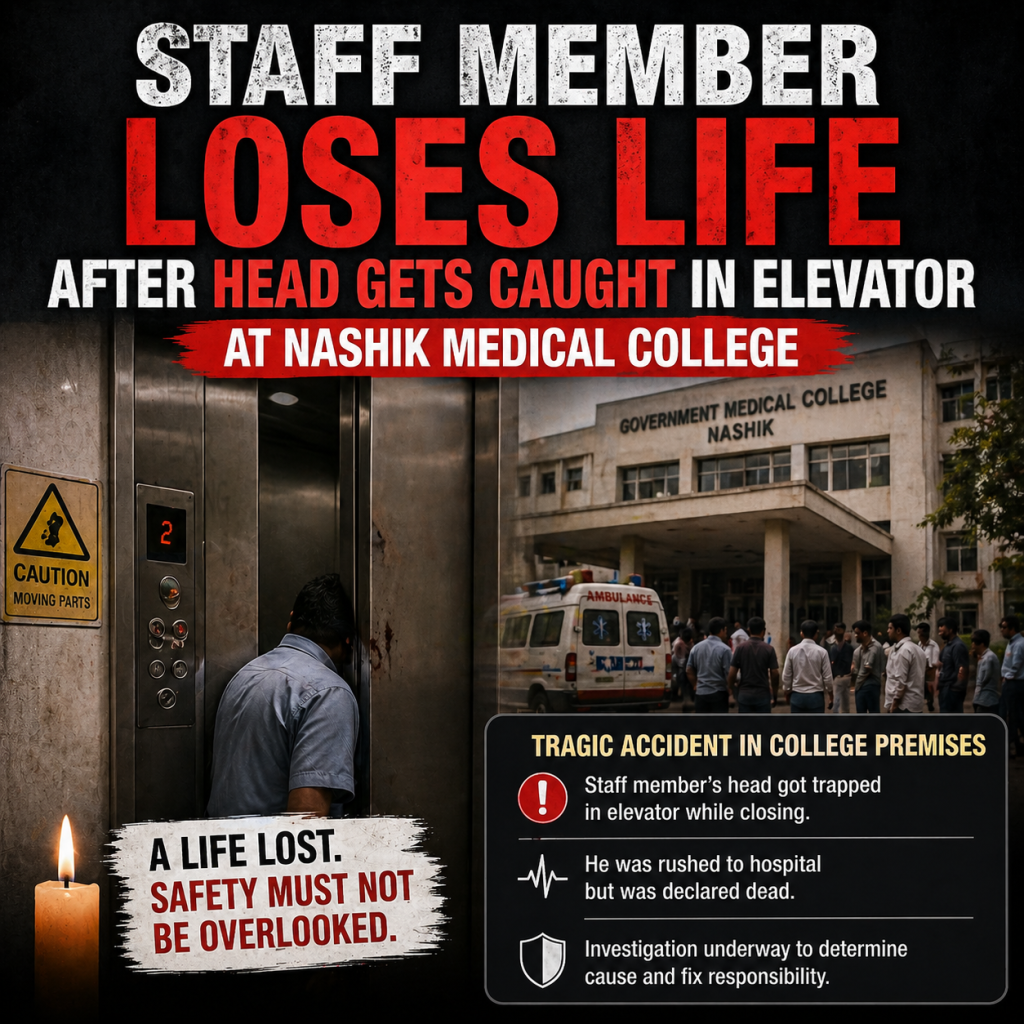
On the morning of April 28, 2026 a quiet corner of Nashik Medical College turned into the scene of a heartbreaking incident. A staff member whose name has not yet been released out of respect for the family, was discovered with their head caught in the closing mechanism of an elevator. Despite immediate medical attention employee could not be saved.
College, a busy hub serving thousands of students, patients and healthcare workers every day, has since expressed deep sorrow and promised a thorough internal review. While the exact sequence of events is still under investigation by local authorities, the incident has sparked urgent conversations across Maharashtra’s healthcare community about elevator safety in high traffic medical buildings. This is not just another news story about an unfortunate accident. It is a stark reminder that even in places dedicated to healing and care, everyday infrastructure can pose hidden risks when maintenance or user awareness falls short.
What We Know So Far About the Incident
According to preliminary information shared with local reporters, employee was using a service elevator in one of the older blocks of the college campus. Witnesses described hearing a sudden commotion around 8:45 AM. Security personnel arrived within minutes and found the individual trapped between the elevator doors and the shaft opening. Emergency services were called immediately. Doctors from the attached hospital rushed to the scene, but the injuries proved fatal. Elevator in question had reportedly been in regular use and had undergone its scheduled maintenance just two months earlier.
College authorities have confirmed they are cooperating fully with the Nashik police and the Directorate of Industrial Safety and Health. A detailed probe is underway to determine whether a mechanical fault, sensor failure, or human error played a role. Until the official report is released, speculation remains unhelpful. What matters now is learning from this loss.
Why Elevator Accidents Still Happen in 2026
Elevators are among the safest forms of transport when properly maintained yet accidents do occur. In busy environments like medical colleges and hospitals, where elevators run almost continuously from early morning till late at night, wear and tear happens faster than most people realise.
Common contributing factors include:
- Worn out door sensors that fail to detect obstructions
- Overloaded cars during peak hours
- Staff or visitors attempting to hold doors open manually
- Delayed response to minor glitches reported by users
- Inadequate training for maintenance staff on newer safety features
In this particular case, investigators are examining whether the doors closed with unusual force or if an obstruction was not detected in time. Such details will emerge only after the technical examination concludes.
Special Risks in Medical and Educational Campuses
Medical colleges are unique environments. Elevators here do not just carry healthy people they transport patients on stretchers, heavy medical equipment, anxious relatives and tired staff working 12 hour shifts. Constant pressure to keep things moving can sometimes lead to shortcuts: propping doors open, ignoring warning beeps or postponing minor repairs.
When something goes wrong in such a setting, consequences are often more severe because response times matter and emotional toll on the community is immense. Students who pass through these corridors every day, junior doctors rushing between wards and patients’ families already under stress all of them deserve to feel safe while using basic infrastructure.
Real Life Lessons from Similar Incidents
This is not the first time an elevator related fatality has occurred in an Indian healthcare or educational institution. In recent years, reports from different states have documented cases where individuals were trapped, fell into shafts due to faulty doors or suffered crush injuries. One recurring pattern stands out: many of these incidents could have been prevented with simple, consistent practices. For example, a 2023 case in a Pune hospital involved a maintenance worker whose hand was caught because the door reversal sensor had been disabled during a quick repair. Another incident in a Delhi medical college involved a student who tried to squeeze into a closing elevator and lost balance. The lesson is clear technology alone is not enough. Human behaviour, regular checks, and a culture of reporting small problems before they become big ones are equally important.
Practical Steps You Can Take Today
Whether you work in a hospital, study in a medical college or simply visit such places frequently, here are actionable measures that can reduce risk:
- Never force or hold elevator doors. Modern elevators have sensitive edges and infrared sensors. If they are closing, wait for the next one. Forcing them can damage the mechanism and create exactly the kind of hazard seen in Nashik.
- Report every unusual sound or behaviour immediately. A grinding noise, delayed door opening or flickering lights might seem minor but in high use buildings these are early warning signs. Most institutions have a maintenance complaint register or app use it.
- Know the emergency procedures. Every elevator should have a clearly marked alarm button and an intercom connected to security or the control room. If you ever get stuck, stay calm, press the alarm and wait for trained personnel. Do not attempt to climb out or pry doors open.
- Avoid overloading. In medical settings, it is tempting to squeeze extra trolleys or equipment into one trip. Respect the posted weight limits. Overloading strains cables, motors and door mechanisms.
- Support regular third party audits. As a staff member or student, you can ask your institution’s administration about the last independent safety inspection. Many colleges now conduct surprise checks in addition to routine servicing.
- Educate new joiners. Orientation programmes for fresh students, interns, and housekeeping staff should include a short module on elevator safety not as a boring lecture, but as a practical demonstration of what to do and what to avoid.
What Institutions Must Do Differently
Nashik incident should prompt every medical college and hospital in the country to review their elevator maintenance contracts. Key recommendations include:
- Switching to predictive maintenance using IoT sensors that alert engineers before a part fails
- Conducting monthly safety drills involving both staff and security teams
- Installing additional CCTV coverage inside and around elevator lobbies for quicker response
- Ensuring backup power systems are tested regularly so elevators do not get stuck during power fluctuations
- Creating a simple “near miss” reporting culture where even small incidents are logged without fear of blame
These steps cost money and time, but they are far less expensive than the human and reputational cost of another tragedy.
Frequently Asked Questions
Q1: What should I do if I get stuck inside an elevator?
Stay calm, press the emergency alarm button, and use the intercom if available. Do not try to force the doors or climb through any opening. Most modern elevators have backup power and will be attended to within minutes.
Q2: How often should elevators in hospitals be inspected?
Indian regulations recommend at least one comprehensive inspection every six months by a licensed agency with routine checks by in house staff every month. High traffic medical buildings often benefit from quarterly independent audits.
Q3: Are there specific safety features hospitals should install?
Yes, Look for door reversal sensors, emergency lighting, two way communication, overload sensors and automatic rescue devices that bring the car to the nearest floor during power failure.
Q4: Can visitors or patients be held responsible in elevator accidents?
Usually not, unless they deliberately tamper with equipment. Responsibility typically lies with the building management for proper maintenance and clear signage.
Q5: How can I check if my workplace or college follows proper elevator safety norms?
Ask the administration for the last maintenance report and inspection certificate. Reputed institutions are usually transparent about these records.
Moving Forward with Greater Care
The loss of a colleague at Nashik Medical College has left the entire campus community shaken. In the coming days, there will be memorial services, internal inquiries, and perhaps stricter protocols but the real tribute to the departed employee would be lasting change not just at this one college, but across every medical institution in India.
Elevators are meant to save time and effort, not take lives. Every time we step into one, we place trust in the people who designed, installed, and maintain it. That trust must be earned through consistent effort.
If you work in or around healthcare facilities, take a moment today to look at the elevators you use. Notice the inspection sticker. Listen for unusual sounds. Report anything that feels off. Encourage your colleagues to do the same. Small actions, repeated daily can prevent the next headline. Safety is not someone else’s job. It is ours together.
Disclaimer
This post is for informational and educational purposes only. It does not constitute medical advice, legal opinion or an official investigation. Readers should consult qualified healthcare professionals for personal health concerns. All details are drawn from media reports and outcomes of any official inquiry may provide further clarity.
Link: According to news reports from India Today
https://www.indiatoday.in/amp/india/story/nashik-medical-college-hospital-hoist-lift-accident-worker-dies-vasantrao-pawar-medical-college-video-2902495-2026-04-28