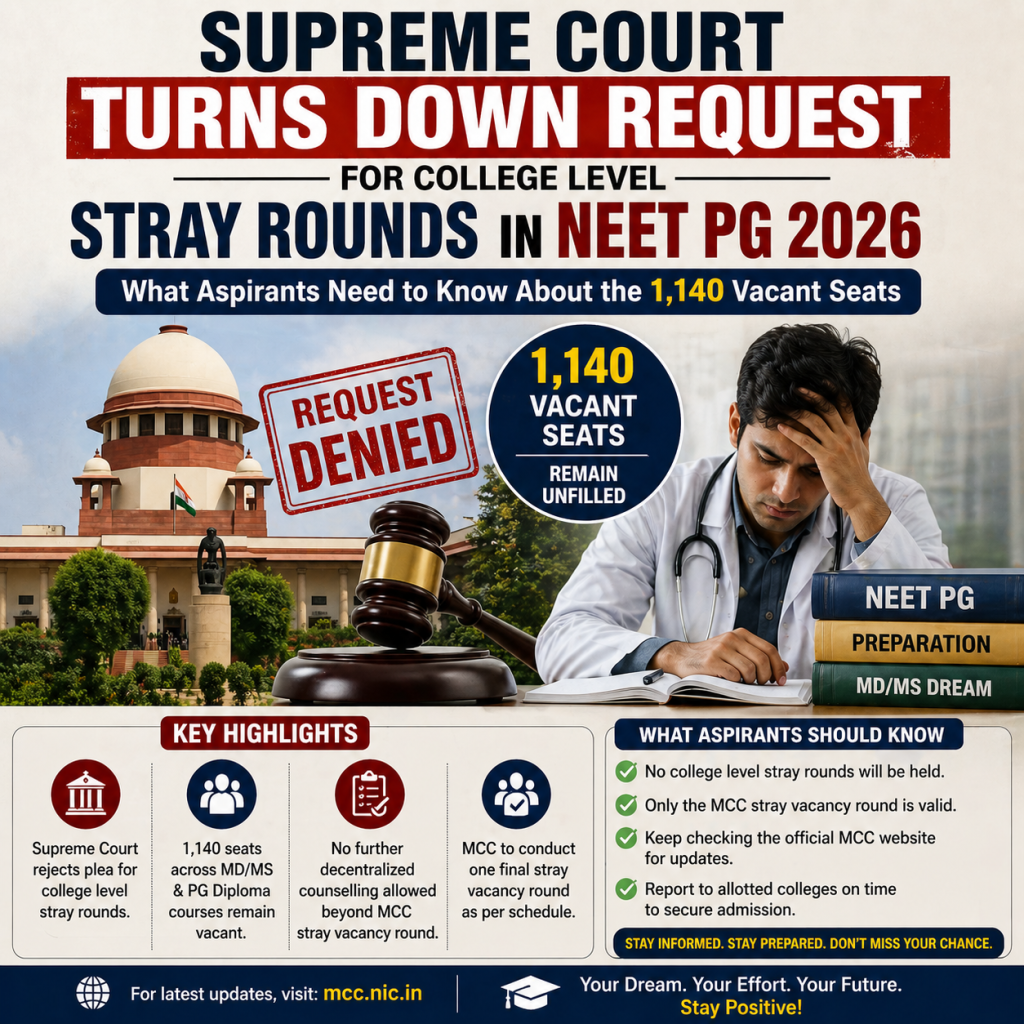
On 29 April 2026 the Supreme Court of India delivered a clear message: process of filling postgraduate medical seats must stay centralised and transparent. In a short but significant order court dismissed a petition that asked for permission to hold “institutional level stray rounds” to fill 1,140 seats still lying vacant after the regular counselling phases. For the thousands of doctors who appeared for NEET PG 2025-26, this ruling brings both clarity and disappointment. Many had hoped that colleges would be allowed to directly admit students for the remaining seats at their own level just like in some previous years. Instead, the highest court has reinforced that only the Medical Counselling Committee (MCC) can conduct any further allotment. Let’s unpack what this actually means for you.
What Exactly Is an “Institutional Level Stray Round”?
In simple terms, after the main counselling rounds (usually Round 1, Round 2 and Round 3) a few seats remain empty. These are called stray vacancies. Normally, MCC runs one or two centralised stray vacancy rounds where students who are still eligible can upgrade or get fresh allotment. An “institutional level stray round” is different. It would let individual medical colleges directly invite applications and fill their own leftover seats without going through the central portal.The petitioners, a group of medical colleges and an association argued that this would help fill seats faster especially in smaller or remote institutions that often struggle to attract students through the central system. They pointed out that 1,140 seats were still unfilled even after multiple rounds and time was running out for the 2026 academic session.
The Supreme Court however did not agree. It observed that allowing colleges to conduct their own rounds could open the door to irregularities, favouritism, and unequal opportunities. The bench emphasised that the centralised process, though sometimes slow, ensures fairness and prevents seats from being sold or given to undeserving candidates.
Why Are 1,140 Seats Still Vacant in NEET PG 2026?
This number has surprised many. India produces a large number of MBBS graduates every year, yet some postgraduate seats especially in non clinical branches like Anatomy, Physiology and Community Medicine and in certain government colleges in smaller states remain empty.
Common reasons include:
- Students preferring clinical subjects (MD Medicine, Surgery, Paediatrics, etc.) over non clinical ones.
- Location preferences many aspirants avoid colleges in remote or less developed areas.
- Some students choosing to drop a year rather than accept a seat they don’t want.
- Strict eligibility rules that prevent many from participating in later rounds.
The 1,140 figure represents roughly 2–3% of the total postgraduate seats available this year. While it may seem small, every seat matters because it directly affects the future supply of specialists in India’s healthcare system.
Court’s Reasoning: Fairness Over Speed
During the hearing Supreme Court noted that past experiences with institutional rounds had led to complaints of manipulation and backdoor entries. The bench asked a simple question: if the centralised system is working for the majority of seats, why create exceptions that could undermine trust? The order was brief but firm. It directed that any remaining vacancies must be handled strictly as per the existing MCC guidelines. No separate institutional rounds would be permitted this year. This decision aligns with the court’s earlier stand in similar matters it has consistently favoured a single window, transparent counselling process to protect students from exploitation.
How This Affects Students Waiting for Seats
If you are one of the aspirants still hoping for a seat, here’s the practical reality:
- No institutional round this year — Colleges cannot independently call students or conduct their own counselling.
- MCC may announce one final stray vacancy round — This is the only legal channel left. Keep checking the official MCC website (mcc.nic.in) daily.
- Fresh choice filling will be required — Even if you participated earlier, you will likely have to fill fresh choices for any new round.
- Document readiness is crucial — Many students lose seats because their documents are not in order. Keep your NEET PG scorecard, MBBS degree, internship completion certificate and category certificates ready in both soft and hard copies.
Real life example: Dr. Priya Sharma (name changed), a 2025 MBBS graduate from Uttar Pradesh had her eyes on a Pathology seat in a government college in Rajasthan. After Round 3, she was waitlisted. She hoped an institutional round would give her a chance. Now, with the court’s order, she is preparing for the possible final stray round while also exploring state counselling options and short term research fellowships as backup.
What Should Aspirants Do Right Now? Practical Steps
Here’s a simple action plan you can follow today:
- Step 1: Visit mcc.nic.in and bookmark the page. Enable notifications if available.
- Step 2: Join official Telegram or WhatsApp groups run by MCC (never pay for “guaranteed seat” groups they are mostly scams).
- Step 3: Download the latest seat matrix and previous year’s stray round data to understand which branches and colleges usually have vacancies.
- Step 4: Prepare a realistic list of acceptable colleges and branches. Being flexible increases your chances.
- Step 5: Keep your email and mobile number updated on the MCC portal. Many students miss important messages because of outdated contact details.
- Step 6: Consider state level counselling simultaneously. Some states conduct their own stray rounds for state quota seats.
Pro tip: If you have already joined a seat but want to upgrade, do not resign until you are sure of the new allotment. Resignation rules are strict and you may lose your original seat.
Broader Impact on Medical Education in India
This ruling is not just about 1,140 seats. It sends a strong signal that the government and judiciary want to maintain strict control over medical admissions. Over the years, repeated court interventions have cleaned up many malpractices that once plagued the system capitation fees, fake documents, and management quota irregularities.
At the same time decision highlights a deeper challenge: why do certain postgraduate seats remain vacant year after year? Experts suggest this points to the need for better incentives for non clinical branches, improved infrastructure in smaller colleges and perhaps a relook at the counselling schedule so that students are not forced to make rushed decisions.
What Happens Next?
As of 30 April 2026 MCC is expected to issue a fresh notice within the next few days regarding any additional stray vacancy round, court has not completely shut the door on filling the seats it has only said that colleges cannot do it on their own.
Students should also keep an eye on:
- Official MCC press releases
- Notifications from the National Medical Commission (NMC)
- Updates from their state counselling authorities
Frequently Asked Questions (FAQ)
Q1. What is the difference between a stray vacancy round and an institutional level round?
A stray vacancy round is conducted centrally by MCC. An institutional round would have allowed individual colleges to fill seats directly. The Supreme Court has banned the latter for now.
Q2. Will the 1,140 seats remain vacant forever?
Unlikely, MCC will probably conduct one more centralised round. Any seats still left after that may carry forward to the next academic year or be converted as per NMC rules.
Q3. Can I approach a college directly for admission now?
No, oing so would be illegal and against the Supreme Court order. All admissions must happen only through the official MCC portal.
Q4. I scored well but didn’t get my preferred branch. What are my options?
You can wait for the final stray round, look at state counselling, consider DNB seats (which have separate counselling) or prepare for NEET PG 2026 while gaining clinical experience.
Q5. How can I avoid missing important updates?
Check the MCC website at least twice a day, follow verified social media handles of MCC and NMC and keep your registered mobile number active. Never rely on unofficial sources.
Final Thoughts: Staying Calm in an Uncertain Process
The Supreme Court’s decision may feel like a setback for some aspirants today but it is a reminder that the system is designed to protect fairness over convenience. Thousands of doctors have successfully navigated similar situations in the past and gone on to build meaningful careers. If you are still waiting for a seat use this time wisely. Revise your clinical knowledge, strengthen your CV with research or observerships and build a strong backup plan, medical profession rewards patience and persistence as much as it rewards academic scores.
Stay informed, stay prepared, and most importantly stay hopeful, next official update from MCC could change everything for you. For the latest authentic updates, always refer to mcc.nic.in and avoid any paid “counselling services” promising guaranteed seats. Your future in medicine is too important to risk on shortcuts.
Disclaimer
This post is for informational and educational purposes only. It does not constitute medical advice, legal opinion or an official investigation. Readers should consult qualified healthcare professionals for personal health concerns. All details are drawn from media reports and outcomes of any official inquiry may provide further clarity.