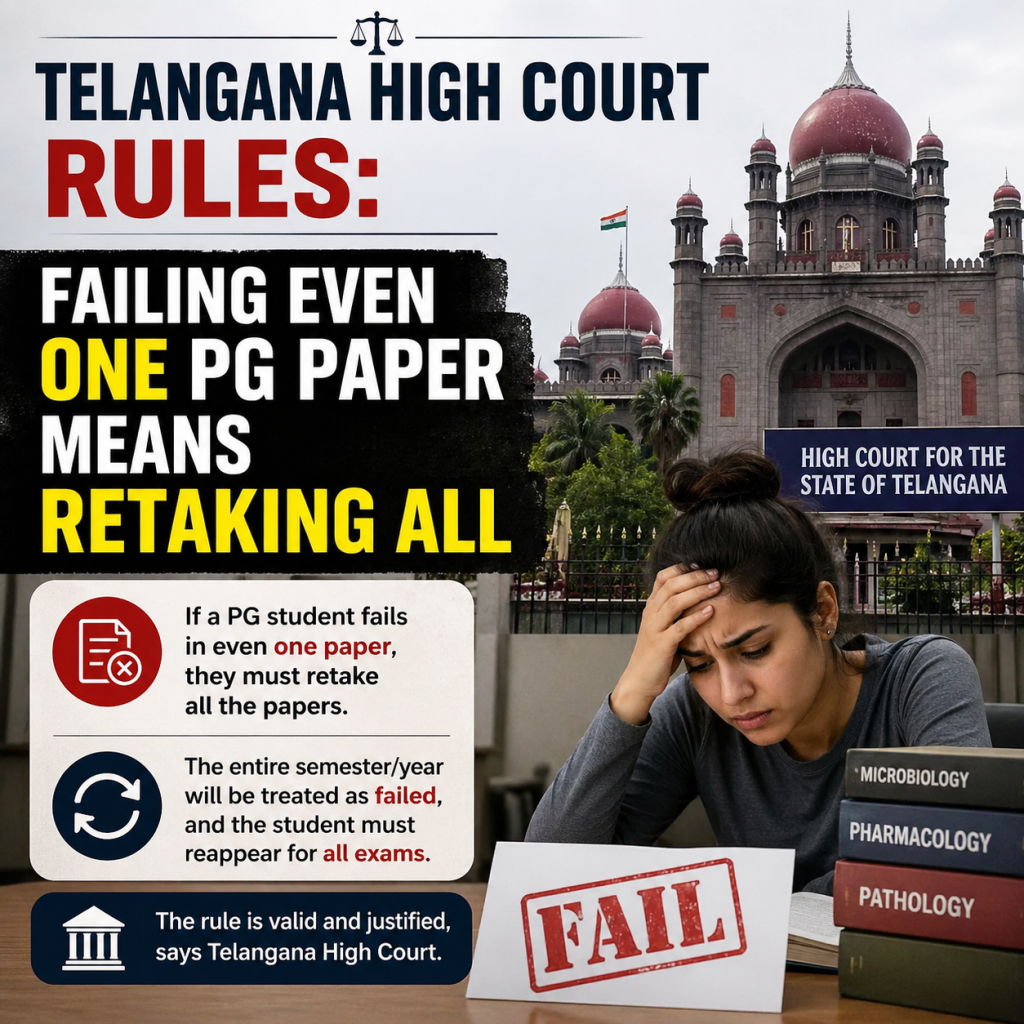
Imagine spending years preparing for your MD or MS exams, only to miss the passing mark in one paper by a single point. You feel confident you can clear that one subject quickly but according to a recent Telangana High Court decision, that option is no longer available. Court has made it clear: if you fail even one paper in a postgraduate medical examination, you must sit for all the papers again along with practicals, clinicals and viva voce.
This ruling delivered on 26 April 2026 has sparked conversations across medical colleges in Telangana and beyond. It directly affects students like the MD Anaesthesiology candidate from Deccan College of Medical Sciences who approached the court seeking permission to retake only the failed paper. Bench led by Justice Nagesh Bheemapaka dismissed the plea, stating that postgraduate medical examinations are designed as a single, integrated assessment of a doctor’s readiness.
For many students currently preparing for or awaiting results of PG medical exams, this decision raises important questions. What exactly does the court mean by “composite assessment”? How does this affect your study strategy? And most importantly, how can you avoid finding yourself in a similar situation?
Let’s break it down in simple terms.
Case That Led to This Ruling
In October 2025, a postgraduate student pursuing MD in Anaesthesiology appeared for the university examinations conducted under Kaloji Narayana Rao University of Health Sciences. He performed well in most subjects but fell short by one mark in Paper-I scoring 39 instead of the required minimum of 40.
Believing he had a strong grasp of the subject, he requested the university to allow him to reappear only for that single paper. When the request was denied, he moved the Telangana High Court arguing that forcing him to retake all papers would cause unnecessary hardship, delay his career, and impose additional financial and emotional burden.
Court carefully examined the university regulations, structure of the PG curriculum and precedents related to medical education. After hearing both sides Justice Bheemapaka upheld the university’s stand. The key observation was straightforward: a postgraduate medical degree is not a collection of independent subjects. It represents a doctor’s overall competence to handle complex clinical situations where knowledge from multiple areas overlaps.
Why the Court Treated the Exam as One Single Unit
Medical education at the postgraduate level is fundamentally different from undergraduate studies. While MBBS builds foundational knowledge, MD/MS training focuses on specialised skills where theory, practical application, and clinical judgment must work together seamlessly. Court emphasised that allowing students to retake only failed papers could create an uneven standard. A doctor who clears three papers but struggles with one might still have gaps in critical areas that affect patient care. Anaesthesiology, for instance, demands precise understanding of pharmacology, physiology and emergency response m subjects that are tested across different papers but applied together in real operations.
This “composite” approach ensures that every specialist who graduates has demonstrated consistent proficiency across the entire curriculum. It is not about being harsh; it is about protecting the integrity of medical practice and, ultimately, patient safety. Similar principles exist in other professional fields. Chartered accountants, for example, often must clear all groups together in certain stages. The logic remains the same: partial competence is not enough when lives or complex decisions are involved.
Real Life Impact: A Scenario Many Students Can Relate To
Consider Priya (name changed), a final year MD student in a Hyderabad medical college. She had always been a consistent performer. During her university exams last year, she scored well above average in three papers but faced unexpected anxiety during the fourth due to a family emergency the night before. She missed the passing mark by two points. Like the student in the recent case, she initially thought, “I’ll just prepare for this one paper again and clear it in the supplementary exam.” The university’s rules and now the High Court’s confirmation mean she must prepare for the full set again.
The practical consequences are significant:
- An extra six to twelve months of preparation time
- Additional exam fees and coaching costs
- Delayed entry into senior residency or private practice
- Emotional stress of repeating the entire process
Priya’s story is not unique. Every year, hundreds of PG students across India face borderline results. This ruling makes it even more important to treat every paper with equal seriousness from day one.
How This Ruling Affects Current and Future PG Students
Decision sends a clear message to medical colleges and students alike: National Medical Commission (NMC) guidelines and university regulations view postgraduate training as holistic. There is no shortcut or selective re-examination route.
For students currently in PG programmes:
- Focus on integrated learning rather than subject-wise compartmentalisation.
- Participate actively in clinical postings, case discussions, and journal clubs these reinforce connections between papers.
- Maintain consistent study habits instead of last-minute cramming for individual subjects.
For those preparing to appear in upcoming PG entrance or university exams:
- Build a study plan that cycles through all subjects regularly.
- Use clinical scenarios to revise theory, this helps retain information across papers.
- Practise time management under exam like conditions for the full set of papers.
Universities may also use this judgment as an opportunity to strengthen student support systems, such as counselling for exam anxiety and structured revision modules that cover the entire curriculum.
Practical Tips to Prepare Holistically and Avoid Last Minute Pressure
- Create an Integrated Study Schedule
Divide your week into blocks covering theory from all papers plus clinical application. For example, dedicate Monday and Tuesday to Paper-I concepts while linking them to practical cases from Paper-II. - Use Active Recall and Spaced Repetition
Instead of passive reading, test yourself on topics from different papers in the same session. Apps like Anki or simple handwritten flashcards work well for this. - Join or Form Study Groups
Discussing cases with peers forces you to connect knowledge across subjects. One student’s strength in physiology can help another struggling with pharmacology applications. - Simulate Full Exam Days
Once a month, attempt a complete set of theory papers under timed conditions. This builds stamina and reveals weak areas early. - Seek Early Feedback
If you consistently score low in any area during internal assessments, address it immediately rather than hoping to “fix it later.” - Take Care of Your Well-Being
Sleep, nutrition, and short breaks are not luxuries, they directly impact memory consolidation and exam performance. Many students who barely miss marks often cite burnout as a contributing factor.
What If You Are Already Facing a Similar Situation?
While the Telangana High Court has set a clear precedent in this case, every situation has its own facts. Students who find themselves in borderline results should:
- Carefully read their university’s examination regulations.
- Consult the academic section or student welfare cell for any available support mechanisms.
- Consider professional counselling if anxiety or external pressures are affecting performance.
- Focus on thorough preparation rather than hoping for selective re-examination.
The ruling does not close all doors; it simply reinforces that the path to becoming a specialist requires demonstrating complete readiness.
Frequently Asked Questions
Q1: Does this ruling apply only to Telangana or across India?
The judgment is specific to the Telangana High Court and the regulations of universities under its jurisdiction. However, many other states follow similar composite assessment principles under NMC guidelines. Students elsewhere should check their own university rules.
Q2: Can a student still approach the Supreme Court after this decision?
In principle, any High Court order can be challenged before the Supreme Court. However, the Telangana High Court’s detailed reasoning on the composite nature of PG exams makes further appeals less likely to succeed unless new legal grounds emerge.
Q3: How should I balance preparation across all papers without getting overwhelmed?
Start early. Create a rotating timetable that covers all subjects every 10–12 days. Link topics thematically for instance, study cardiovascular physiology alongside related anaesthetic drugs and clinical monitoring techniques.
Q4: Will this ruling lead to stricter evaluation in future exams?
Court did not comment on evaluation standards. It simply upheld the existing rule that the examination must be treated as a whole. Universities continue to follow NMC prescribed marking schemes.
Q5: What resources can help me prepare more effectively for integrated PG exams?
Standard textbooks, previous year question papers, and clinical case discussions with seniors remain the most reliable. Many students also benefit from structured revision modules offered by their own departments.
Final Thoughts: A Reminder to Prepare with Purpose
The Telangana High Court’s decision is more than a legal outcome it is a reminder that medicine is not about clearing individual hurdles but about building reliable competence across the board. For every student dreaming of becoming a skilled anaesthesiologist, surgeon, or physician, this ruling reinforces the value of consistent, thorough preparation. If you are currently in a postgraduate programme or gearing up for exams, take this moment to reflect on your study approach. Are you treating every subject with equal seriousness? Are you connecting theory with clinical practice? Small, steady improvements today can prevent the stress of repeating an entire set of exams tomorrow.
Stay informed about university notifications, support systems, and peer experiences. Most importantly, remember why you chose this path to serve patients with confidence and skill. That goal is best achieved when preparation matches the integrated nature of the profession itself.
If this article helped clarify the recent ruling for you or someone you know, consider sharing it with fellow medical students. Knowledge shared is preparation strengthened. Wishing all aspiring specialists clarity, focus and success in their journey ahead.
Disclaimer
This post is for informational and educational purposes only. It does not constitute medical advice, legal opinion or an official investigation. Readers should consult qualified healthcare professionals for personal health concerns. All details are drawn from media reports and outcomes of any official inquiry may provide further clarity.