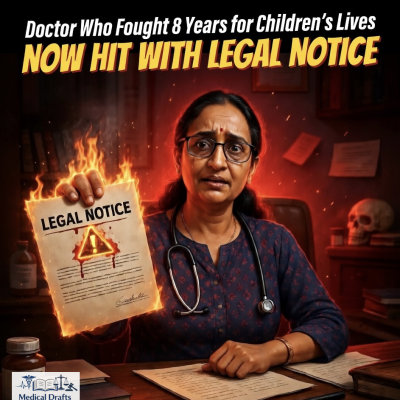

Doctor Who Fought 8 Years for Children’s Lives Now Hit with Legal Notice
Hyderabad paediatrician Dr. Sivaranjani Santosh, who advocated for clearer ORS labelling, receives legal notice from companies linked to Kenvue and Johnson & Johnson.
Hyderabad paediatrician Dr. Sivaranjani Santosh, who advocated for clearer ORS labelling, receives legal notice from companies linked to Kenvue and Johnson & Johnson.
The Rajasthan Government Health Scheme (RGHS) has been a lifeline for lakhs of state government employees, pensioners and their families but right now cashless medicine distribution at private OPD pharmacies has been suspended due to massive pending payments
Read MoreA 45 year old patient named Biswajit Samanta from Nimta reportedly collapsed and died at RG Kar Medical College and Hospital after his family claims he was forced to walk to a distant toilet while in critical condition. No stretcher, wheelchair or assistance was provided despite repeated requests.
Read MoreA landmark decision that transform medical education and public healthcare in Andhra Pradesh, State government has given the green light to recruit 520 fresh staff positions for the new Government Medical College at Piduguralla. This move comes as the state gears up to welcome its first batch of MBBS students at the college from the 2026-27 academic session.
Read MoreOn March 21,2026 company disclosed that it received a draft tax assessment order proposing additions of ₹570.51 crore to its income for FY 2022–23.
Read MoreA 24 year old Anisha Rai from Devkali village in Ballia passed away at a private hospital in the Kotwali area while undergoing surgery for kidney stones. Her family alleges that doctors performed a far more invasive abdominal operation than promised, leading to excessive bleeding and her untimely death.
Read MoreHarish Rana passed at AIIMS Delhi after 13 years in a vegetative state marks India’s first Supreme Court approved passive euthanasia. A moving story of dignity, compassion and legal evolution.
Read MoreShocking story of a Hyderabad doctor stranded in Kuwait amid Middle East tensions who escaped by traveling 1,460 km through the desert. A real life survival journey of courage, risk and determination.
Read MoreA doctor attacked while helping a patient in Ahmedabad, this disturbing event raises serious concerns about safety and respect for healthcare workers.
Read MoreThe Karnataka government has taken an important step to improve emergency healthcare in the southern part of the state. On March 23, 2026 it was announced that ₹10 crore has been approved to upgrade trauma care centres in 11 hospitals across Mysuru and Chamarajanagar districts.
Read MoreIn a significant ruling State Consumer Disputes Redressal Commission in Chandigarh has delivered justice in the tragic death of 19 year old student Gurpreet Kaur.
Read MoreA major healthcare revolution is underway in Himachal Pradesh. With a ₹3,000 crore investment, the state government plans to modernize medical colleges, introduce cutting-edge technology, and improve access to quality treatment. Will this bold move bridge the gap between rural and urban healthcare?
Read More