Whether you are a student preparing for NEET, parent planning your child’s future or an institution looking to expand this development carries real weight. It could open doors for more training spots without compromising the core standards that protect quality.
Let’s walk through what has actually shifted, why it matters now and how different groups might feel the effects in the coming years.
What Exactly Changed in the Regulations?
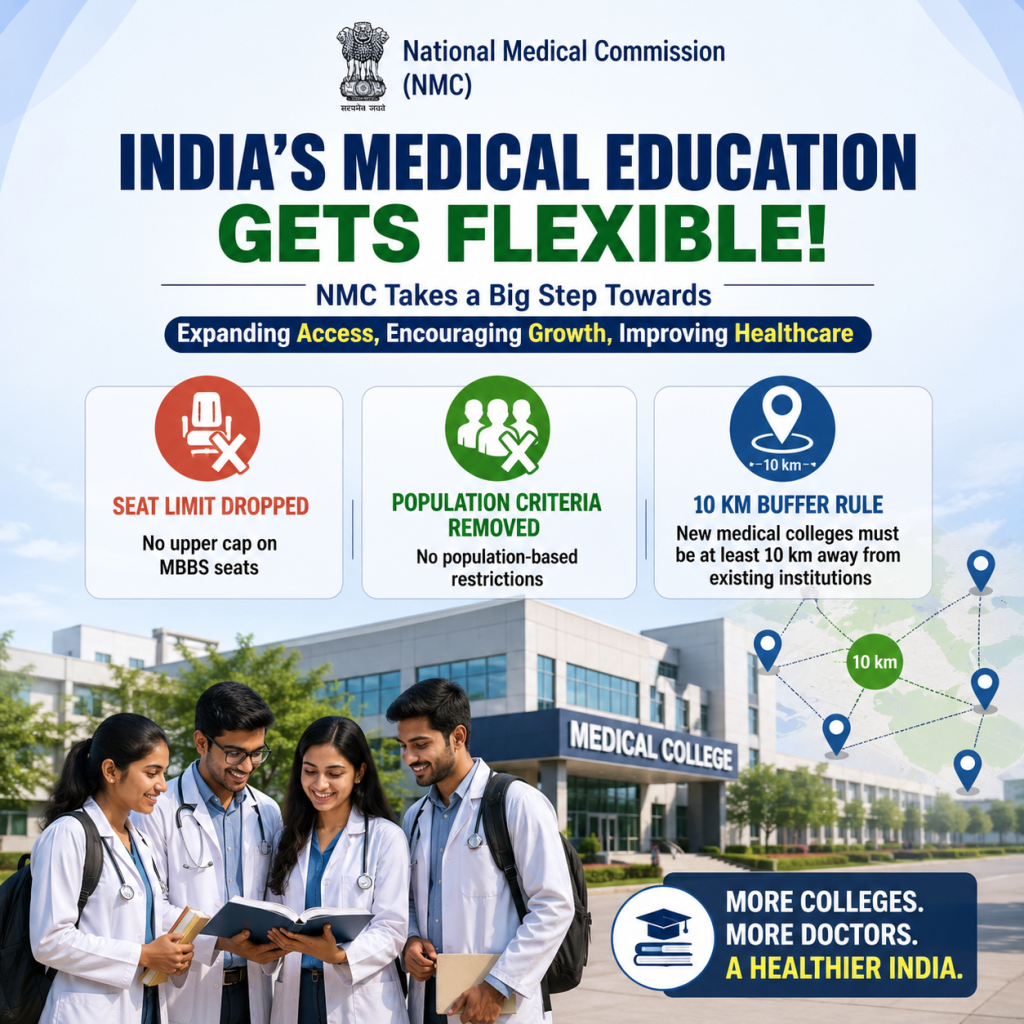
Updates focus on three practical areas that previously shaped how new medical colleges were approved and how existing ones operated. First, earlier limit tied to 150 MBBS seats has been lifted. Colleges no longer face that specific ceiling when they demonstrate they have enough hospital beds, qualified teachers, laboratories and other facilities. The focus moves entirely to whether institution can actually support the number of students it wants to admit.
Second, old population based ratio requirement has been dropped. In the past, approvals sometimes depended on how many people lived in a district or state relative to the number of existing colleges. That calculation is no longer part of the decision process. This gives states and private groups more flexibility to set up colleges where they see a genuine need for doctors, even if the local population numbers did not previously “qualify.”
Third, new 10 kilometre distance guideline now applies. Any new medical college must be located at least 10 kilometres away from an already functioning one. The idea is straightforward: avoid crowding too many colleges into the exact same area, which could strain shared resources like patient inflow for clinical training and competition for experienced faculty members.
These points were outlined in the recent communication from the National Medical Commission dated 28 April 2026. The changes sit inside the broader Undergraduate Medical Education Regulations framework that has guided MBBS programmes since 2023.
Why These Adjustments Matter Right Now
India continues to face a shortage of doctors especially in smaller towns and rural districts. At the same time thousands of students clear NEET every year but cannot find a seat because the total number of MBBS places has grown more slowly than demand. By removing the seat cap and the population ratio, National Medical Commission is essentially saying that good infrastructure and teaching standards should be the main tests not arbitrary numbers. This could encourage colleges in states that previously struggled to meet the old ratio rules to move forward with expansion plans.
10 kilometre rule adds a layer of order. Without it, multiple colleges might pop up within a few kilometres of each other, all competing for the same pool of patients and senior doctors. That kind of clustering can weaken hands on training for students, new distance requirement tries to spread opportunities more evenly across regions.
How This Could Play Out in Real Districts
Consider a mid sized town in central India that currently has one government medical college serving a wide surrounding area. Under the old rules, opening another college nearby was difficult because the population ratio was already considered “satisfied.” Now, a private trust or state government could explore setting up a second institution 12 kilometres away provided it builds a proper 500 bed teaching hospital and recruits enough professors. For students, this might eventually translate into more seats closer to home. Families in smaller cities often hesitate to send their children to distant metros for six years of study. More local options could reduce that burden.
On the flip side existing colleges near the 10 kilometre boundary will need to check their exact location, rule applies mainly to new approvals but institutions planning major expansions should review how close they sit to neighbours. Clear maps and distance calculations will become part of future application files.
What Students and Parents Should Keep in Mind
More seats do not automatically mean easier admission. NEET remains the single gateway. What changes is the total pool of available places. In the medium term, this could ease pressure in states that previously had very few colleges relative to their population. Parents often ask whether quality will suffer. National Medical Commission has made it clear that every college must still meet strict benchmarks for faculty numbers, bed strength, equipment and patient load. Annual inspections and surprise checks continue. Colleges that cut corners will risk losing recognition, just as before.
A practical tip: when shortlisting colleges, look beyond the total seat count. Check the hospital’s daily outpatient numbers, the student to bed ratio and whether the institution has a functional skills lab. These details often tell you more about training quality than the headline seat number.
Practical Steps for Colleges Thinking of Expanding or Starting Fresh
If you represent a trust or state health department considering a new or larger medical college, here are some grounded actions:
- Map every existing college within a 15 kilometre radius first. Use official land records and GPS tools to confirm the 10 kilometre buffer. This single step can save months of wasted effort later.
- Focus on infrastructure that exceeds minimum requirements. A 600 bed hospital with modern diagnostic facilities and a good mix of urban and rural patient inflow will stand out during inspections.
- Plan faculty recruitment early. Senior professors and associate professors are still in short supply. Partnerships with established medical universities for faculty exchange can help new colleges get off the ground.
- Engage with the local community. Colleges that involve nearby primary health centres for community medicine postings often receive smoother approvals because they show real integration with public health needs.
These steps are not shortcuts; they reflect what successful colleges have done in the past when rules were tighter.
Possible Challenges and Balanced Viewpoints
Any expansion brings questions. Some observers worry that rapid growth could stretch the pool of qualified teachers. Others point out that the 10-kilometre rule might unintentionally limit options in densely populated urban corridors where land is scarce. National Medical Commission appears to have weighed these concerns by keeping all other quality standards intact, message seems to be: grow, but grow responsibly. Time will tell how smoothly the new balance works. Regular public reports on inspection outcomes will help everyone track whether standards hold.
Frequently Asked Questions
Will the total number of MBBS seats rise immediately?
Not overnight. Each college still needs separate approval for extra seats, and new colleges take two to three years to become functional, changes remove barriers but actual seat growth depends on how many institutions apply and qualify.
Does the 10 kilometre rule apply to existing colleges?
The rule mainly guides fresh approvals. Existing colleges that already sit closer than 10 kilometres are not required to relocate. However, if they seek major new permissions, distance to neighbours may come up during review.
How will this affect NEET cut offs?
Cut offs depend on the number of applicants versus available seats each year. A gradual increase in seats could ease competition slightly in some categories and states, but the effect will vary year to year.
Can a college in a metro city still expand under these rules?
Yes, provided it meets infrastructure norms and any new block or additional seats satisfy the distance guideline with nearby institutions. Metro colleges often already have strong hospitals, so expansion may be simpler for them.
Where can I read the official notification?
National Medical Commission publishes all updates on its website under the regulations and notifications section. Checking there directly is the most reliable way to stay updated.
Looking Ahead: What This Means for India’s Healthcare Future
India needs many more well-trained doctors if it wants to improve health outcomes in every district. These regulatory tweaks remove two long standing bottlenecks while adding one sensible guardrail, result is a framework that gives states and institutions more room to respond to local needs without lowering the bar on quality.
For students and families, message is hopeful but practical: prepare seriously for NEET, research colleges thoroughly, and keep an eye on official announcements. For colleges, the opportunity is real, but success will still depend on solid planning and honest execution, healthcare landscape in India is shifting. Those who stay informed and focus on genuine standards will be best positioned to benefit. If you are part of this journey whether as a future doctor, an educator or a policymaker now is a good moment to revisit your plans with these updated guidelines in mind, coming years will show how effectively the new approach translates into more doctors serving communities across the country.
gazette-notificationamendment27426-344265
Disclaimer
This post is for informational and educational purposes only. It does not constitute medical advice, legal opinion or an official investigation. Readers should consult qualified healthcare professionals for personal health concerns. All details are drawn from media reports and outcomes of any official inquiry may provide further clarity.